As of today, out of season, returns ~December. Earth Exhibit tracks the live conditions and flags it the moment it is on.
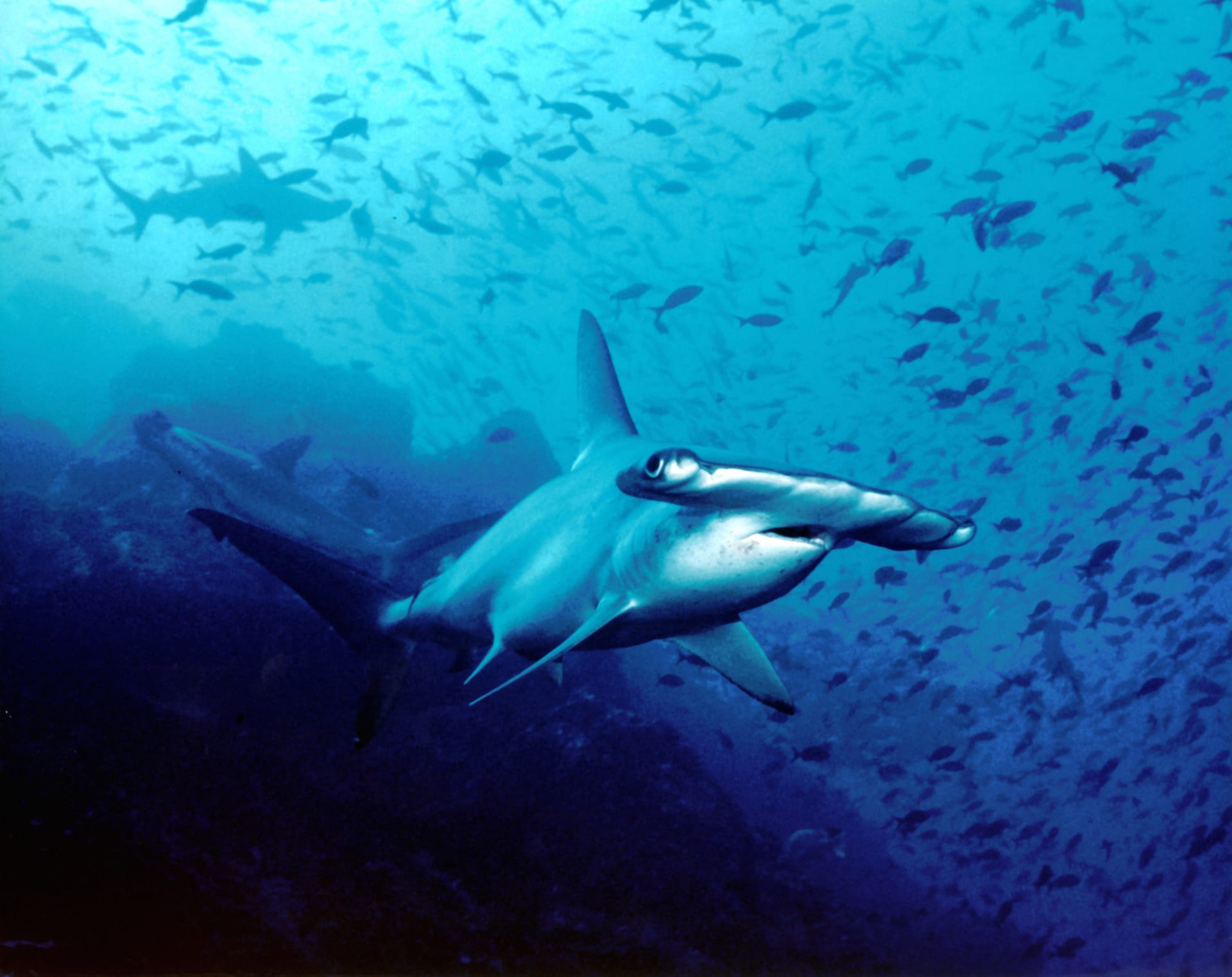
The boat cuts its engine 10 minutes from Kubura Port. You back-roll into 24-degree water with nothing but blue below. The seafloor is 70 meters down. You descend to 15 meters, drift with the current, and wait. Then they appear: a living river of scalloped hammerhead sharks, 100 bodies thick, coursing past in synchronized formation. Divers call it the hammerhead river. It happens only in winter, and only here at Yonaguni, Japan's westernmost island.
The Science Behind Yonaguni's Hammerhead Aggregation
Scalloped hammerhead sharks (Sphyrna lewini) gather in massive seasonal schools near Yonaguni Island during winter , forming one of the most reliable hammerhead aggregations accessible by day boat anywhere in the world. The island sits in the path of the Kuroshio Current, and the indirect impact of this warm current creates favorable conditions for larger hammerhead encounters .
The hammerheads you see here are mature females. Their distinctive cephalofoil head shape -- the hammer -- packs sensory organs called ampullae of Lorenzini across its entire surface, giving them a 360-degree electrical field detection range. They hunt stingrays buried in sand by sensing the weak electric fields generated by muscle contractions. The wide head also provides hydrodynamic lift, allowing efficient cruising at depth with minimal energy expenditure.
The sharks at Yonaguni are often larger, mature individuals that boldly approach divers , unlike the skittish juveniles that school at other hammerhead sites in Japan. The reason for their winter aggregation remains debated. Some researchers suggest mating behavior. Others point to optimal foraging conditions when the Kuroshio pushes nutrient-rich water against the seamount topography, concentrating prey. What's certain is that the phenomenon is seasonal, predictable, and under the right conditions, overwhelming.
When and Where to See the Hammerhead River
The prime viewing window runs from December to February , with peak encounters typically from January to March . Schools can exceed 100 to 200 hammerhead sharks during the best days. Some sources extend the season into May, but the densest aggregations happen in the coldest months.
Irizaki, at the western point of Yonaguni Island, is the primary dive site for hammerhead encounters . The boat ride from Kubura Port is only 5 minutes . You will be watching hammerheads in the middle of the ocean, away from reefs or underwater structures -- 100% blue water diving .
Average visibility reaches 30 meters, and water temperature averages 21 degrees Celsius in winter . When conditions are good, visibility can exceed 50 meters . Early morning dives (6-8am) offer the best shark activity. Three dives per day is standard during hammerhead season, rotating between dive groups to maximize boat efficiency.
Getting there requires commitment. Yonaguni lies 111 kilometers east of Taiwan, closer to Taiwan than mainland Japan . Fly from Naha or Ishigaki on small turboprop planes. Accommodations are limited, especially during peak hammerhead season, so book months ahead . Six months advance booking is common for group dive trips .
Your Witnessing Guide
Do not attempt these dives unless you are an advanced diver. The usual recommendation is Advanced Open Water certification with at least 100 logged dives . Some operators demand 150 logged dives. The reason: all diving at Yonaguni is drift diving in moderate to strong currents, maintaining neutral buoyancy at depths of 15-20 meters, with the seabed at 60 meters .
Entry is a negative back-roll on the guide's count -- "Ichi, Ni, San" -- followed by immediate descent . You have no reef, no wall, no reference point except your dive computer. Do not chase the hammerhead sharks, or they will swim away. Follow the guide's order, keep distance, and wait for them to come to you .
Gear requirements:
- 5mm wetsuit minimum.
Water temperatures range from 21-23 degrees Celsius . Add a hood and gloves for thermal protection.
- Dive computer and surface marker buoy (SMB) are mandatory.
- Wide-angle lens for underwater photography (10-17mm range). Video works well for capturing the sheer scale of the schools.
- Reef hook can help you hold position in current if needed, though most dives are pure drift.
Camera settings for hammerhead photography in blue water:
- ISO 400-800 to maintain fast shutter speeds in open water.
- Shutter speed 1/250 or faster to freeze shark motion.
- Aperture f/8 to f/11 for depth of field.
- Strobe positioning: angle outward to minimize backscatter in blue water.
The water is colder (around 22-24 degrees Celsius) and the seas are significantly rougher in winter . Strong northern winds are common during this season . Flights and ferry services cancel frequently due to weather. Build extra days into your travel plan.
The cost for three dives per day, including lunch and insurance, is approximately 17,000 yen. Full equipment rental adds about 5,000 yen per day as of early 2026.
Why It Matters
Scalloped hammerhead sharks are listed as Critically Endangered on the IUCN Red List. Global populations have declined by 80-90% over the past three decades due to targeted fishing for their fins and bycatch in commercial fisheries. Their fins are among the most valuable in the shark fin trade. The aggregations at Yonaguni represent one of the few remaining accessible populations in the Northwest Pacific.
You may also see schools of dogtooth tuna, barracuda, and bigeye trevally during hammerhead dives. Occasionally, sailfish and whale sharks appear . The biodiversity here reflects the health of the Kuroshio Current ecosystem, which delivers warm tropical water northward along the Pacific coast of Japan.
Hammerhead schooling behavior is poorly understood. Unlike most shark species, scalloped hammerheads form large daytime aggregations around seamounts and islands, dispersing at night to hunt. The schools are almost exclusively female. Males are solitary or form smaller groups. Some scientists hypothesize that the schools serve as mating grounds where females assess male fitness. Others suggest communal predator avoidance or navigation benefits tied to geomagnetic field detection.
Yonaguni's remoteness offers protection, but it also makes enforcement difficult. Japanese coastal waters allow commercial shark fishing, and scalloped hammerheads are caught as bycatch in longline fisheries targeting tuna. The dive tourism industry has created economic incentive to protect the aggregation, but no formal marine protected area exists around the hammerhead sites.
The other reason divers visit Yonaguni is the Monument: a massive underwater rock formation discovered in the 1980s, featuring right angles, terraces, and what appear to be carved steps. Whether it's a natural geological feature or the remnant of an ancient civilization remains contentious. The Monument dive is easier -- shallower, with structure to reference -- and dive operators often include it as a rest day between hammerhead dives.
If you make it to Yonaguni in late winter and the conditions align, you'll drift in open ocean surrounded by a biomass of apex predators that outweighs you 500 to 1. There's no baiting, no chumming, no artificial attraction. The sharks are there because the island, the current, and the season create conditions they need. Track live conditions for this and 940+ phenomena on the Earth Exhibit app: https://earthexhibit.com
This is the short version
This page shows a taste. The app has the full list of where to see this, the exact timing, and live conditions for 1,000+ natural phenomena worldwide, so you know the moment one is genuinely worth the trip.