As of Jun 17, 2026, 4:21 PM, in season, next peak: Mara river crossings (~July 1). Earth Exhibit tracks the live conditions and flags it the moment it is on.
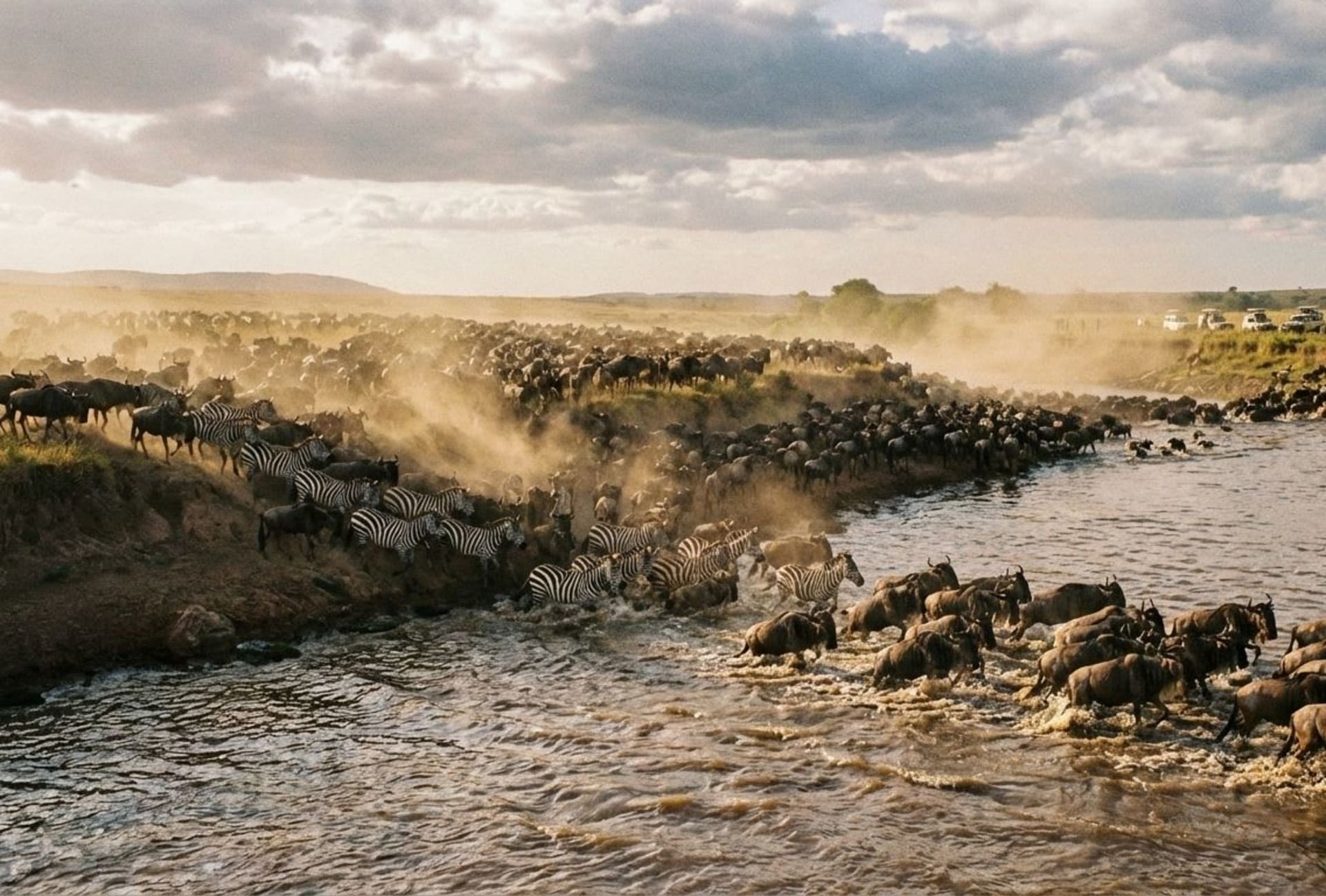
The dust hits you first. Not a gentle haze but a wall of particulate so thick it coats the inside of your nostrils and settles into the creases of your knuckles. You are parked on a bluff above the Mara River, engine off, and below you the water is brown and moving fast. On the far bank, a column of wildebeest stretches backward until it dissolves into the savanna. There are thousands visible. There are hundreds of thousands you cannot see. One animal steps to the edge of the bank. Then another. Then, with no discernible signal, the entire column detonates downward, bodies launching off a four-meter drop into the current, legs churning, heads thrown back, the sound of it reaching you as a single low roar that is part splash, part bellow, part the dull percussion of hooves striking submerged rock. A crocodile takes one near the middle of the crossing. The herd does not pause. It cannot pause. 1.5 million wildebeest, 400,000 zebra, and 200,000 gazelle are locked into a circuit that has no off switch, no committee, no leader. It is the largest overland migration on the planet, and it operates on nothing more than rain and grass and an ancient chemical insistence to move.
You will never feel smaller than you do watching it.
What Drives Two Million Animals in a Loop
The migration is not a single event with a start and a finish. It is a continuous, year-round clockwise circuit covering roughly 800 kilometers through the Serengeti-Mara ecosystem, an area spanning southern Kenya and northern Tanzania. The animals are chasing the rains, or more precisely, chasing the flush of nutritious new grass that follows rainfall by roughly two to three weeks. Wildebeest (Connochaetes taurinus) have an unusually acute sensitivity to distant thunderstorms. Research from the University of Groningen has shown they can detect rain events from as far as 50 kilometers away, likely through barometric pressure changes and the smell of petrichor carried on wind currents.
The cycle begins in the southern Serengeti plains around Ndutu (-3.018, 34.995), where short-grass savanna grows on volcanic soil deposited by eruptions from Ol Doinyo Lengai and the Ngorongoro highlands. This grass is exceptionally rich in phosphorus and calcium, which is why roughly 500,000 calves are born here between late January and March, most of them within a concentrated two-to-three-week window. The synchronized birthing is a survival strategy called predator swamping. Hyenas, jackals, and lions cannot consume calves fast enough to make a dent when half a million drop within days of each other.
By April, the southern plains are grazed down. The herds begin drifting northwest through the Central Serengeti around Seronera (-2.45, 34.833), where woodland and medium-grass savanna provide transitional forage. By June, the leading columns push into the Western Corridor near Kirawira (-2.208, 34.136), where the Grumeti River presents the first major water crossing. Crocodiles here are among the largest Nile crocodiles documented anywhere, some exceeding five meters. The Grumeti crossings receive less attention than the Mara, but they are no less violent.
Then comes July. The herds swing north into Kenya, funneling toward the Mara River crossings (-1.529, 33.975) and spreading across the Masai Mara (-1.586, 35.252). This is the period most people picture when they hear "the migration." It is also the most unpredictable. Herds may approach a crossing point, stand at the bank for hours, then turn around and walk away. They may cross at a calm, shallow ford with zero casualties, or they may pile into a steep-banked narrows where dozens drown in minutes. No guide, no matter how experienced, can guarantee you will see a crossing on any given day. This is important to understand before you book.
By October and November, the rains begin returning to the southern Serengeti. The herds turn south, re-entering Tanzania, completing the loop. Pregnant females are already carrying the next generation.
When and Where to Position Yourself
Because the migration is continuous, there is technically no wrong time to visit. But what you see varies enormously by month and location.
January to March: Calving season, Southern Serengeti (Ndutu). The plains are green and flat, visibility extends for kilometers, and the concentration of predators around calving herds is extraordinary. You will see lion hunts, cheetah sprints, hyena clan activity. The light is spectacular. Ndutu is accessed through the Ngorongoro Conservation Area, which requires separate fees on top of Serengeti park entry. Lodges here are fewer and book out months ahead for February.
April to May: The long rains. This is the low season. Roads in the Serengeti turn to mud. Some camps close. If you do not mind getting stuck occasionally and enjoy having the park nearly to yourself, rates drop significantly. The herds are moving through central Serengeti, often spread thin and harder to locate.
June: Western Corridor (Grumeti crossings). The herds consolidate near the Grumeti River. Crossings here can be superb but are less frequent and less publicized. Fewer vehicles, which means fewer obstructed sightlines.
July to October: Mara River crossings, Masai Mara / Northern Serengeti. This is peak season, peak pricing, and peak crowds. Popular crossing points like the Mara North Conservancy can have 30 or more safari vehicles jockeying for position during an active crossing. You will need to arrive at a crossing point by early morning and be prepared to wait for hours. Some days the herds cross multiple times. Some days they do nothing. The Kenyan side (Masai Mara) tends to have more vehicles than the Tanzanian side (Kogatende / Lamai), but both offer front-row access.
November to December: Return south through eastern Serengeti. Less dramatic than the northward push, but the landscape is lush and the herds are moving steadily. A good time for photography with green backgrounds rather than the dry-season browns.
Witnessing and Photographing the Crossings
Your most important piece of equipment is a telephoto lens of 400mm or longer. At the Mara crossings, vehicles are positioned on a bluff above the river, and the action unfolds at 50 to 200 meters. A 100-400mm zoom gives flexibility. A 600mm prime gives reach into the chaos for isolating individual animals mid-jump or capturing a crocodile strike. Bring a camera beanbag rather than a tripod. You will be shooting from the roof hatch or window of a Land Cruiser, and a beanbag draped over the frame gives you stability without the bulk.
Dust covers for your gear are not optional. The Serengeti in dry season produces talc-fine volcanic dust that infiltrates lens barrels, sensor chambers, and memory card slots. Bring ziplock bags, lens wraps, and a rocket blower. Clean your sensor every evening.
For the crossings themselves: position your vehicle so you are looking straight into the oncoming herd, not at a side angle. This compresses the column visually and fills the frame with bodies. Shoot in burst mode, but discipline yourself. A crossing can last 20 minutes and you will burn through cards and battery if you hold the shutter from the start. Wait for peak moments: the initial plunge off the bank, the scramble up the far side where animals slip on wet clay, the crocodile ambush if it comes.
Dawn and dusk light transforms the dust into gold. Midday crossings happen, but the light is flat and harsh. The best single image you will take on this trip will almost certainly be backlit.
Wear neutral-colored clothing (khaki, olive, tan). Bright colors are discouraged and some parks prohibit them. Apply DEET-based insect repellent and take malaria prophylaxis. The Mara region is in a malaria zone and tsetse flies are common near river crossings. Sunscreen and a wide-brimmed hat are essential. Dehydration on a game drive is a real risk because you are focused on animals and forget to drink water for six hours.
The System That Makes It Possible
The Serengeti-Mara ecosystem functions because of a gradient. The southern volcanic plains produce mineral-rich grass but cannot sustain grazing year-round. The northern woodlands and riverine forests produce tall grass year-round but with lower nutritional density. The migration exploits both, and in doing so, it maintains both. Wildebeest grazing stimulates grass regrowth and nutrient cycling. Their dung fertilizes the soil. Their drowned bodies in the Mara River contribute an estimated 1,100 tonnes of biomass annually to the river ecosystem, feeding fish, crocodiles, and riparian vegetation downstream.
Remove the migration and the entire system degrades. This is not theoretical. The Loliondo corridor on the eastern edge of the Serengeti has faced increasing pressure from agricultural encroachment, and herds that historically used this route have been compressed into narrower pathways. The Tanzanian government and Maasai communities continue to negotiate land use in this zone. On the Kenyan side, the Mara conservancies (privately managed land bordering the national reserve) have provided a buffer, but they depend on tourism revenue to justify keeping land unfenced and unfarmed.
What you are watching when you see a crossing is not just spectacle. It is a nutrient pump, a predator economy, a grassland maintenance system, and a political negotiation between governments, indigenous communities, and international tourism, all compressed into the body of an animal that weighs 250 kilograms and has a brain the size of your fist.
This is the short version
This page shows a taste. The app has the full list of where to see this, the exact timing, and live conditions for 1,000+ natural phenomena worldwide, so you know the moment one is genuinely worth the trip.