As of today, out of season, returns ~September. Earth Exhibit tracks the live conditions and flags it the moment it is on.
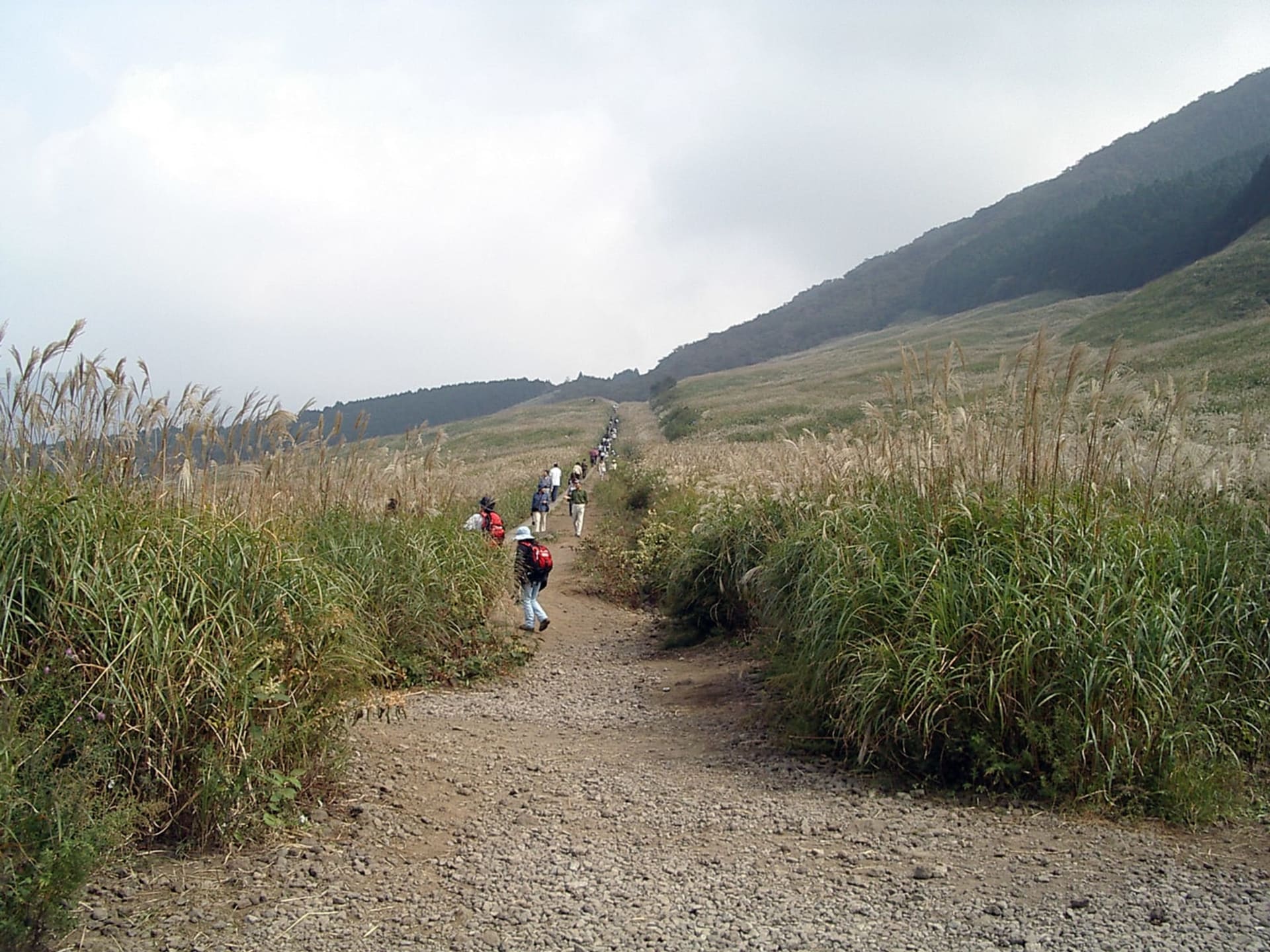
The trail cuts straight through the middle. On both sides, Miscanthus sinensis seed plumes rise to eye level, some stalks pushing past two meters. The October wind catches them, and the whole hillside ripples, silver catching afternoon light then flipping to gold. The Sengokuhara Susuki Grass Fields spread over 8 hectares , and you can walk directly into them on a single gravel path that climbs the western slope of Mount Hakone.
In late September the Sengokuhara Susuki Festival marks the season when susuki turns golden and the plumes reach full height . Photographers arrive at dawn to catch backlighting. By 7am on October weekends, the trailhead is busy.
The Science Behind Sengokuhara Susuki Grass Fields
Miscanthus sinensis, called susuki in Japan, is a perennial C4 grass native to eastern Asia. In autumn its seed heads mature into feathery plumes made up of hundreds of tiny spikelets, each surrounded by long silky hairs that catch and diffuse light. The hairs start pinkish-silver, shift through cream and beige, then turn golden-tan as the seeds ripen. At peak, the plumes are fully expanded, and the density of individual grass clumps creates a continuous field of moving texture.
The Sengokuhara plateau sits at 650 meters elevation inside the Hakone caldera, formed by volcanic eruptions and a landslide roughly 3,000 years ago . The land was initially tested for grain farming, but volcanic ash soil and humidity made traditional agriculture impossible . Instead, susuki colonized the open ground. The grass thrives in full sun and nutrient-poor soils where tree seedlings struggle. Without intervention, the plateau would revert to woodland, but each March the fields undergo a traditional grassland burning to prevent trees and shrubs from overgrowing . That March fire, called yamayaki, resets the ecosystem and keeps the susuki dominant.
The volcanic substrate drains quickly, so susuki's deep rhizome network anchors the plants and pulls moisture from lower soil layers during dry spells. By late summer, the grass has stored enough energy to push up flowering stalks. The plumes emerge in early September, fully open by late September, and hold their structure through November before winter browns them.
When and Where to See Sengokuhara Susuki Grass Fields
The season runs from late September to early November, with the plumes turning golden and reaching full height by early October . The best window is the first three weeks of October, when the plumes are at maximum fluff and the color shift from silver to gold is complete. By mid-November the seed heads have dispersed and the stalks start to collapse.
A single wide walking path extends into the field from the west base of the hillside to a higher vantage point further up the slope . The main viewing area sits directly at the Sengoku Kogen bus stop on Prefectural Route 75. From the trailhead, the path climbs gently for roughly 500 meters, reaching a low summit where you can see Mount Kintoki to the north and wetlands stretching below.
Afternoon light is optimal. Between 2pm and 4pm the sun angle is low enough to backlight the plumes without harsh overhead glare. Photographers camp the upper viewpoint for sunset. Early morning visits, around 8am, offer solitude before crowds arrive .
Access from Tokyo: Odakyu Romancecar from Shinjuku to Hakone-Yumoto takes 85 to 100 minutes. From Hakone-Yumoto Station, take Hakone Tozan Bus Line T toward Togendai and get off at Sengoku Kogen in about 30 minutes (1,100 yen) . The Hakone FreePass covers this route and is the most cost-effective option for a day trip combining other Hakone sites.
By car from Tokyo, take the Tomei Expressway to Gotemba, then Route 138 west toward Hakone. The drive takes 1.5 to 2 hours depending on traffic. Parking options include Sengokuhara Susuki Kogen Parking right next to the fields, and temporary lots open September through November near the water treatment plant . Peak season parking fills by mid-morning on weekends. Paid lots charge 500 to 1,000 yen depending on proximity.
Your Witnessing Guide
The gravel path is wide but uneven in places. Sturdy closed-toe shoes with grip are necessary. Sandals or smooth-soled sneakers will slip on loose stones. The trail has a gentle incline, but the footing requires attention.
Layers are critical. At 650 meters elevation, October mornings start cool, often below 10 degrees Celsius, then warm into the mid-teens by afternoon. Bring a windbreaker. The plateau is exposed, and the wind picks up in the afternoon, which is when the grass looks best but also when you will feel the chill.
Photography: Golden hour is the target. Shoot between 3pm and sunset with the sun behind the grass to catch the translucent glow of the plumes. A wide-angle lens (24-35mm) captures the sweep of the field and the path cutting through. A telephoto (70-200mm) isolates individual plumes and compresses the depth of the hillside. Polarizing filters reduce glare off the seed heads and deepen the blue sky. Settings: ISO 100-400, aperture f/8 to f/11 for depth across the field, shutter speed 1/250 or faster to freeze the grass motion in wind. If the wind drops, slow to 1/60 and capture the sway as slight blur.
Bring water. There are no facilities on the trail. Portable restrooms are available near the main parking area and bus stop during peak season.
Stay on the path. The grass grows densely, and off-trail trampling damages the root systems that take a full year to recover after the spring burn. Sections near the trail are roped off to prevent erosion.
Ticks are present in tall grass. Tuck pants into socks if you plan to sit near the field edges. Check clothing and exposed skin after your visit.
Do not use flash or white LED lights. If visiting near dusk for sunset shots, natural light only. Flash washes out the translucent quality of the plumes.
Why It Matters
Susuki grasslands were once common across Japan's volcanic highlands and abandoned agricultural zones, but development and forest encroachment have reduced their extent. Sengokuhara is one of the few large accessible fields remaining near a major urban center. The site has been designated as one of the "50 Best Scenic Spots of Kanagawa" and one of the "100 Best Flower Spots of Kanagawa" .
The annual yamayaki is not decorative. Without burning, tree seeds blow into the grassland, germinate, and eventually transform it into mixed woodland. Susuki requires sunny environments and withers as trees block sunlight . From 1970 for about 20 years, no controlled burning was conducted, and the grassland gradually became overgrown with trees. To restore the susuki landscape, yamayaki resumed in 1989 through local resident efforts . The March burn is now scheduled for a windless day in early to mid-March, and the spectacle of flames sweeping across the entire plateau draws its own audience.
Ecologically, susuki grasslands support species that depend on open, sun-exposed habitats. Pheasants forage in the fields, and small mammals use the dense cover. The grass itself stabilizes volcanic soils prone to erosion, anchoring slopes with its rhizome network.
Culturally, susuki marks the transition from summer to autumn in Japanese seasonal awareness. The plumes appear in poetry, painting, and traditional moon-viewing rituals in September. At Sengokuhara, the scale of the display and the accessibility make it a living link to that seasonal tradition, compressed into a few weeks each October when the plateau turns silver and gold.
This is the short version
This page shows a taste. The app has the full list of where to see this, the exact timing, and live conditions for 1,000+ natural phenomena worldwide, so you know the moment one is genuinely worth the trip.