As of today, out of season, returns ~February. Earth Exhibit tracks the live conditions and flags it the moment it is on.
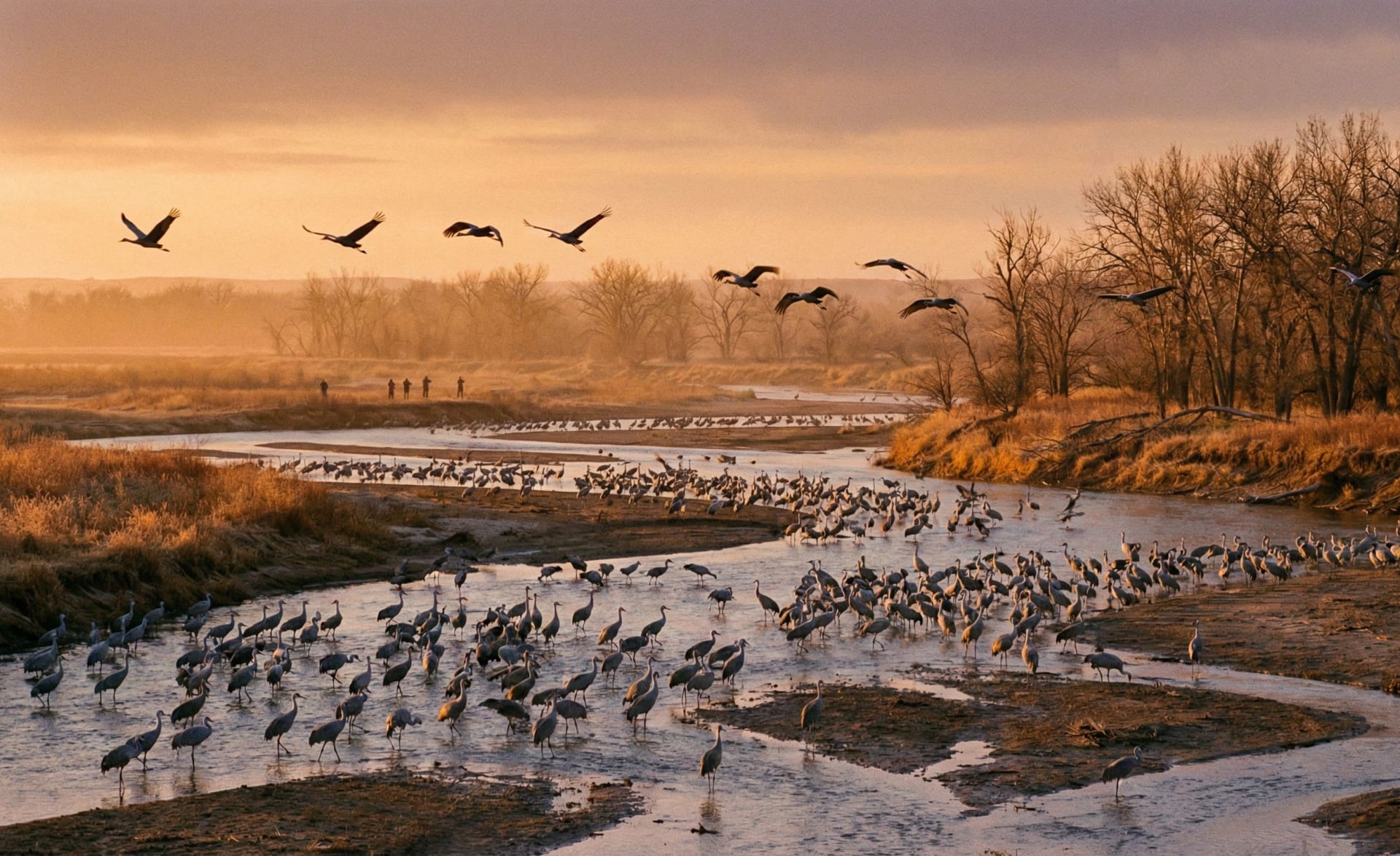
You hear them before you see anything. In the pre-dawn dark of a Nebraska March morning, sealed inside a plywood blind on the banks of the Platte River, the sound arrives like something geological. A rolling, rattling chorus of hundreds of thousands of throats calling at once. The "kar-r-r-r-o-o-o" bugle of sandhill cranes vibrating through the cold air, through the walls of the blind, through your sternum. Then the first grey light catches the river, and you realize the shallow water in front of you is not empty. It is packed, shoulder to shoulder, with tall grey birds standing in the current. Thousands of them. Tens of thousands. And this is just your quarter-mile of river. The same scene stretches for eighty miles in either direction.
The Science of a Continental Bottleneck
Every spring, roughly 600,000 to 800,000 sandhill cranes (*Antigone canadensis*) converge on an 80-mile stretch of the Platte River in central Nebraska. That figure represents approximately 80% of the entire world population of this species, funneled into a single corridor of braided river channels and surrounding cornfields. No other crane gathering on Earth comes close.
The birds arrive from wintering grounds in Texas, New Mexico, and northern Mexico, following flyways that have been carved into their behavior over deep time. Sandhill cranes have existed for at least 2.5 million years, making them one of the oldest living bird species. Fossil records from the Pliocene show essentially the same animal, the same proportions, the same bones. Their bugle call, produced by an elongated trachea that coils inside the breastbone like a French horn, is among the most ancient bird vocalizations still sounding on this continent.
They stop on the Platte for three to five weeks. Not to rest. To eat. Each crane gains 15 to 20% of its body weight during the stopover, gorging on waste grain in the harvested cornfields that surround the river. A four-foot-tall bird with a six-foot wingspan needs serious fuel reserves to continue north to breeding territories scattered across Canada, Alaska, and into Siberia. The Platte is their gas station, and the surrounding agricultural landscape is the pump.
At night they roost standing in the shallow braided channels. The wide, ankle-deep water offers protection from coyotes and bobcats. The openness means no predator can approach without being spotted. They stand packed together, sometimes so densely that the river surface vanishes beneath grey feathers. At dawn, they lift off to feed. At dusk, they return. The cycle repeats for weeks, and each day the numbers shift as new waves arrive from the south and earlier arrivals push north.
When and Where to Position Yourself
The core window runs through March, though early arrivals appear in mid-February and stragglers linger into mid-April. Peak concentration typically falls in the second and third weeks of March, when the highest density of birds overlaps on the river. Timing shifts year to year depending on weather patterns and snow cover to the north.
The primary viewing locations cluster in a stretch of central Nebraska near Kearney:
Rowe Sanctuary (40.670, -98.884) and the Iain Nicolson Audubon Center at Rowe Sanctuary (40.671, -98.971) operate guided blind experiences that are the gold standard for viewing. You enter the blind before sunset or well before dawn, and you stay put. Reservations fill months in advance. This is not a drop-in experience.
Crane Trust Nature & Visitor Center (40.796, -98.493) offers its own blind programs and daytime viewing from observation platforms along the river. Their approach includes more educational programming and guided walks through wet meadow habitat.
Fort Kearny State Recreation Area (40.655, -98.995) provides a public viewing platform on a bridge that spans the Platte. This is the free, no-reservation option. The trade-off: you are farther from the birds, exposed to the wind, and surrounded by other people. During peak weekends, the bridge gets crowded and noisy. It still works. You will still see the lift-off. But the intimacy of a blind experience is something else entirely.
One honest friction point: the blind experiences demand real commitment to stillness. You sit in a cold, dark wooden structure for two to three hours. You cannot leave early without disturbing every bird in the area and ruining the experience for everyone else in the blind. Children under a certain age are not permitted at some sites for this reason. If you are someone who gets restless, plan accordingly. Bring patience and a thermos.
Witnessing and Photographing the Lift-Off
The dawn lift-off is the event. The moment when the grey river of standing birds erupts into the sky. It does not happen all at once. It cascades. One group startles, then the next, then the next, and within minutes the sky overhead is a wheeling, calling mass of cranes peeling off toward the cornfields. The sound during a mass lift-off is something no recording fully captures. It is immersive, directional, layered. Thousands of bugling calls overlapping at different distances, punctuated by the heavy percussion of wingbeats.
For photography, a 600mm lens or longer is ideal for isolating individual birds against the dawn sky or capturing detailed portraits of cranes standing in the river. A 300mm lens works for small groups. But do not overlook the wide-angle option. A wide shot of a mass lift-off, with the horizon packed with silhouettes, tells a story that a tight crop cannot. Bring both if you can carry both.
Dawn light is golden but brief. You get perhaps twenty minutes of warm, low-angle light before the sun climbs and the quality flattens. A sturdy tripod is non-negotiable in the low-light conditions of early morning. Blinds have shooting ports sized for long lenses, so check the port dimensions against your setup before your session.
Shoot video of the lift-off. Even if you consider yourself a stills photographer. The sound is half the phenomenon, and a photograph is silent. Fifteen seconds of handheld video with the audio of 50,000 cranes calling will be the file you return to most.
Gear list for a blind session: Warm layers (temperatures regularly sit in the teens or twenties Fahrenheit before dawn in March), insulated boots, hand warmers (your fingers will stop working otherwise), binoculars for scanning, telephoto lens with tripod, a red headlamp (white light disturbs the birds), a thermos with something hot, and a camp chair if your blind does not provide seating. Dress as if you will be sitting motionless in a freezer for three hours, because that is approximately what you will be doing.
The Bigger Picture: Why the Platte Matters
The Platte River's braided channel structure is what makes this gathering possible. Wide, shallow, treeless. The cranes need open water with clear sightlines. Over the past century, water diversion for agriculture and the encroachment of vegetation on sandbars have narrowed the usable habitat. Conservation organizations including the Crane Trust and Audubon's Rowe Sanctuary actively manage river channels by clearing woody vegetation and advocating for water flows that maintain the shallow braided structure the cranes require.
Without active habitat management, the Platte River stopover would degrade. The cranes would compress into fewer and fewer miles of suitable river, increasing disease risk and competition for roosting space. The fact that this gathering still happens at its current scale is a direct result of decades of conservation work. It is not a guarantee. It is maintained.
The sandhill crane migration also serves as a sentinel for broader ecosystem health in the Central Flyway. The same wetlands and river systems that support cranes support dozens of other migratory species. When the Platte works for cranes, it works for a cascade of other birds, amphibians, and invertebrates that depend on intact riparian habitat.
For those watching from the blinds, none of this policy context matters in the moment. What matters is the sound, the density, the sheer improbability of 600,000 large birds choosing this one stretch of river across the entire continent. The cranes have been making this choice for longer than agriculture, longer than the state of Nebraska, longer than the current course of the river itself. They remember the Platte the way geology remembers. Slowly, and without negotiation.
This is the short version
This page shows a taste. The app has the full list of where to see this, the exact timing, and live conditions for 1,000+ natural phenomena worldwide, so you know the moment one is genuinely worth the trip.