As of today, in season now. Earth Exhibit tracks the live conditions and flags it the moment it is on.
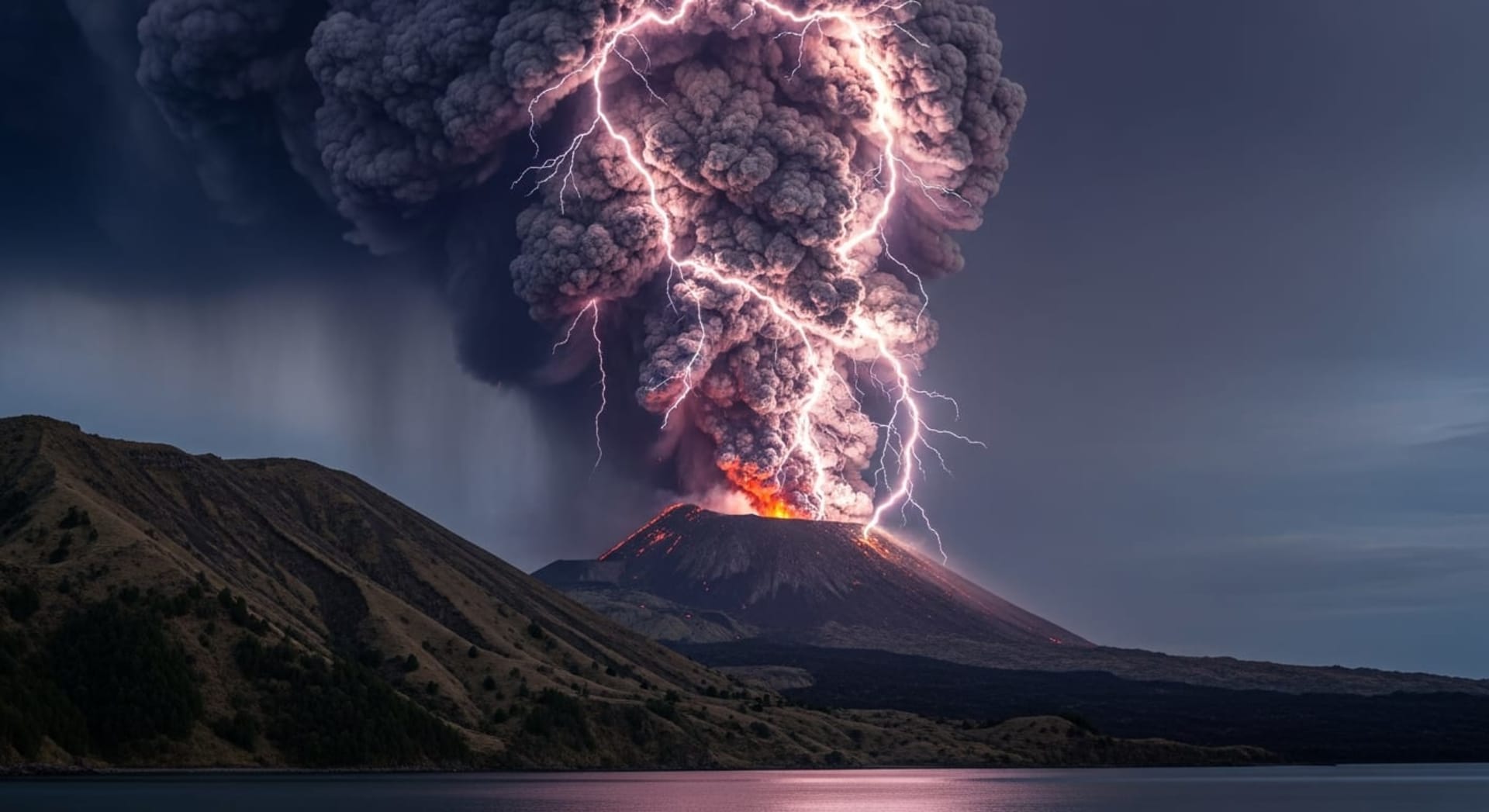
The flash happens before you hear the eruption. A jagged bolt of electric blue cuts through the ash column, branching like frozen veins against the night sky. This is not weather. Sakurajima has been erupting continuously since 2017, producing frequent explosive events , and when the eruptions are vigorous enough, the volcano generates its own lightning within the ash plume itself.
Sakurajima sits just eight kilometers from Kagoshima City, close enough that residents sweep volcanic ash from their porches most mornings. It is the most active volcano in Japan , with hundreds to thousands of small explosions each year. But the phenomenon that draws scientists and storm chasers from across the globe is not just the eruptions. It is the lightning that crackles through the ash clouds, a rare electrical display created not by rain but by rock fragments colliding at supersonic speed.
The Science Behind Sakurajima Volcanic Lightning
Ash, rock fragments, and volcanic gases ejected during an eruption create a highly turbulent environment where intense friction leads to static charge separation, and this charge buildup can result in visible lightning strikes , particularly in ash-rich plumes.
The process begins at the vent. When magma erupts explosively, it shatters into billions of ash particles ranging from micrometers to millimeters in size. These fragments are accelerated through the vent at velocities that exceed 100 meters per second, colliding violently with one another. The dominant mechanism of volcanic lightning is similar to that of lightning in thunderstorms, in that it requires the collision of particles and subsequent separation of positive and negative charge .
Scientists have identified two types of discharges at Sakurajima: Type A impulses interpreted as cloud-to-ground lightning, and Type B discharges characterized by weak electromagnetic variations with multiple peaks, interpreted as intra-cloud lightning . The presence of sulfur dioxide and fine volcanic ash enhances conductivity, increasing the likelihood of electrical discharges .
Electrical activity occurs at the onset of an eruption as near-continual VHF emissions at rates of up to tens of thousands per second, then small-scale lightning flashes of several hundred meters begin to occur, followed later by larger-scale flashes reminiscent of regular atmospheric lightning .
What makes Sakurajima particularly valuable for study is the predictability. Unlike most volcanoes that erupt sporadically, Sakurajima's consistent activity provides repeated opportunities to observe volcanic lightning under controlled conditions. The overall duration, length, peak current, and charge transfer all exhibit values 1 to 2 orders of magnitude smaller than those of thunderstorm lightning , making volcanic lightning essentially a miniature version of its meteorological cousin.
When and Where to See Sakurajima Volcanic Lightning
Sakurajima does not keep a schedule, but the odds improve when you understand the patterns. Eruptive activity has been ongoing since 2017 at Alert Level 3, with the public warned to stay cautious within 2 kilometers of Minamidake and Showa craters . Nightly crater incandescence is visible in webcam images, and small eruptive events occur occasionally .
The volcano erupts year-round. There is no seasonal peak. What matters is the vigor of the eruption. Lightning pulses tend to occur during eruptions that emit volcanic ash to high altitudes , typically those rising above 1,500 meters. Night viewing is critical. While lightning occurs during daylight eruptions, the flashes are washed out by ambient light. After dark, the contrast is sharp: glowing magma at the vent, black ash column, electric blue discharge.
Three primary viewing locations offer different perspectives:
Arimura Lava Observatory sits on the island's east flank, 3 kilometers from the summit. This is the closest legal approach, and the sound alone makes the trek worthwhile. The eruption arrives as a low thump felt in your chest before you hear the roar. Lightning flashes are brief, often lasting less than half a second, so keep your eyes on the upper plume.
Sakurajima Visitor Center Observation Deck provides a safer, more accessible vantage from the northwest. The deck is staffed and offers real-time updates from the Japan Meteorological Agency. When the wind blows southeast (common in winter), this side stays clear of ashfall.
Kagoshima Waterfront / Nagisa Park is the city-side view across the bay. You lose proximity, but gain context: the entire volcanic complex framed against the night sky, with the lights of Kagoshima in the foreground. A 200mm lens compresses the distance, making the flashes appear larger than they are.
Access is straightforward. Fly into Kagoshima Airport (KOJ) or connect via train to Kagoshima-Chuo Station. The Sakurajima ferry departs from Kagoshima Port every 15 minutes, day and night, and the 15-minute crossing is inexpensive. Rent a car on the island or use the Sakurajima Island View Bus, which loops to the main observatories. The ferry runs even during minor eruptions unless JMA issues an evacuation order, which happens only during the most severe activity.
The best time of day is night, ideally between 9pm and 3am when human light pollution is minimal and the crater incandescence provides a visual anchor. Check the JMA webcams before you go (publicly accessible online). If you see steady glow at the crater and a fresh ash plume within the last few hours, conditions are promising.
Your Witnessing Guide
Volcanic lightning photography is harder than it looks. The flashes are brief and unpredictable, often occurring inside dense ash where they are partially obscured. Here is what works:
Camera settings: Manual mode, ISO 800 to 1600, aperture f/4 to f/5.6, shutter speed 2 to 4 seconds. Use continuous shooting mode if your camera allows it. A wide-angle lens (16mm to 35mm) captures the full plume. A telephoto (200mm to 400mm) isolates individual lightning bolts but requires precise framing and a rock-solid tripod. Pre-focus manually on the crater (autofocus will hunt in the dark), then switch to manual focus and do not touch it again.
The real trick is patience. Volcanic lightning is not continuous. An eruption may produce a single bolt or dozens, scattered over 10 to 30 seconds. Keep shooting through the entire plume development. The most dramatic flashes often occur 10 to 20 seconds after the eruption onset, when the ash column is fully expanded and charged particles have had time to separate.
Gear checklist: Sturdy boots with ankle support (lava fields are sharp and uneven), long pants (ash is abrasive and gets everywhere), N95 mask rated for fine particulate (not a surgical mask, which is useless against volcanic ash), water (at least 2 liters), gloves, first-aid kit, headlamp with red filter (preserves night vision), emergency whistle. If the wind shifts and you are downwind of an eruption, ash will envelop you in seconds. The mask is not optional. Goggles help but fog easily.
Safety protocol: Monitor JMA alerts in real-time. Alert Level 3 restricts access within 2 kilometers of the craters. Do not approach closer. Ballistic blocks ejected during explosions can travel 600 meters or more. If you hear a deep rumble, watch the crater. If the rumble intensifies and the ground shakes, move to higher ground immediately. Pyroclastic flows are rare at Sakurajima's current activity level but not impossible. JMA warns residents and authorities to remain cautious of potential pyroclastic flows, ballistic projectiles, and ashfall .
Do not rely on cell service on the island. Coverage is spotty at the observatories. Download offline maps. Bring a portable charger. If you are shooting from Kagoshima waterfront, you are safe from all but the most catastrophic eruptions, but you sacrifice proximity.
Why It Matters
Volcanic lightning is more than spectacle. It is a diagnostic tool. Volcanic lightning may provide a valuable monitoring tool for active volcanoes, allowing detection of ash emissions from safe distance and in inclement weather conditions . Scientists use lightning frequency and intensity to estimate ash plume density, eruption vigor, and even the silica content of the magma. A plume that generates sustained lightning is particle-rich and turbulent, indicating a high-energy eruption. A plume with sparse flashes suggests lower ash content or less vigorous ejection.
Comparison with atmospheric sounding and maximum plume height data show that the effect of hydrometeors on flash generation at Sakurajima is negligible , meaning the lightning here is purely volcanic, unassisted by rain or ice. This makes Sakurajima an ideal natural laboratory for studying charge separation in non-meteorological environments.
Culturally, Sakurajima has shaped Kagoshima. The city's schools have covered ash shelters. Residents carry umbrellas on clear days. The local tourism board sells "ash art" kits. But there is also pride. Sakurajima is Kagoshima's identity, visible from nearly every street corner, a daily reminder that the ground beneath is not inert.
Sakurajima was designated a Decade Volcano in 1991, identifying it as worthy of particular study as part of the United Nations' International Decade for Natural Disaster Reduction . Approximately 5,000 people live within 5 kilometers of the volcano, making real-time monitoring critical. The Sakurajima Volcano Observatory, established in 1960, operates a dense network of seismometers, GPS stations, tilt meters, and gas sensors. Every eruption is tracked, measured, cataloged. The data feeds directly into hazard models that protect not just Kagoshima but volcanic regions worldwide.
This is the short version
This page shows a taste. The app has the full list of where to see this, the exact timing, and live conditions for 1,000+ natural phenomena worldwide, so you know the moment one is genuinely worth the trip.