As of today, out of season, returns ~January. Earth Exhibit tracks the live conditions and flags it the moment it is on.
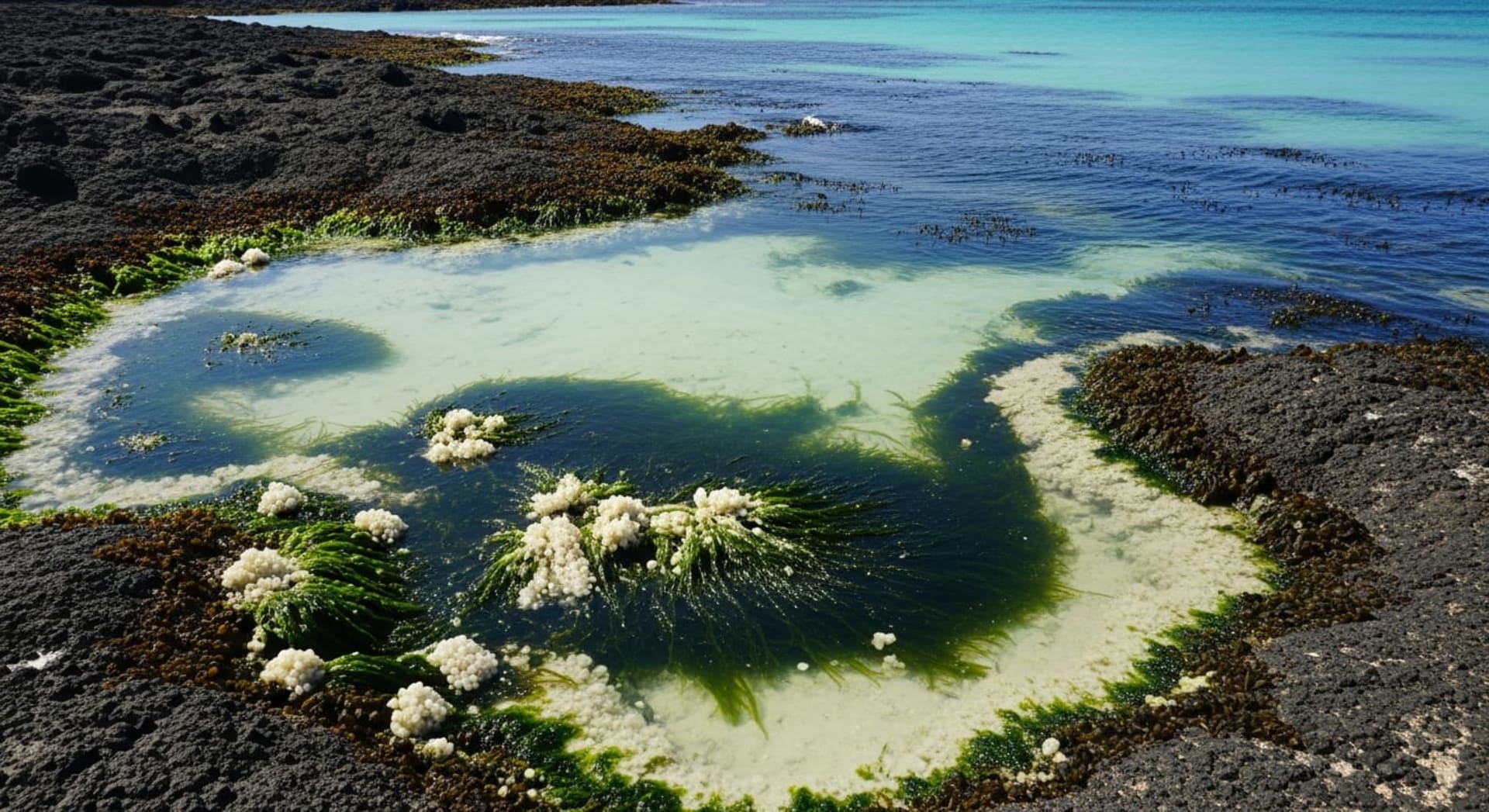
The water at Akkeshi Bay looks wrong. Not polluted, not turbid, just wrong. The green-gray sea has gone pale, almost opalescent, and the kelp fronds along the shore are draped in thick white mats that look like foam but hold their shape against the current. This is kuki: Pacific herring swarming shallow water to spawn, releasing milt that clouds the sea milk-white . The phenomenon vanished from Hokkaido after World War II but has returned annually since 2020 , bringing back a spectacle that once defined spring along the island's coasts.
The Science Behind Pacific Herring Spawn
Pacific herring (Clupea pallasii) reach sexual maturity at 3 to 4 years and spawn every spring in shallow, vegetated intertidal and subtidal zones . Males and females release milt and eggs into the water column simultaneously, with the adhesive eggs attaching to kelp, seagrass, and bottom substrate . The milky appearance comes from sperm density during active spawning. An entire school can spawn within hours, producing egg densities up to 6,000,000 eggs per square meter .
Behavioral studies using acceleration loggers show spawning synchronizes across hundreds of individuals within 30 to 40 minutes, reflecting rising, milling, substrate testing, and gamete release . Male milt may contain pheromones that stimulate females to begin egg deposition , triggering the collective spawn that turns bays white.
Eggs hatch roughly two weeks after fertilization, with timing dependent on water temperature . A single female can lay around 20,000 eggs per year , but juvenile survival is only about one adult per ten thousand eggs due to heavy predation .
When and Where to See Pacific Herring Spawn
The core season for Hokkaido's herring spawn runs from March to April, with local variation. In Japan, peak spawning varies between January and May depending on location . In Akkeshi, two distinct populations spawn: marsh herring in early April and cherry blossom herring mainly in May .
Key viewing locations:
Akkeshi Bay and Lake Akkeshi (42.948581, 144.7702355): Eggs attach to seagrasses and seaweeds in the densely vegetated eastern inner lake . The lake connects to the bay via narrow channels, and herring migrate between both during spawn. Accessible by car from Kushiro Airport (KUH), about 90 minutes east.
Cape Nosappu shoreline (43.3852858, 145.8169297): Japan's easternmost point offers rocky intertidal zones where egg masses coat kelp beds. The cape itself is a popular landmark. Drive from Nemuro city, 20 minutes northeast.
Rausu coast, Shiretoko Peninsula (44.1528287, 145.1867802): Remote shoreline along the World Heritage Site. Herring spawn in kelp forests visible from low cliffs and beach access points. Fly into Memanbetsu Airport (MMB) and drive 2.5 hours.
In 2023, kuki was observed in at least 11 municipalities along Hokkaido's Sea of Japan coast through April . The phenomenon has become more frequent since recovery efforts began. The 2022 catch reached 5,326 tons, the highest in 20 years, and 4,592 tons were caught through April 2023 .
Best time of day: Early morning at low tide. Spawning typically occurs in shallows during falling or low tide when kelp beds are most accessible. Check tide charts for your location.
Your Witnessing Guide
Herring spawn requires patience and timing. The milky water appears suddenly, lasts days to weeks, then vanishes as schools move on.
What to bring:
- Waterproof boots with good traction (rocks are slick with spawn)
- Layered cold-weather clothing (March-April mornings are near freezing)
- Binoculars for scanning shorelines from safe vantage points
- Camera with zoom lens (70-200mm or longer for detail shots)
- Field guide to North Pacific fish
- Water and snacks (remote coastlines lack services)
- Insect repellent (spring sees early mosquito emergence in wetlands)
Photography settings: For milky water and egg-covered kelp: ISO 400-800, f/8 to f/11 for depth of field, shutter 1/250 or faster to freeze wave motion. Overcast light works well, reducing glare on wet surfaces. Shoot kelp mats at eye level or below to emphasize texture. Polarizing filters cut surface reflection if you are shooting into water.
For herring schools in shallows: ISO 800-1600, continuous autofocus, burst mode. Schools move fast and break apart quickly.
Safety: Intertidal rocks become extremely slippery when coated with milt and eggs. Stay off kelp beds entirely. Cold water (around 10 degrees Celsius) poses hypothermia risk if you fall in. Check tide schedules before walking out onto exposed flats. Rising tides can cut off access quickly. Keep distance from active fishing gear and commercial boats working the spawn.
Why It Matters
Pacific herring provide a critical link between planktonic and predator trophic levels, serving as forage for numerous fish, birds, and marine mammals . The spawn itself attracts seabirds, seals, and predatory fish that gorge on eggs and adults. The herring spawn is linked to seabird and marine mammal migrations and remains a subsistence harvest for Alaska Natives and First Nations in British Columbia .
Hokkaido's herring fishery peaked in the early 20th century at 1 million tons annually, then collapsed by the mid-1950s due to overfishing and environmental changes . Mass spawning along Hokkaido coasts ceased after 1960 . Kuki returned thanks to fry release programs, with catches rising from 200 to 300 tons in the early 2000s to over 2,000 tons by 2009 .
The recovery remains fragile. Loss of spawning habitat from dredging, construction, oil spills, and water quality decline threatens herring populations . Climate change may reduce prey availability (zooplankton and phytoplankton), further stressing stocks.
In traditional Hokkaido culture, herring wealth built the "herring palaces" that still stand along the coast. The spawn also has deep ties to Indigenous harvest traditions. The spring harvest of herring eggs on kelp has long been an important subsistence resource in coastal Alaska communities , a practice shared across the Pacific Rim.
This is the short version
This page shows a taste. The app has the full list of where to see this, the exact timing, and live conditions for 1,000+ natural phenomena worldwide, so you know the moment one is genuinely worth the trip.