As of Jun 15, 2026, 11:13 PM, out of season, returns ~May. Earth Exhibit tracks the live conditions and flags it the moment it is on.
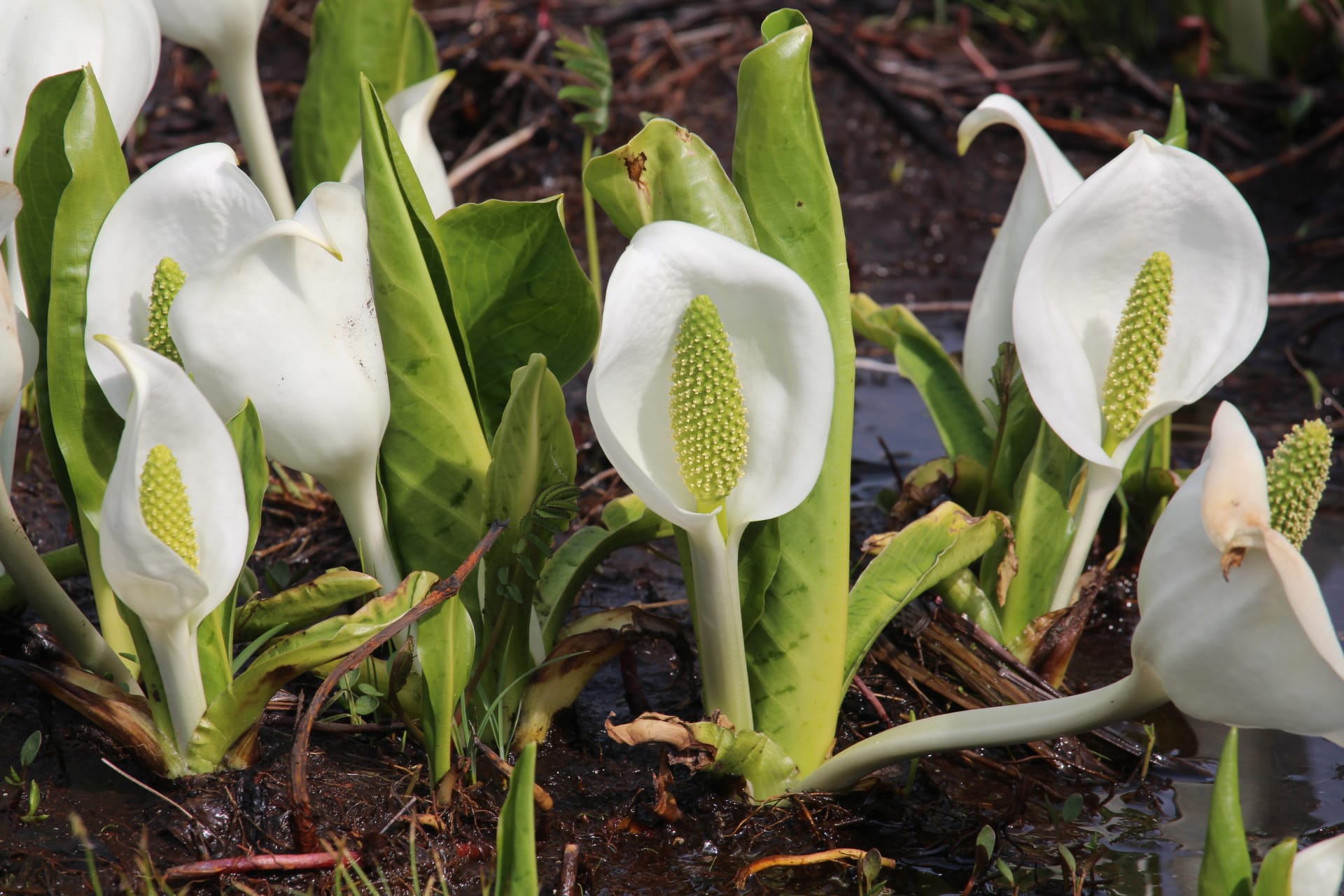
The last snow patches are still melting when the first white spathes push through the marsh. Thousands of them. Asian skunk cabbage (Lysichiton camtschatcense) transforms Ozegahara into a high-altitude field of white and yellow, each plant rising from waterlogged peat that stayed frozen until weeks ago. From late May to early June, the hiking season starts with the blooming of the mizubasho flowers . You have maybe three weeks to see it before the flowers fade and the marsh moves into its summer phase.
The Science Behind Oze Mizubasho
What looks like a single white flower is actually a modified leaf called a spathe, wrapped around a cylindrical spadix covered in tiny true flowers. The real flowers are the rice-grained, light yellowish-green ones around a rod-shaped inflorescence . These small flowers are oblong, 2-3 mm long, and bisexual, with both pistils and stamens . The white spathe acts as a reflector, bouncing light toward the spadix to attract early-season pollinators when few other flowers compete for attention.
Lysichiton camtschatcense is a perennial grass of the genus Lysichiton in the Araceae family, native to Siberia and north of central Japan . The plant contains calcium oxalate crystals throughout its tissues, making it toxic to most herbivores. Bears have been known to eat it after hibernation to expel residual tailings from their bodies , using the plant's laxative properties as a digestive reset.
The species evolved during the last ice age. Oze was formed in the Ice age. The plants of Oze are mostly cold district plants that started habituating during the Ice age . When temperatures warmed, most ice-age flora disappeared from lower elevations, but Ozegahara's high-altitude wetland provided a refuge. The marsh sits at 1,400 meters, where cool summers and heavy winter snowpack maintain conditions similar to those 10,000 years ago.
When and Where to See Oze Mizubasho
The peak flowering season of mizubasho is at the end of May each year , extending into early June depending on snowmelt timing. Years with heavier winter snow push the bloom later. The past winter saw more snow than usual, and the timing of the flowers was slightly delayed compared to the average year (as of early 2026 conditions, check current forecasts).
Ozegahara Marsh is the primary viewing location. The Ozegahara Marshland, located about 1400 meters above sea level, is about six kilometers long and one kilometer wide, and has hundreds of small, distinct pools . The densest concentrations appear around the Research Exhibition Garden near Yamanohana, where deer fencing protects the plants.
Access requires planning. The Hatomachitoge trailhead on the Gunma side of the park is the easiest and most popular. Visitors need to use a shuttle bus (1000 yen one way) for the final twelve kilometers of the journey to the trailhead during most of the hiking season . From the trailhead, the path leads about one hour downhill through the forest into the marshland .
Direct highway buses run from Shinjuku to Tokura from May through October, then you transfer to the Hatomachitoge shuttle. Alternatively, take the Joetsu Shinkansen to Jomo-Kogen Station (75 minutes from Tokyo), then bus to Tokura (110 minutes). Total journey from Tokyo: roughly four hours. Arrive the day before if you want to hit the marsh at dawn.
Oze is extremely crowded on the weekends in June, the peak flowering season of mizubasho . Go midweek if possible. Early morning offers the best light and fewer people on the boardwalks.
Your Witnessing Guide
The marsh temperature at dawn in late May can drop to 5 degrees Celsius even when Tokyo is hitting 25. Layer up. Start with a base layer, add a fleece, pack a waterproof shell. The weather shifts fast at this elevation.
Footwear: waterproof hiking boots with ankle support. The trail descends 100 meters through forest before reaching the marsh, and the return climb at the end of a long day is harder than it looks. Boardwalks are well-maintained but can be slick after rain.
Bear bells are mandatory. If you see a bear, remain calm, and it will likely amble away. You can buy bells at Hatomachi Base Cafe & Shop . Make noise on the forested sections of trail. Bears are active in May as they emerge from hibernation.
Photography: The white spathes blow out easily in direct sun. Shoot early morning or late afternoon when light is softer. A polarizing filter helps manage reflections from the wet marsh. Wide-angle lens (16-35mm equivalent) captures the scale. Macro lens (90-105mm) for spadix details. Set ISO 400, aperture f/8 for depth of field across flower clusters, shutter speed 1/250 or faster to freeze motion if there's wind.
The boardwalk route from Hatomachitoge to Ryugu and back covers roughly 7.7 kilometers and takes four to five hours at a moderate pace. Bring water (refill at Yamanohana Visitor Center), energy bars, sun protection. Toilets are available at Yamanohana and Ryugu. No trash bins exist in the marsh, pack everything out.
Mountain huts near the marsh offer overnight stays. Booking ahead is required during bloom season. Staying overnight lets you catch the marsh at sunrise when mist rises from the pools and the light is cleanest.
Why It Matters
More than 900 species of vascular plants are confirmed in the marsh , making Ozegahara one of Japan's most biodiverse wetlands. The mizubasho bloom is the first wave in a succession that includes marsh marigolds in late May, cotton sedge in July, and daylilies in late summer. Each species depends on specific moisture and temperature conditions that the marsh provides.
The white spathe is more than visual spectacle. It creates a microclimate around the spadix, raising internal temperatures several degrees above ambient to speed pollen maturation and attract early pollinators. This thermogenic property is rare among temperate plants and represents an evolutionary adaptation to short alpine growing seasons.
Oze National Park exists because of conservation fights in the 1950s and 1960s. Public-led efforts stopped the construction of electric power generation plants that would have flooded much of the area. Other initiatives included blocking road development into the park and launching programs against littering and other potential damage from tourism . The boardwalks you walk on were built to prevent erosion from foot traffic that was killing vegetation.
Deer are now the primary threat. Populations have increased since the 1990s, and they browse mizubasho extensively. The fenced Research Exhibition Garden near Yamanohana shows what the marsh looks like without deer pressure, with flower densities triple those in unfenced areas. Park management is testing various control methods.
The mizubasho appears in the lyrics of "Natsu no Omoide" (Memories of Summer), a 1949 song taught to every Japanese schoolchild. "When Summer Comes I remember..." the song begins, anchoring Oze in national consciousness as a place of return and seasonal memory. The flower's Japanese name translates roughly as "water banana plant," referencing the large leaves that emerge after the spathe fades.
This is the short version
This page shows a taste. The app has the full list of where to see this, the exact timing, and live conditions for 1,000+ natural phenomena worldwide, so you know the moment one is genuinely worth the trip.