As of today, out of season, returns ~November. Earth Exhibit tracks the live conditions and flags it the moment it is on.
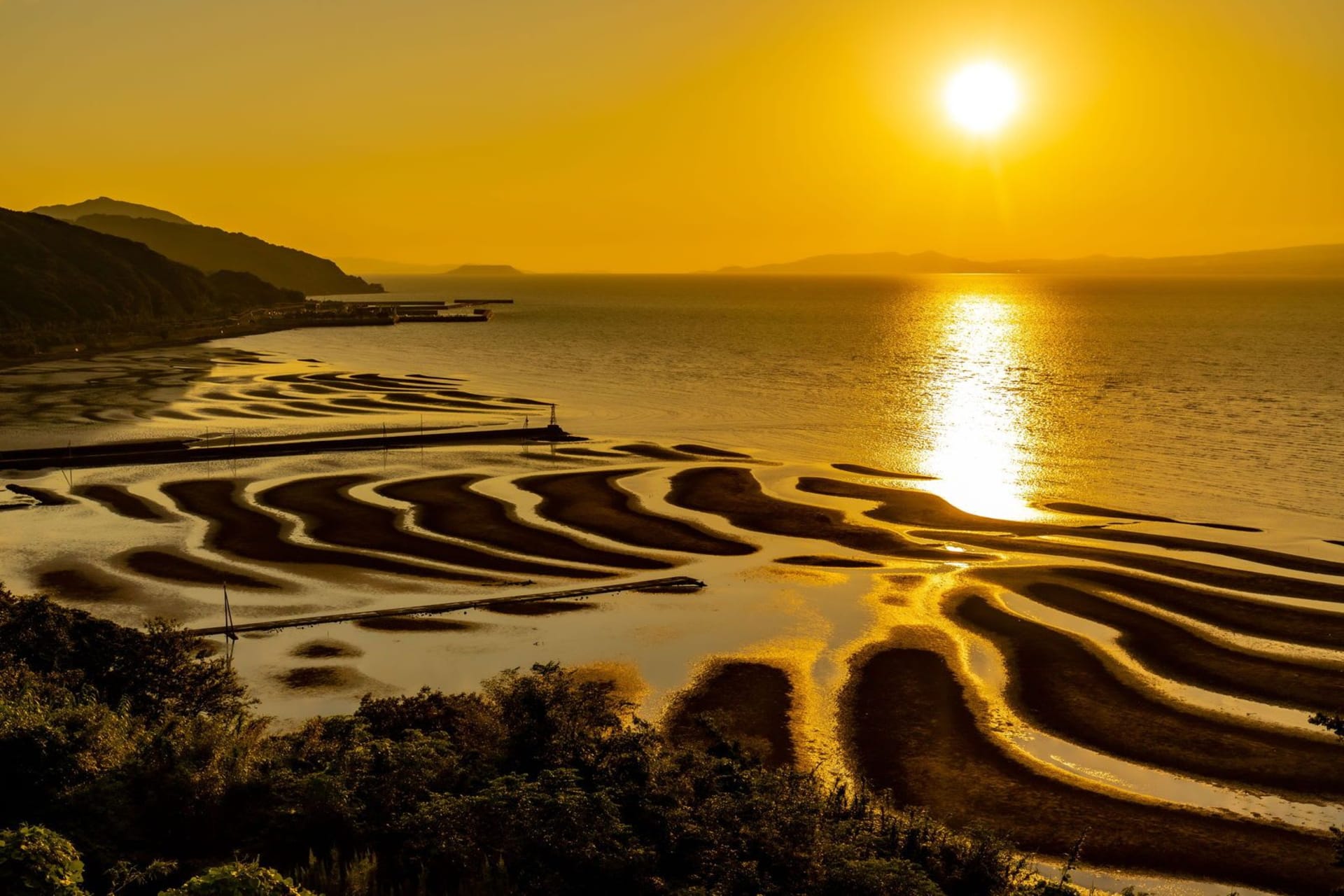
Stand on the coastal promenade at dawn and watch the Ariake Sea retreat. In less than an hour, the waterline withdraws more than two kilometers offshore, exposing vast mudflats striped with crescentic ripples. But here, woven among those natural patterns, you find something else: spirals thirty meters across, geometric mandalas, faces the size of trucks, all carved into the wet sand. The tide has uncovered sand art drawn on the Okoshiki Coast's intertidal flats, large-scale patterns that appear from the sea bottom when the tide begins to dry . The artworks will survive six hours at most before the Ariake Sea returns to erase them.
The Science Behind the Canvas
The Ariake Sea is known for its large tide difference; at low tide, the ocean floor appears until offshore more than 2 kilometers . At Okoshiki Beach, the spring tide rises as much as four meters , one of the most extreme tidal ranges in Japan. This hyper-tidal environment creates the substrate for sand art: firm, fine-grained sediment saturated with just enough moisture to hold crisp edges.
Due to the large tidal difference, a unique ripple is created in the sand when the tide falls . These natural wave patterns, called samon in Japanese, form the backdrop. Artists work atop and alongside them, using the tide's own geometry as part of the composition. The sand here contains enough silt to bind grains together, essential for designs that must resist wind and foot traffic during the narrow viewing window.
Timing is governed by lunar cycles. The mudflat is most clearly seen during the spring tide when the tidal range is the greatest , typically around new and full moons. Artists must begin work immediately as the tide drops, often before sunrise, and complete pieces before the flats become accessible to the public. The race is literal: falling water exposes new canvas by the minute, but rising water reclaims it just as fast.
When and Where to See Okoshiki Sand Art
The core season runs March through November, when weather permits outdoor work and tides align with daylight hours. Peak viewing occurs during spring tide windows, particularly from March to May and September to October when temperatures are mild.
Three primary viewing locations offer different perspectives:
Okoshiki Beach Viewing Point (32.6638758, 130.5321275): The main observatory sits along the coastal promenade with elevated sightlines across the flats. Make sure to show your taxi driver the lookout point if arriving by car, as access roads can be confusing.
Okoshiki Coastal Promenade Observatory: A walking trail extends along the shore with multiple vantage points. Best for photographers who want to move between compositions as light shifts.
Okoshiki Artist Staging Area: Where organized installations are created. Community groups and local artists coordinate scheduled displays here, particularly during festivals and cultural events.
The Okoshiki Coast can be accessed easily by train on the Misumi Line; the walk from JR Oda Station to the Okoshiki beach is less than a kilometer, taking less than ten minutes . However, from the train station you have to take a taxi to the Okoshiki seashore to reach optimal viewing areas. Taxi fare to and from Ouda Station to lookout point is about $16 US .
A rental car provides the most flexibility for aligning visits with tide schedules. From Kumamoto Airport, drive west approximately 90 minutes toward the Uto Peninsula coastal area. From Fukuoka Airport, allow three hours.
You have to go during low tide or it's pointless . Check Uto City's tide calendar before planning your trip. Artworks appear only during the lowest tides, and the setting sun and the ebb tide of the Ariake Sea overlap with each other only several times a year , creating the most dramatic viewing conditions.
Your Witnessing Guide
Gear checklist:
- Binoculars for distant viewing (artworks can be hundreds of meters offshore)
- Camera with zoom lens (200mm minimum recommended for detail shots)
- Wide-angle lens for capturing scale
- Sturdy waterproof boots (flats are slippery and wet)
- Sun protection (no shade on exposed mudflats)
- Water and snacks (limited services at viewing areas)
- Field guide to tidal species (the flats teem with mudskippers, crabs, and bivalves)
- Rain jacket (weather shifts quickly)
- Insect repellent (mosquitoes thrive in tidal zones)
Photography settings: The challenge is capturing contrast on a monochromatic surface. Shoot during golden hour when raking light emphasizes texture. Try ISO 200-400, aperture f/8-f/11 for sharpness across large areas, shutter speed 1/250 or faster to freeze ripples in wind. A polarizing filter cuts glare from wet sand. For aerial perspective, climb to the promenade observatory; for intimate details, wait until the tide drops low enough to permit safe access to the flats (but never venture beyond marked zones).
Safety considerations: Tides return quickly; tides create a unique pattern in the sandbar , but that same force can isolate unwary visitors. Never turn your back on the sea. The substrate transitions from firm to quicksand-soft without warning. Wear boots with ankle support. Follow local guidance on access boundaries. Worth it but you have to go during low tide , and you must leave before the turn.
Artists use rakes, wide boards, and their own footsteps to create patterns. On sandy beaches, a technique called "sand raking" exposes the damp underlayer to create contrasts between light and dark; the patterns resemble man-made crop circles and are typically extremely large . Some designs incorporate rollers dragged across the flats to produce continuous curves. Others employ stencils for geometric precision. The work is physically demanding: artists cover kilometers, bending and dragging tools through ankle-deep sand, racing against the clock.
Why It Matters
Tidal art occupies a unique space between land art and performance. The work exists in full only briefly, witnessed by those present at the right hour, then erased completely. The works are ephemeral and are primarily shared through documentation or part of a live performance . This impermanence is central to the practice, echoing Buddhist concepts of transience and the Japanese aesthetic principle of mono no aware (the pathos of things).
The Ariake Sea itself is ecologically significant. Its extreme tides create one of Japan's most productive estuaries, supporting fisheries, nori cultivation, and rich invertebrate communities. The scenery where marine products such as offshore seaweed laver are cultivated is part of the beauty . The mudflats function as critical habitat for migratory shorebirds and endemic species like the mudskipper.
The name "Okoshiki" means "palanquin," derived from a legend which states that when Emperor Keiko toured Kyushu, his eyes were arrested by the beauty of the coastline and he ordered his palanquin to stop. The scenery has been selected for inclusion in Japan's 100 best beaches and 100 best sunsets . The contemporary sand art tradition builds on this long history of recognizing the coast's visual power.
Artists and community groups coordinate installations around festivals and environmental awareness events. The practice draws attention to tidal ecosystems often overlooked in favor of coral reefs or forests. By transforming the flats into temporary galleries, artists invite viewers to consider what lives in and depends on these spaces. The art is participatory, too: organized events welcome volunteers to help create patterns, turning spectators into collaborators.
Climate change poses risks. Rising sea levels and shifting storm patterns may alter tidal dynamics, potentially reducing the exposed flats or changing sediment composition. Coastal development pressures compete with conservation priorities. The ephemeral art form thus becomes a time-marker, documenting the current state of a coastline in flux.
This is the short version
This page shows a taste. The app has the full list of where to see this, the exact timing, and live conditions for 1,000+ natural phenomena worldwide, so you know the moment one is genuinely worth the trip.