As of today, out of season, returns ~January. Earth Exhibit tracks the live conditions and flags it the moment it is on.
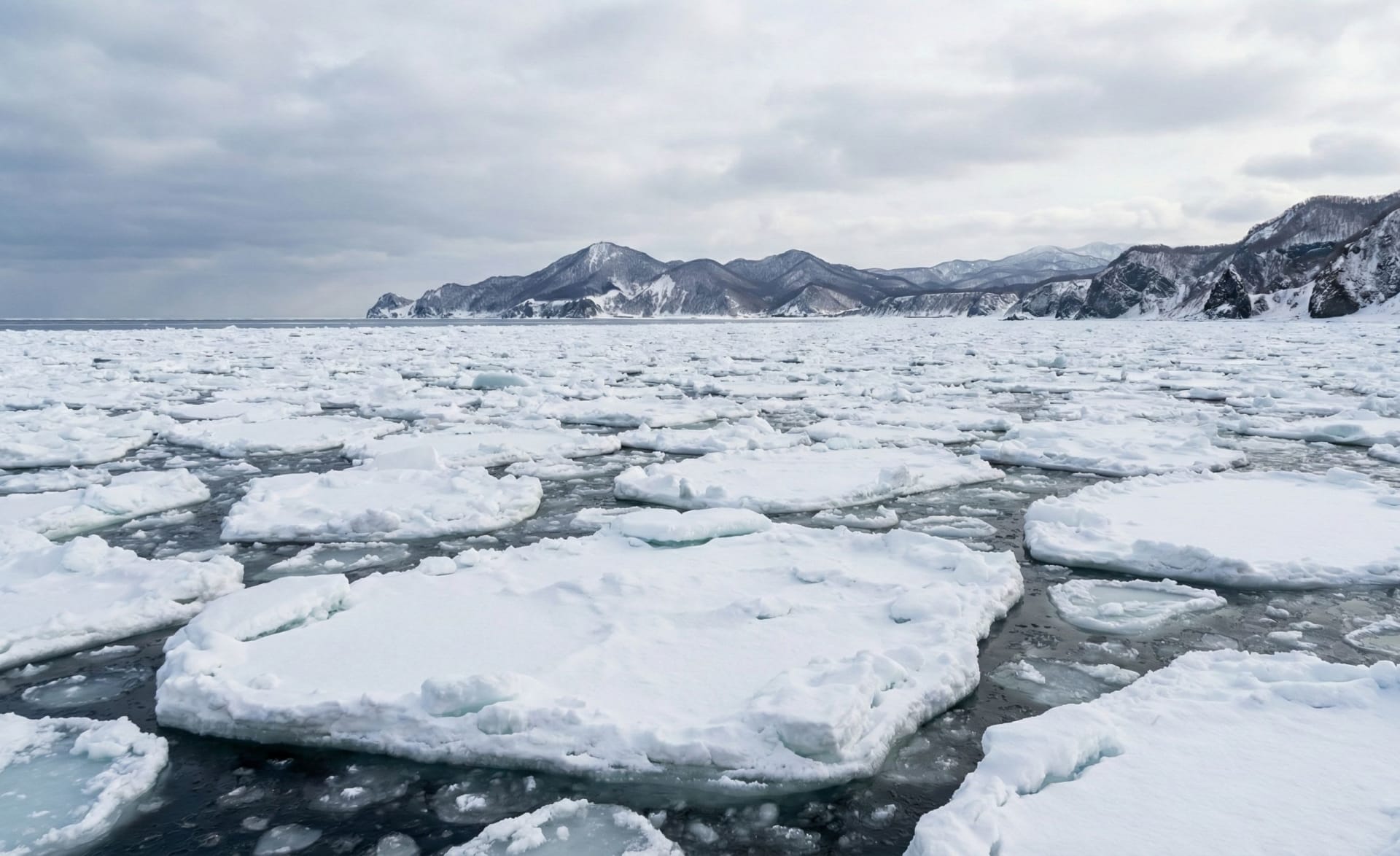
The ship's hull groans. Then cracks, sharp and sudden, echo across the frozen Sea of Okhotsk as the Aurora icebreaker plows forward. The drift ice reached Abashiri's coast on January 22nd this year , earlier than some seasons, and now in late February the sea stretches white to the horizon, broken only by leads of dark water. At 44 degrees north latitude, the same as Venice or Portland, Oregon, this is the Northern Hemisphere's southernmost point where ocean water freezes . The season peaks now, and by April the ice will be gone.
The Science Behind Okhotsk Drift Ice
The ice begins its 1,000-kilometer journey from the Amur River on the Russian-Chinese border , and the process starts far upstream. Freshwater from the Amur and other rivers mixes with seawater, creating a less saline water mass that freezes at a warmer temperature than pure seawater alone . On the northernmost coast of the Sea of Okhotsk, seawater cools to minus 1.8 degrees Celsius under severe cold air, forming small needle-like and plate-like ice crystals near the surface .
As ice crystals stick together, the drift ice grows, but only the hard-to-freeze salt is left behind . Taste a fragment of drift ice and you'll find it's freshwater, not salty. Wind and the southward-flowing East Sakhalin Current carry these frozen masses down along Sakhalin Island's coast. By mid-January to early February, the ice reaches Hokkaido, blanketing the coast from Abashiri to the Shiretoko Peninsula in white.
The timing varies. Drift ice is not seen every day because it is always moved by wind and tide, and the position can change in a short time depending on sea conditions . Some winters, warm temperatures keep the ice offshore. In cold years, floes push as far south as Kushiro on the Pacific coast.
When and Where to See Okhotsk Drift Ice
The best viewing window is usually the second half of February , when ice coverage is thickest and most reliable. The season runs January 20 through late March, but average temperatures during the drift ice season from mid-February to early March hover around minus 6 degrees Celsius . Expect minus 10 to minus 20 on clear days.
Abashiri is the primary staging point. Abashiri sits at 44 degrees north latitude, the southernmost point where the ocean freezes . The Aurora icebreaker typically operates from late January to late March , departing from the Roadside Station Ryuhyo-Kaido Abashiri terminal. Cruises run between 3 and 7 times daily depending on the period: 4 departures in late January, 5 departures February 1-28, and 3-5 departures in March . Each cruise lasts about one hour and travels 10 kilometers one way .
Utoro on the Shiretoko Peninsula offers a wilder experience. During the drift ice season from late January to early March, a drift ice field spreads out below the cliffs , visible from snowshoe trails along the coast. Mombetsu, north of Abashiri, operates the Garinko II icebreaker with massive front screws that chew through ice differently than the Aurora's hull-weight method.
The ice can't always be seen from land, so the only way to view it is by boat from Abashiri . On good days, shoreline viewing works from Kitahama Station south to Abashiri Port, where the JR line runs right along the coast. The special Drift Ice Monogatari tourist train runs twice daily during the season.
Access: From Memanbetsu Airport, a limousine bus reaches Abashiri Bus Terminal in 35 minutes, then the Aurora terminal in an additional 5 minutes . From Sapporo, the JR limited express takes 5.5 hours. Book icebreaker tickets at least a few days ahead in peak season.
Your Witnessing Guide
The cold is the challenge. At minus 10 to minus 20, exposed skin freezes in minutes, and camera batteries die fast. Layer thermal base layers under a down jacket, then add a windproof shell. The average winter temperature in Abashiri ranges from 0 to minus 10 degrees Celsius, and it gets colder on the sea, so we recommend wearing a thick outwear . Insulated boots with non-slip soles are non-negotiable. The ship's deck is steel and slick with ice.
Bring hand warmers, at least four pairs. Two for your gloves, two for your pockets to swap out dead camera batteries. There is a heater inside the ship, but most passengers see the view from outside . The observation deck offers the best vantage for the ice-breaking action, but you'll feel every degree below zero.
For photography: ISO 400-800, shutter speed 1/500 or faster to freeze motion, aperture f/8 for depth. The light is flat and bright, reflecting off endless white. Expose for the ice, not the sky, or everything washes out. Spare batteries are critical. Keep them warm against your body until you need them.
If you're lucky, you might see Steller's sea eagles and seals, so bring binoculars or a telephoto lens . The eagles are massive, with wingspans reaching 2.5 meters, and they rest on ice floes between fishing dives. Spotted seals haul out on larger floes to sun themselves even in winter.
Safety: Tour companies in Abashiri and Utoro offer drift ice walking tours with protective dry suits , but never walk on drift ice without a guide. The ice looks solid but hides gaps and weak spots. Water temperature is near freezing. Without a dry suit, you have minutes before hypothermia sets in.
Why It Matters
The area and duration of ice floes along the coast of Hokkaido have nearly halved compared to 100 years ago . Due to global warming, the amount and thickness of drift ice has decreased considerably since the late 1980s, and it happens increasingly that the ice does not quite reach the Japanese coast during some periods in the season . The Sea of Okhotsk has warmed in some places by as much as 3 degrees Celsius since preindustrial times, three times faster than the global mean, and warming inhibits the formation of sea ice .
Yet when it arrives, the ice brings life, not sterility. Under the ice floes, a large amount and variety of plankton are active, including clione , the tiny translucent sea angels that swim beneath the frozen surface. As ice forms, it expels salt into the deeper layers, and this heavy water flows east toward the Pacific, carrying oxygen and nutrients that support abundant sea life .
The drift ice is why the Sea of Okhotsk is one of Japan's richest fishing grounds. Scallops, salmon, crab. The ice seeds spring phytoplankton blooms that feed the entire marine food chain. Steller's sea eagles fly above the drift ice, and in winter, half of this eagle's global population gathers in Hokkaido . The endangered species depends on the ice and the fish it concentrates.
The Ainu, Hokkaido's indigenous people, called the drift ice ohtsuku, recognizing its annual return as part of the seasonal rhythm. Modern Abashiri celebrates with the Okhotsk Drift Ice Festival each February, held under the theme "SAVE THE ICE SAVE THE EARTH," focusing on drift ice that is losing strength year by year due to the effects of global warming .
The ice might not last another century at current warming rates. The salmon fishery on the northern Japanese coast has already collapsed, falling 70% in the last 15 years as warming drives fish populations north . Each season that the ice reaches Hokkaido is no longer guaranteed.
This is the short version
This page shows a taste. The app has the full list of where to see this, the exact timing, and live conditions for 1,000+ natural phenomena worldwide, so you know the moment one is genuinely worth the trip.