As of today, out of season, returns ~January. Earth Exhibit tracks the live conditions and flags it the moment it is on.
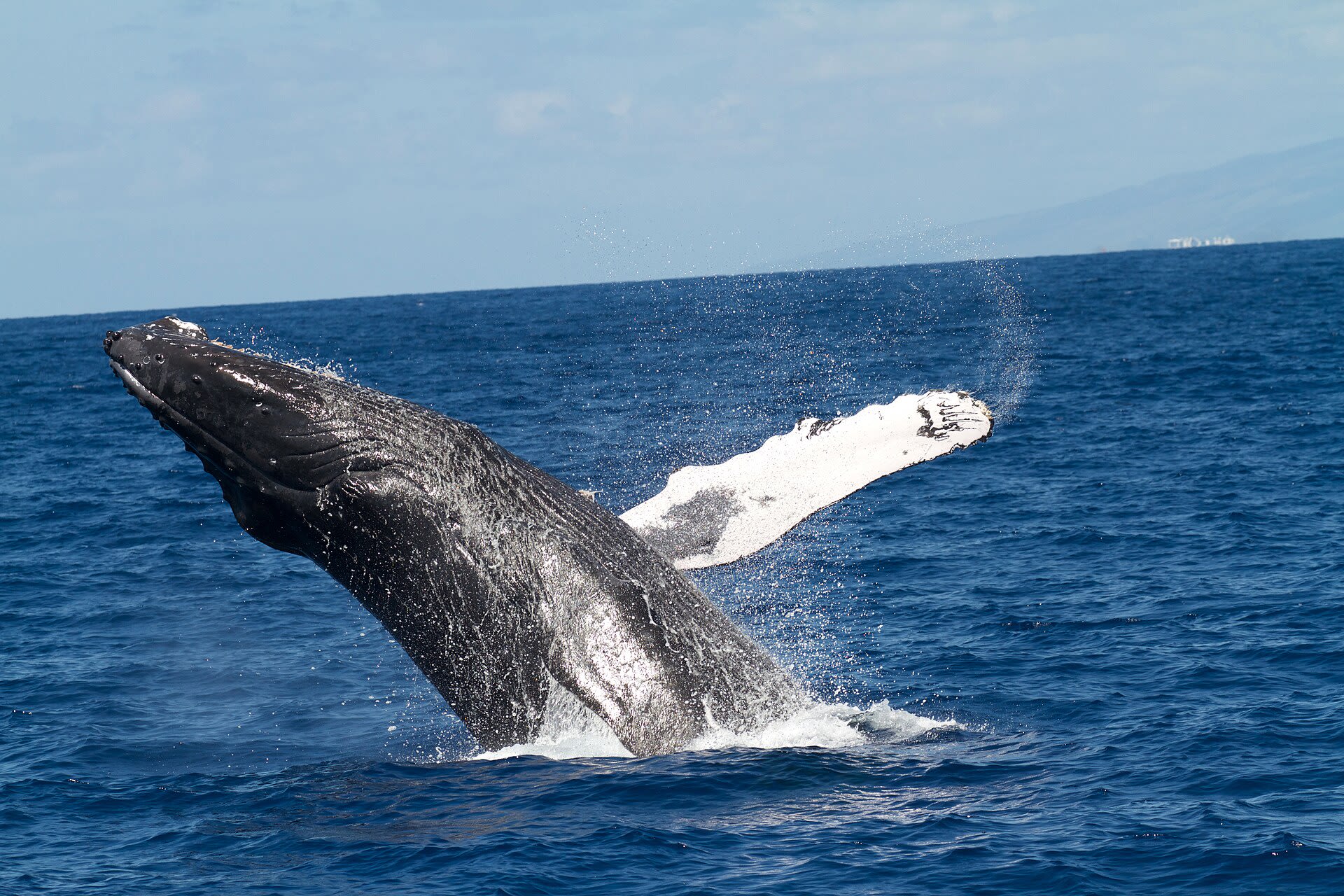
The boat motors cut. In the sudden silence, you hear it: a low rumbling exhalation that carries across flat water. Then the blow, a vertical mist column that hangs in the air before dissipating. Forty meters ahead, a 13-meter humpback whale surfaces, rolls, and lifts a barnacle-crusted pectoral fin the length of your boat before slapping it down with a crack that echoes off Chichijima's volcanic cliffs. The Ogasawara Whale Watching Association reports above 90% success rates for humpback whale sightings by boat during the season .
Humpback whales arrive in the Ogasawara Islands from December to May for mating, calving, and raising young . The core season runs February through March, when warm subtropical water 1,000 kilometers south of Tokyo transforms into a nursery for one of the North Pacific's breeding populations.
The Science Behind Ogasawara Humpback Whale Season
The humpback whale (Megaptera novaeangliae) is a baleen whale in the family Balaenopteridae. Adults range from 14 to 17 meters long and weigh up to 40 metric tons . The scientific name translates to "big-winged New Englander," a reference to the species' distinctive pectoral fins that can reach five meters in length.
During summer, these whales feed on fish from the Kamchatka Peninsula to the Aleutian Islands, then return to Ogasawara for breeding . They make this migration while fasting entirely. No feeding occurs in the breeding grounds. Instead, the whales rely on blubber reserves accumulated during months of gorging in northern waters, where they can consume over a ton of krill and small fish per day.
Newborn calves measure about four meters long with milk-gray body color and wrinkle-like lines. They surface to breathe every two to three minutes, compared to adults' 10 to 15 minute intervals . This physiological constraint explains why calves stay near the surface and why mother-calf pairs frequent shallow protected waters around Chichijima and Hahajima.
Competition groups form when multiple males fight over a single female, engaging in violent behaviors including hitting with pectoral fins and tail fins, and attacking with barnacles on their bodies . These surface-active groups produce some of the most dramatic sightings: breaches, peduncle throws, head lunges, all visible from tour boats that maintain the mandatory 100-meter distance.
Male humpback whales produce complex songs during breeding season, believed to be displays of competitive fitness directed toward other males rather than attempts to attract females . On calm days, you can hear the song through the hull of the boat, a series of moans, cries, and rumbles that can last 20 minutes and carry for kilometers underwater.
When and Where to See Ogasawara Humpback Whales
The season runs from February through April , with February and March offering the highest concentration of whales and the most active breeding behaviors. Numbers peak from February through April . By late April, most adults have begun the northward migration back to feeding grounds, though stragglers are occasionally sighted into May.
Tours depart from two points: Chichijima (the main island) and Hahajima (50 kilometers farther south). Chichijima sits about 1,000 kilometers south of Tokyo, with Hahajima 50 kilometers farther south . Both islands serve as bases for licensed whale-watching operators.
The 24-hour ferry from Tokyo departs four to six times per month , which constrains trip planning. Most visitors schedule six days total: one day outbound on the ferry, three or four days on the islands for whale tours and other activities, then one day return. The ferry schedule determines your arrival and departure dates, so book months ahead during peak whale season.
Scheduled whale-watching trips run daily during the season, lasting two to six hours each . Morning departures offer the calmest sea conditions. Humpback whales are frequently viewed between February and April , with sighting success rates consistently above 90 percent according to association records, but no tour operator guarantees a sighting. These are wild animals in open ocean.
Shore-based viewing is possible from February to April at designated lookouts, with no risk of seasickness and 7- to 8-power binoculars recommended . The Weather Station Observatory near Futami Port on Chichijima provides elevated views across breeding waters, particularly effective for spotting blows and breaches at distance.
Water temperature in February averages 20 degrees Celsius. Air temperature ranges from 17 to 19 degrees, but wind chill on moving boats drops the effective temperature significantly.
Your Witnessing Guide
Book through the Ogasawara Whale Watching Association or licensed member operators. Fifteen boats on Chichijima and one on Hahajima are association members . Boats range from 12 to 30 passengers. Reserve in advance; February and March tours fill quickly.
Bring:
- Binoculars (8x or 10x magnification) for scanning distant blows and identifying behaviors
- Camera with telephoto lens (200mm minimum) for breaches and surface behaviors. Shooting from a moving boat in open ocean requires fast shutter speeds: 1/1000 second minimum, ISO 400-800, continuous autofocus mode. A 70-200mm zoom lens offers flexibility.
- Polarized sunglasses to cut glare and spot subsurface shapes
- Layered waterproof clothing: the February wind is cold. Long-sleeve rash guard, fleece, and a waterproof windbreaker over it. Spray comes over the bow.
- Hat with chin strap so it does not blow off
- Sunscreen (reef-safe formulation) reapplied every two hours. The subtropical sun burns even in winter.
- Motion sickness medication taken 30 minutes before departure. Open-ocean swells can exceed two meters.
- Waterproof bag or dry bag for electronics
Tour boats follow strict voluntary regulations established by the Ogasawara Whale Watching Association. Boats must slow down within 300 meters of whales and must not approach within 100 meters of humpback whales . Operators cut engines when whales surface nearby, allowing the animals to control the encounter. If a whale approaches the boat voluntarily, you stay still and let it pass.
Seasickness is common. The crossing from Chichijima to open-ocean whale zones takes 30 to 60 minutes through swells. If prone to motion sickness, take medication before boarding, sit near the center of the boat where motion is minimized, and keep your eyes on the horizon. Ginger candy helps. Avoid reading or looking at screens.
Expect wet conditions. Even on calm days, spray comes over the bow when the boat accelerates between sightings. Waterproof your gear. Keep one hand on a rail at all times when standing; boat decks pitch unpredictably.
Access logistics: The Ogasawara-Maru ferry departs from Takeshiba Terminal in Tokyo. The trip takes 24 hours , arriving at Futami Port on Chichijima at 11:00 AM the following day. Ferry fares range from about 30,000 to 90,000 yen one way depending on class and season. Economy class includes a bedroll in a dormitory room. Higher classes offer semi-private bunks or private cabins with in-room toilets and showers .
No airport exists on Ogasawara. The ferry is the only way in.
Inter-island travel between Chichijima and Hahajima uses the Hahajima-Maru, a smaller ferry that runs once or twice daily depending on season and sea conditions. The crossing takes about two hours.
Why It Matters
Breeding areas in the western North Pacific include the Ogasawara Islands, Ryukyu Islands, and the Philippines . The Ogasawara population represents part of a broader western North Pacific stock that feeds in waters from the Aleutian Islands to the Kamchatka Peninsula and breeds across multiple island groups from Japan to the Philippines.
The Western North Pacific population of humpback whales is listed as endangered under the U.S. Endangered Species Act , one of only four populations globally that remain protected. While global humpback numbers have recovered dramatically from 20th-century whaling, the western North Pacific stock remains at lower abundance than other populations.
The Ogasawara Islands are a UNESCO Natural World Heritage site , recognized for both terrestrial and marine ecosystems that evolved in isolation. The whale-watching regulations enforced by local operators balance tourism access with protection of breeding habitat. The 100-meter approach rule reduces disturbance during critical reproductive behaviors.
Mothers with newborn calves are particularly sensitive to vessel approach. In the latter half of the season, mother and calf whales are often seen together, staying together for almost a year . These pairs require space. Responsible operators identify mother-calf pairs and maintain extra distance, reducing stress on animals that are already managing the energetic demands of lactation while fasting.
Climate change poses uncertain risks. Warming in high-latitude feeding grounds could alter prey distribution, potentially affecting the nutritional condition of whales arriving at breeding areas. Vessel strikes remain a threat in shipping lanes between Tokyo and Ogasawara, though regulations requiring speed reductions in whale season mitigate risk.
The phenomenon is ephemeral by design. Humpback whales use Ogasawara for only four to five months annually. Miss the February-to-March window and you wait another year. The whales follow an internal calendar driven by gestation cycles and migration timing refined over millennia. You adjust your schedule to theirs, not the reverse.
This is the short version
This page shows a taste. The app has the full list of where to see this, the exact timing, and live conditions for 1,000+ natural phenomena worldwide, so you know the moment one is genuinely worth the trip.