As of today, out of season, returns ~April. Earth Exhibit tracks the live conditions and flags it the moment it is on.
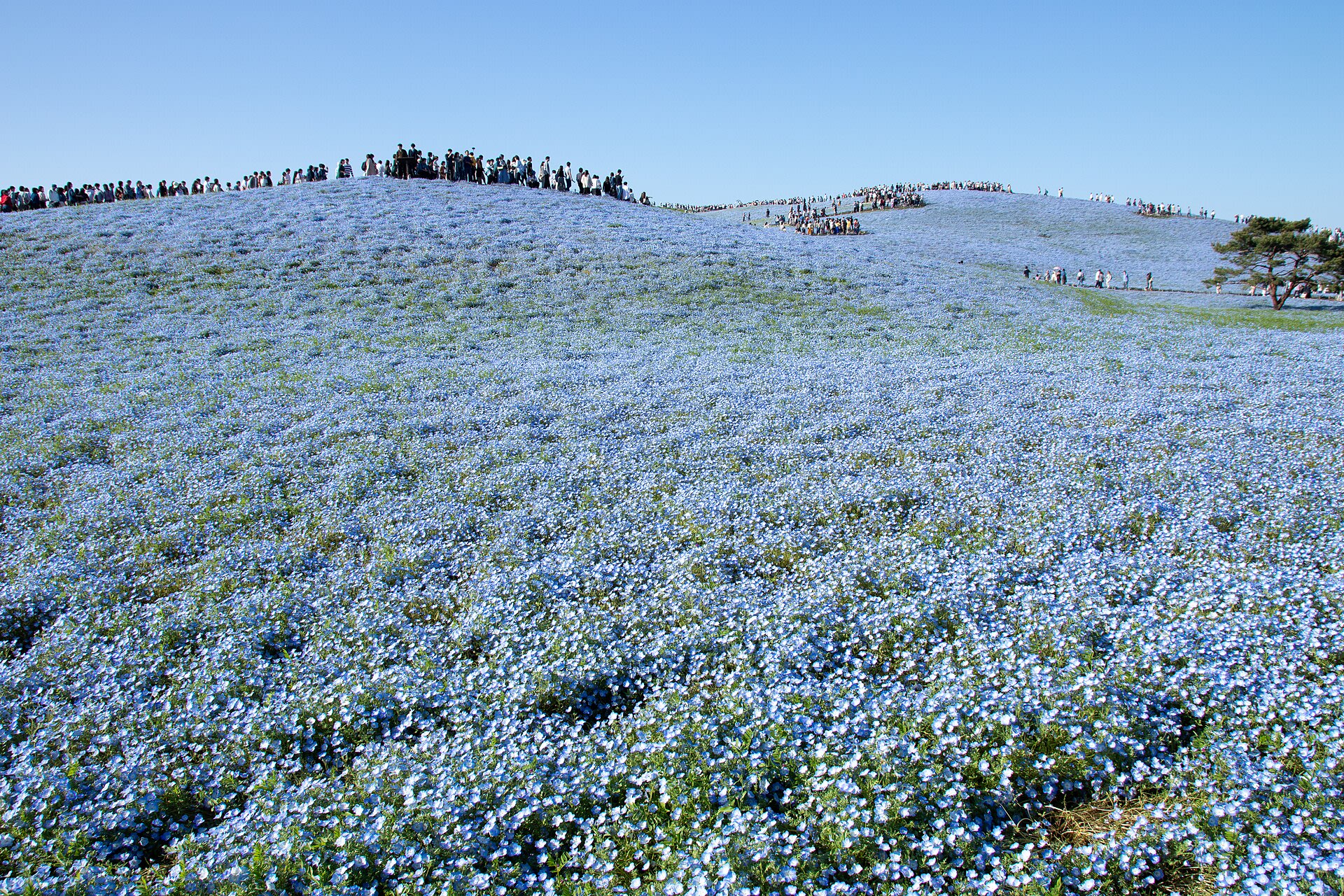
The hill doesn't just turn blue. It erases the horizon. Stand at the base of Miharashi Hill in late April and the 4.5 million nemophila flowers covering 3.5 hectares blur into the Pacific sky until you can't tell where earth ends and atmosphere begins. The 2026 season is tracking toward peak bloom between April 20 and May 5 , with traffic jams stretching for several kilometers during Golden Week .
The Science Behind Nemophila Menziesii
Nemophila menziesii, commonly called baby blue eyes, is an annual herb native to western North America . Each flower measures 1.5 inches across with bright blue petals, a light blue center stained white or yellow, and darker spots near the base . The plant belongs to the borage family (Boraginaceae), same lineage as forget-me-nots.
The stems are fleshy and grow 8 to 12 inches tall, with a spreading habit that thrives in cool climates where nighttime temperatures consistently drop below 65 degrees Fahrenheit . This temperature requirement explains why the bloom window is narrow and why the display fades as summer arrives. Seeds are sown every November, covered with frost-free sheets during winter, then carefully watered and weeded until blooms appear from mid-April to early May .
The blue pigment in nemophila petals is rare in the plant kingdom. Flowers display blue with a white center, usually marked with blue veins and black dots near the center , creating the distinctive pattern that gives the species its common name. Each bloom faces upward, maximizing visibility from above, which is why the hillside photographs so dramatically.
Nemophila was first planted at Hitachi Seaside Park because its natural color harmonizes with the blue sky and ocean . The park sits on former sand dunes along the Pacific coast in Hitachinaka City, Ibaraki Prefecture. What was once a military airfield is now one of Japan's most photographed seasonal spectacles.
When and Where to See the Nemophila Bloom
Peak bloom typically occurs during the last week of April or Golden Week, when many Japanese people are on holiday . Weather affects timing each year. In some seasons the bloom arrives up to two weeks early due to warmer winters.
The display covers Miharashi Hill (Miharashi no Oka), a 4.2-hectare hillside inside Hitachi Seaside Park. Enter through the West Entrance Tsubasa no Gate to reach Miharashi Hill most efficiently . The park covers 215 hectares total, so entering through the wrong gate means a long walk or train ride to the nemophila zone.
From Tokyo Station, take the JR Joban Line Limited Express "Hitachi" or "Tokiwa" to Katsuta Station (85 to 100 minutes), then the Ibaraki-Kotsu bus toward Kaihin-Koen (15 minutes) to reach the West Entrance stop . During nemophila season, additional shuttle buses run from Ajigaura Station on the Hitachinaka Seaside Railway.
Golden Week (late April through early May) brings severe congestion. Many navigation systems route drivers to Hitachinaka IC, but this creates traffic that can take 1 to 2 hours just to enter the parking lot . Exit instead at Hitachinaka Port IC on the Joban Expressway and head to the West Parking Lot via Prefectural Road 6, which avoids the main traffic completely .
During Golden Week, the park opens early at 7am with fewer people and better photo opportunities . Morning light between 7am and 10am makes the blue blooms shine most beautifully, and you can leave before traffic builds . Weekdays outside the Golden Week window offer similar views with a fraction of the crowds.
The bloom lasts roughly two weeks at peak density. Daffodils bloom from late March to mid-April, and tulips from mid- to late April, overlapping with the early nemophila . At the base of Miharashi Hill, yellow nanohana (rapeseed blossoms) create a color contrast with the blue hillside above.
Your Witnessing Guide
Arrive early or skip Golden Week entirely. Those are your two options for manageable crowds. The park opens at 9:30am during most of the season, but 7am during Golden Week. Be there when the gates open.
Bring a wide-angle lens if you're photographing. The hillside is vast and the horizon-blending effect requires capturing foreground flowers, mid-distance slope, and sky in a single frame. A 16-35mm lens works well. For midday shooting when light is harsh, try a polarizing filter to deepen the blue tones without oversaturating.
Camera settings: Start with ISO 100-200 in morning light, aperture f/8 to f/11 for depth of field across the hillside, and shutter speed around 1/250 to 1/500 depending on wind. Nemophila stems are thin and flowers move in even light breezes, so freeze motion unless you want intentional blur. Cloudy days work better than harsh noon sun, which washes out the delicate blue.
Wear comfortable walking shoes. The hill has paved paths, but you'll cover distance. A sun hat and sunscreen are essential since there's no shade on Miharashi Hill. Bring water. The park has cafes and food stalls, but lines get long during peak season.
The Seaside Train runs throughout the park (600 yen for a day pass, 700 yen during peak nemophila season). Bicycle rentals are available near the West Entrance. Both options make sense if you plan to explore beyond the nemophila hill to see tulips, daffodils, or the ocean-facing sand dune garden.
Stay on designated paths. With 4.5 million plants covering the hillside, trampling even a small section creates visible damage that takes weeks to recover. Park staff monitor the hill during peak season.
Wind and rain close some areas and damage petals. Check the park's official website before traveling for bloom status updates and weather-related closures. The park occasionally restricts access to Miharashi Hill when conditions threaten the flowers.
Why It Matters
Hitachi Seaside Park sits on land that was once a Japanese Imperial Army airfield, then a U.S. military installation after World War II. The city of Hitachinaka transformed the natural sand dunes into rolling hills and pathways starting 30 years ago . The city began planting nemophila in 2002, and within a few years the event became one of Ibaraki Prefecture's most recognized sights .
The park demonstrates how designed ecosystems can support both tourism and ecological function. Warm Pacific currents and cold winters clash here, creating conditions where northern and southern flora can both grow . The same hill that turns blue in spring becomes crimson in October when kochia (summer cypress) bushes transform.
Nemophila is not native to Japan. It evolved in California coastal grasslands and chaparral, where it blooms in meadows after winter rains. The species thrives in sandy, well-drained soil, which the Hitachinaka dunes provide naturally. By choosing a North American wildflower adapted to coastal conditions and cool springs, park designers created a sustainable display that requires minimal irrigation and fits the local climate.
The bloom is not threatened, but it is labor-intensive. Seeds must be sown each November, protected through winter, weeded, and watered until April. The display exists because park staff commit to this cycle annually. Miss a planting season and the hill stays bare the following spring.
Culturally, the nemophila bloom has become a seasonal marker in the Tokyo region, similar to cherry blossoms but less crowded and more photogenic for those seeking blue instead of pink. The phenomenon appears in social media feeds worldwide each April, often mistaken for a digitally altered image. It isn't. The blue is real, the scale is real, and the ephemeral nature is what drives people to make the two-hour trip from Tokyo before the petals fade.
This is the short version
This page shows a taste. The app has the full list of where to see this, the exact timing, and live conditions for 1,000+ natural phenomena worldwide, so you know the moment one is genuinely worth the trip.