As of today, in season now. Earth Exhibit tracks the live conditions and flags it the moment it is on.
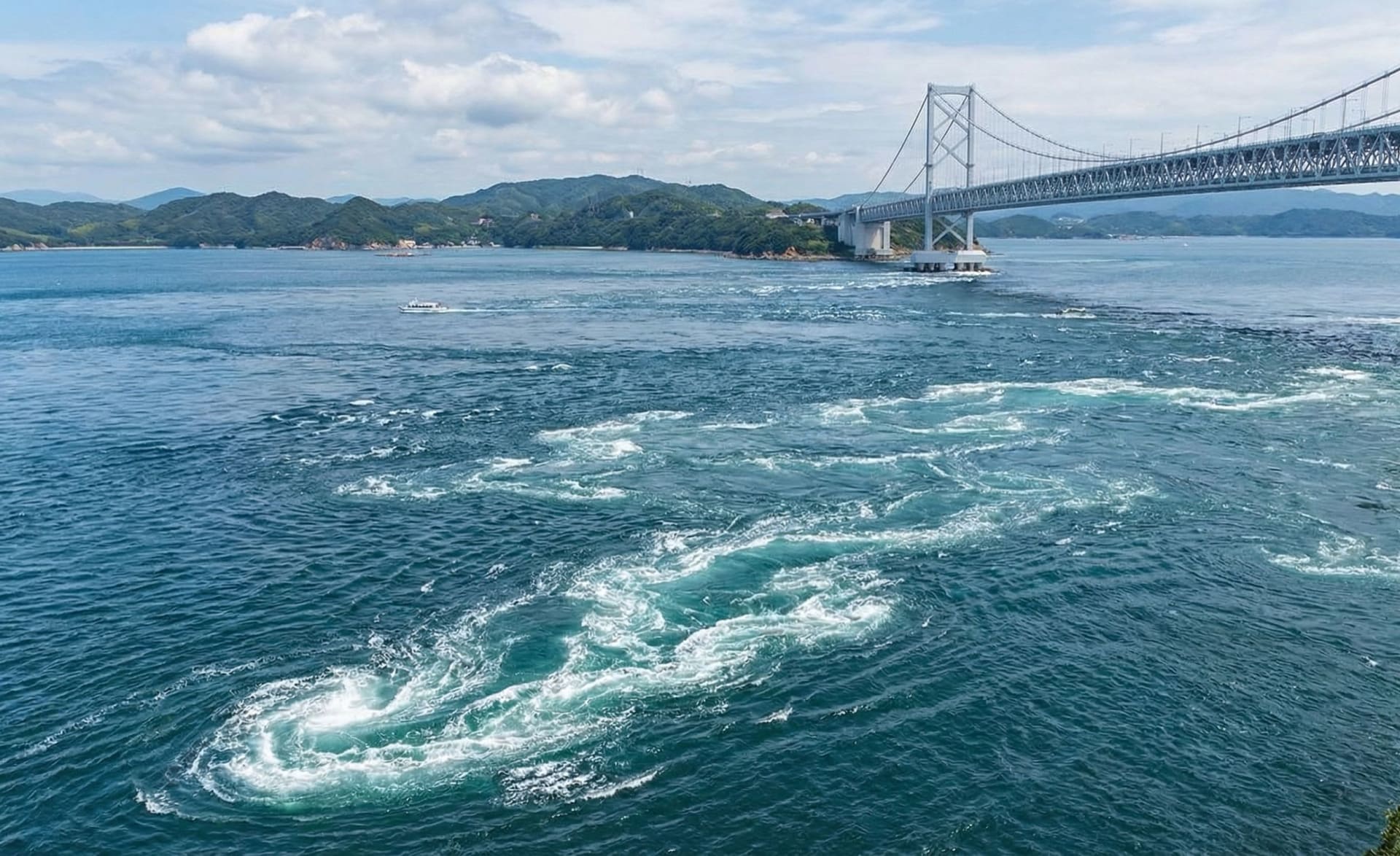
The sea shouldn't move like this. You're standing 45 meters above the Naruto Strait, staring through the glass floor panels of Uzu no Michi walkway, and the water below is spinning itself into spirals the size of city buses. During spring tides, vortices reach up to 20 meters in diameter , each one whirling with enough force to pull a boat sideways. The strait roars. Naruto City hosts the Spring Whirlpool Festival in 2026 , marking the start of prime viewing season when these massive tidal whirlpools hit their peak intensity.
The Physics Behind the Vortex Field
The Naruto whirlpools form in the Naruto Strait, a channel between Naruto in Tokushima and Awaji Island in Hyogo . The strait has a width of about 1.3 kilometers , a narrow bottleneck connecting two massive bodies of water with conflicting tidal schedules.
The strait is one of the connections between the Pacific Ocean and the Inland Sea, a body of water separating Honshu and Shikoku . Here's where it gets hydraulically violent: The tide creates a difference in the water level of up to 1.5 meters between the Inland Sea and the Pacific . When high tide floods the Kii Channel from the Pacific, it takes roughly six hours for that tidal surge to work its way through the Seto Inland Sea and reach the Naruto Strait from the opposite direction. By then, the Pacific side has already switched to low tide. You end up with 1.5 meters of elevation difference across a 1.3-kilometer-wide gap.
The water rushes through the Naruto channel at a speed of about 13 to 15 kilometers per hour four times a day, twice flowing in and twice flowing out . During spring tides, currents can reach speeds of over 20 kilometers per hour, the fastest in Japan . The strait also has deep underwater depressions reaching 140 meters on the Pacific side and 200 meters on the Seto side. When fast-moving surface water hits these submerged trenches, the speed differential between the center current and the slower edges generates rotational shear. Whirlpools spin up like liquid tornadoes.
Spring tides are unrelated to the spring season, occurring year-round during a new or full moon . Every two weeks, when the sun, Earth, and moon align, gravitational forces stack and tidal ranges amplify. That's when the Naruto Strait transforms into a vortex field.
When and Where to See the Naruto Whirlpools
The period between the end of March and end of April is said to be the best time to see the whirlpools . March and April bring frequent spring tides and calmer weather, ideal for boat tours and clear viewing from the bridge walkway. Whirlpools tend to be larger in summer than in winter and are largest during spring tides , so the phenomenon persists year-round but peaks twice monthly when the moon phase aligns.
Timing your visit requires checking the daily tide tables. The best viewing window is one and a half hours before and after the time of fastest current . High tide and low tide occur twice each per day , which means you get four daily opportunities to see whirlpools, though only two typically fall within daylight hours. Depending on weather, some days allow viewing even one hour before or after the stated time, while other days extend the window to two hours .
The Naruto Strait sits between Naruto City in Tokushima Prefecture on Shikoku's northeast coast and Awaji Island. From Tokushima Station, buses run to Naruto Park in about 20 minutes. From Osaka or Kobe, the drive takes 1.5 to 2 hours via the Kobe-Awaji-Naruto Expressway. If you're flying in, Tokushima Awaodori Airport connects to Naruto by bus in roughly 40 minutes.
Three viewing options exist. Uzu no Michi is an enclosed walkway that extends under the Onaruto Bridge and overlooks the whirlpools . The walkway's observation room sits 45 meters above the whirlpools below, with glass windows set in the floor . Admission costs 510 yen. The walkway is 450 meters long, runs through the lower deck of the bridge, and offers a top-down perspective that lets you track multiple vortices simultaneously.
Uzushio Kisen operates small boats with water-level decks from a pier just outside Naruto Park . Uzushio Kankosen operates the Aqua Eddy (medium boats with two decks and underwater windows) and Wonder Naruto (large boats with two decks) . Boat tours last 20 to 30 minutes and depart about twice per hour . The Wonder Naruto's upper deck provides the best vantage point. Tours cost around 1,800 to 2,800 yen depending on the vessel and deck.
The best land-based views are from the Senjojiki Observatory , which sits in Naruto Park and overlooks both the strait and the Onaruto Bridge. Eska Hill is accessible via a 68-meter-long paid escalator and offers a 360-degree panorama.
Your Witnessing Guide
Bring a telephoto lens if you're shooting from Uzu no Michi. The whirlpools sit 45 meters below you, so a 70-200mm or longer lens will pull tight shots of individual vortices. A wide-angle lens captures the full bridge walkway with the strait beyond. Use a polarizing filter to cut glare off the water surface and reveal the spiral structure beneath.
For boat tours, pack a jacket even in summer. The strait funnels wind, and spray from the whirlpools can soak the lower decks of smaller boats. Seasickness medication is wise if you're prone to motion sickness; the boats maneuver aggressively to position near active vortices, and the tidal currents produce constant chop. Life jackets are provided and required.
Camera settings for boat shooting: ISO 400 to 800 to maintain fast shutter speeds. Whirlpools move quickly, so aim for at least 1/500 second to freeze the water's motion. Continuous autofocus helps track the vortices as they drift and dissolve. Shoot in burst mode. Whirlpools collapse and reform unpredictably, and you'll miss the moment if you wait.
From the walkway, the glass floor panels create reflection issues. Press your lens hood against the glass or shoot at an angle to minimize glare. Tripods are allowed but impractical when other visitors are moving through the narrow corridor. Handheld stabilization or high ISO values compensate.
Tide table checking is non-negotiable. The official Uzushio Tourism Association website publishes daily schedules showing peak current times color-coded by whirlpool size: red for large, blue for medium, black for small. Arriving 90 minutes before the listed time lets you watch the strait transition from calm to chaos as the current accelerates.
Weather matters less than tide timing, but rain reduces visibility from the walkway and makes boat tours uncomfortable. Check the forecast, but don't cancel for clouds. The whirlpools form regardless of sky conditions.
Why the Naruto Whirlpools Matter
The top three fastest tidal currents are those in the Naruto Channel, Italy's Strait of Messina, and Canada's Seymour Narrows . The Naruto Strait holds the distinction of generating Japan's most powerful tidal flows, a hydraulic force that has shaped both the local ecosystem and regional culture for centuries.
The strait's name likely derives from the thunderous sound the whirlpools produce at peak intensity, with "naru" meaning roar and "to" referencing the Seto Inland Sea. This roaring water has inspired everything from the spiral pattern on narutomaki fish cakes to the surname of the manga character Naruto Uzumaki, whose name translates directly to "whirlpool."
The extreme currents create a unique marine environment. Nutrient-rich deep water surges to the surface four times daily, fertilizing phytoplankton blooms that support dense fish populations. Local fishermen time their trips around the tidal cycles, avoiding the strait during peak flow but exploiting the calmer windows when predatory fish gather to feed on disoriented baitfish swept through the channel.
The whirlpools also serve as a natural laboratory for studying vortex dynamics. The predictability of the tidal schedule allows researchers to model how rotating flows interact with complex seafloor topography, data that applies to everything from understanding ocean circulation patterns to designing more efficient ship propellers.
This is the short version
This page shows a taste. The app has the full list of where to see this, the exact timing, and live conditions for 1,000+ natural phenomena worldwide, so you know the moment one is genuinely worth the trip.