As of today, out of season, returns ~November. Earth Exhibit tracks the live conditions and flags it the moment it is on.
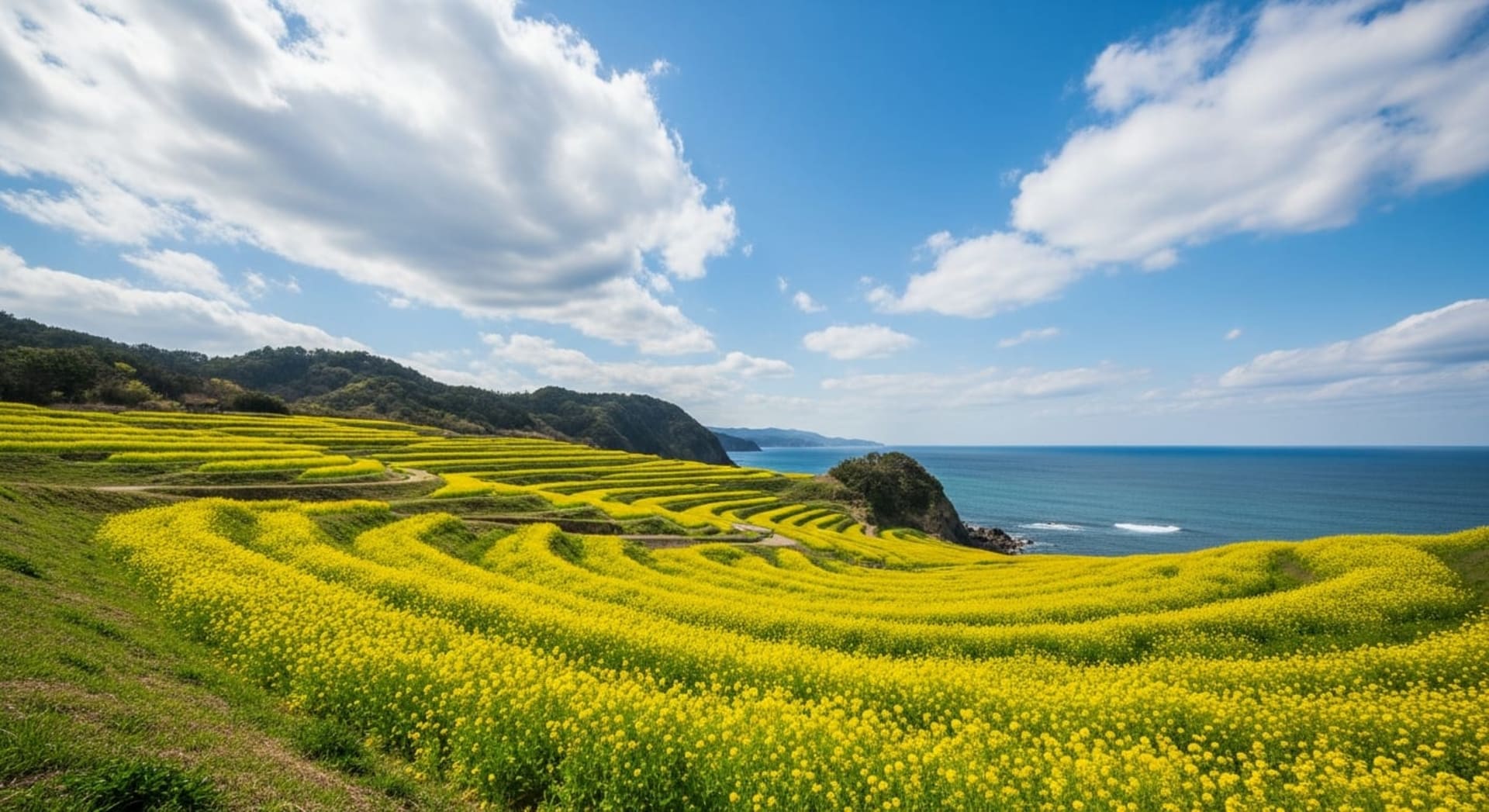
The coastal road curves, and suddenly the slope ahead looks like it has been dipped in yellow paint. Rapeseed blooms pour down terraced paddies at Shiroyone Senmaida, stopping just meters from where waves break on the Sea of Japan. The flowers, Brassica spp., form such continuous bands across the Noto Peninsula and Tojinbo cliffs that locals call the spectacle nami-no-hana, wave flowers, for the way the yellow crests roll over farmland and spill toward the shore. Peak bloom opens in late March and runs through April.
The Science Behind Nami-no-hana
Nanohana refers to the young stems, leaves, and unopened or slightly opened flower buds of the rapeseed plant (Brassica spp.), with bright green firm stems, broad serrated leaves, and green clustered buds that reveal yellow blooms as they mature. Each four-petaled flower produces copious pollen meant for bee and fly pollinators, and the plants grow to over one meter in height before being cut back if harvested as a vegetable green or left to mature for seed oil production.
Two main varieties dominate Japanese cultivation: Kizaki no Natane, grown primarily for rapeseed oil, and Haru no Kagayaki, typically used as a food source. Both bloom vigorously in early spring when cool-season growth peaks before summer heat sets in. The bright yellow pigment comes from carotenoids and flavonoids in the petals, evolved to attract pollinators across open agricultural fields.
In Noto and Tojinbo, the combination of well-drained coastal slopes, mild spring temperatures, and full-day sun exposure creates ideal rapeseed growing conditions. Fields and terraces bloom synchronously, producing the wave effect visible from roads and observation points miles away.
When and Where to See Nami-no-hana
March through April defines the core season. Flowering begins in late February in the southernmost pockets of the Noto Peninsula and progresses northward, peaking by early April in higher or more northern fields. Timing shifts slightly each year based on winter temperatures and March rainfall.
Tojinbo Cliffs (Fukui Prefecture): One kilometer of rugged basalt cliffs rising up to 30 meters above the Sea of Japan, carved by waves into deep chasms and precipitous bluffs. Rapeseed fields occupy coastal slopes and accessible flatland within walking distance of the main cliff viewing area. From Fukui Station, take the Echizen Railway Mikuni Awara Line to Mikuniminato Station (50 minutes, 820 yen), then a 10-minute bus or 30-minute walk. Parking lots line the approach. Morning light hits the fields before the cliffs fall into shadow around 2pm.
Shiroyone Senmaida Rice Terraces (Wajima, Noto Peninsula): 1,004 small rice paddies stretch down a steep slope to the Sea of Japan coastline. In spring, before rice planting begins in May, the terraces fill with water and shimmer like mirrors , and scattered rapeseed blooms along terrace edges and nearby fields add yellow accents. The terraces themselves are not planted with rapeseed, but adjacent agricultural plots and field borders bloom simultaneously, creating layered color. From Kanazawa Station, take the Wajima Express Bus (2.5 hours), then transfer to the Machino Line local bus to Shiroyone Senmaida stop. Driving from Kanazawa takes roughly 2 hours via Route 249.
Notojima Seaside Park and Coastal Fields (Noto Peninsula): Fields around Notojima Island and the eastern Noto coast bloom densely. Roads like Route 249 pass multiple viewing pullouts. Public access is easiest along designated farm roads; do not enter working fields.
Best viewing occurs mid-morning, when the sun is high enough to illuminate the entire slope without harsh shadows. Overcast days flatten the yellow into a pale wash. Clear mornings after rain produce the most saturated color.
Your Witnessing Guide
Camera setup: Shoot at f/8 to f/11 for depth across terraced slopes. ISO 100-400 in daylight. Shutter speed 1/250s or faster to freeze flowers moving in coastal wind. A polarizing filter deepens blue sky and makes the yellow appear more vivid by cutting haze. Telephoto lenses (70-200mm) compress distant fields into dense yellow bands; wide-angle lenses (16-35mm) capture the sweep from flowers to sea horizon.
Macro work: Bring a 90-105mm macro lens for individual flower detail. Rapeseed blooms measure 1.5-2cm across. Shoot at f/4-f/5.6 to isolate a single flower against blurred yellow behind it. Early morning dew adds texture.
Clothing and gear: Coastal winds average 10-15 km/h in March and April, and gusts off the Sea of Japan can reach 25 km/h. Windproof jacket required. Paths at Shiroyone Senmaida and Tojinbo can be muddy after rain; waterproof hiking boots with grip are non-negotiable. At Tojinbo, visitors are free to walk right up to the unmarked edges of the bluffs , so stable footing matters.
Bring water, snacks, and sun protection. Sunscreen, a wide-brimmed hat, and polarized sunglasses. The reflective glare off yellow fields and sea is intense by midday. A small picnic setup works well; roadside stations near Shiroyone Senmaida and Tojinbo sell local onigiri and nanohana-flavored treats.
Drones: Restricted near villages and cliff edges in Tojinbo and around Shiroyone Senmaida. Check local signage and avoid flying over private farmland without permission.
Why It Matters
Rapeseed is seen as a symbol of cheer, hard work, luck, and strength, with roots extending deep into the ground for a sturdy base, while flowers and leaves point skyward, representing hope for the future. In feng shui belief, the bright yellow blooms are thought to bring positive energy. Nanohana has symbolized spring in ancient texts, including haikus, poems, and songs, and was mentioned in the Manyoshu, one of the oldest collections of Japanese poetry, compiled in 759 CE.
Ecologically, rapeseed plays a working role. The plants are nitrogen-fixing and improve soil structure when tilled back as green manure. Blooms provide early-season nectar for honeybees emerging from winter. In some areas, rapeseed is intentionally cultivated for phytoremediation, as the plants absorb certain soil contaminants while keeping seeds uncontaminated.
Culturally, the pairing of yellow nanohana fields planted beneath early-blooming cherry trees has become one of Japan's most photogenic early-spring scenes , replicated in festivals from Izu to Noto. The contrast between pink blossoms overhead and yellow carpets below defines the visual rhythm of rural March across western Japan.
Fields in Noto face pressure from aging farmers and declining rural populations. The Shiroyone Senmaida Scenic Preservation Council, a public interest association, maintains the terraced fields through subsidies and cultivation support, and in 2011, Ishikawa Prefecture's 'Noto's Satoyama and Satoumi' was designated a Globally Important Agricultural Heritage System (GIAHS) by the FAO. This recognition helps fund maintenance and keeps traditional hand-cultivation practices alive. Visiting during bloom season supports the local economy that sustains these landscapes.
At Tojinbo, the cliffs themselves are a designated natural monument, and the surrounding agricultural slopes benefit from tourism infrastructure. The rapeseed blooms add seasonal pull that extends visitor seasons beyond the summer peak, distributing economic benefit more evenly across the calendar.
This is the short version
This page shows a taste. The app has the full list of where to see this, the exact timing, and live conditions for 1,000+ natural phenomena worldwide, so you know the moment one is genuinely worth the trip.