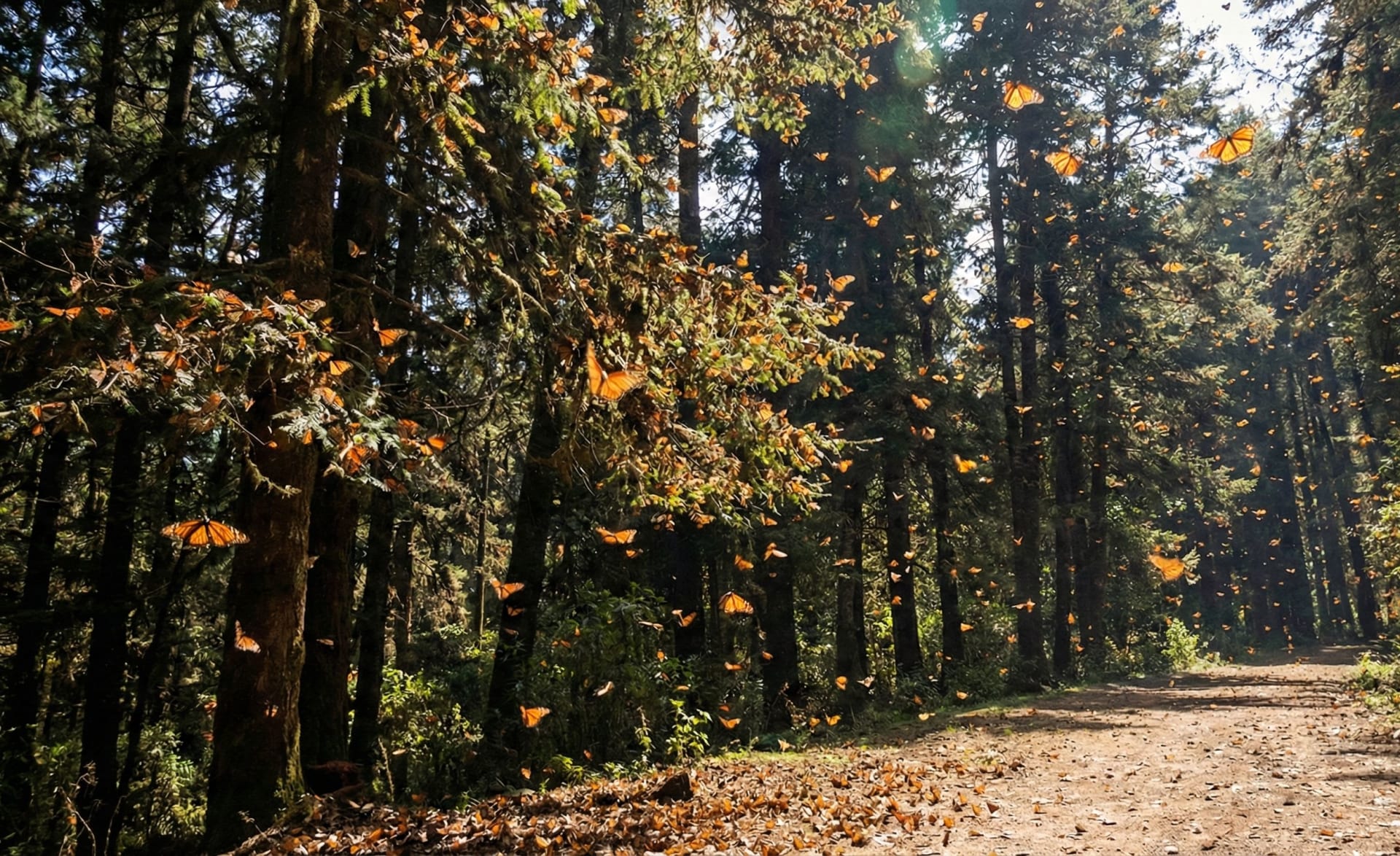
The first thing you notice is the sound. Not birdsong, not wind through the canopy, but a low, papery rustling, like ten thousand pages turning at once. You are standing at 3,000 meters in an oyamel fir forest in Michoacan, Mexico, and the trees above you are not the color they should be. Their branches sag under the weight of millions of monarch butterflies (*Danaus plexippus*), packed so densely that the bark has disappeared beneath a living quilt of orange and black. Then the sun breaks through the clouds, and the forest detonates. Clusters of monarchs peel off the branches in waves, filling the air so thickly that you lose the horizon. They land on your arms, your camera, your hat. The air smells faintly of milkweed and damp earth, and for a few stunned minutes, you forget that you have lungs and just stand there.

This is El Rosario, late January, and you are surrounded by roughly 60 million butterflies in a single colony. There are a dozen more colonies scattered across these mountains. The total count across all overwintering sites can reach 300 million individuals. Every single one of them flew here from somewhere in eastern North America, some from as far as southern Canada. They crossed deserts, highways, cities, and the Gulf Coast to reach this exact altitude, this exact species of tree, this exact temperature band. And the generation that made the flight will never return.

The Science of a 4,800-Kilometer Gamble

The monarch migration is the longest known insect migration on Earth. Individual butterflies travel up to 4,800 kilometers from breeding grounds across the eastern United States and southern Canada to a handful of forested peaks in the Transvolcanic Belt of central Mexico. The flight takes roughly two months, with monarchs covering 80 to 160 kilometers per day, riding thermals to conserve energy.

What makes this feat almost absurd is that no individual monarch has ever made this trip before. Summer generations of monarchs live only 2 to 5 weeks. They hatch, breed, and die, leapfrogging northward through multiple generations across the continent each spring and summer. But the final generation born in late August or September is different. Triggered by shortening daylight and cooler temperatures, these monarchs enter reproductive diapause. Their bodies shift resources from reproduction to fat storage and flight muscle. This so-called "super generation" lives 8 to 9 months, roughly four times longer than any of its parents or grandparents.

These super generation monarchs navigate south using a combination of a time-compensated sun compass (calibrated by circadian clocks in their antennae) and magnetic sensing tied to the Earth's geomagnetic field. Researchers at the University of Massachusetts have demonstrated that monarchs possess light-dependent magnetoreception, likely using cryptochrome proteins in their eyes. They are, in a real sense, reading the planet's magnetic signature while watching the sun's arc, and integrating both signals into a coherent heading that points them toward mountains they have never seen.

Their destination is brutally specific. Monarchs do not simply head to "Mexico." They converge on oyamel fir (*Abies religiosa*) forests between 2,400 and 3,600 meters elevation in a few dozen square kilometers of Michoacan and the State of Mexico. These forests provide a microclimate that is cold enough to induce torpor (a state of reduced metabolic activity that conserves the butterflies' fat reserves through winter) but not so cold that it kills them. The temperature sweet spot hovers between 4 and 12 degrees Celsius. If the forest freezes, as happened during a devastating storm in March 2002 that killed an estimated 75 percent of one colony (roughly 250 million butterflies), the results are catastrophic.

The trees themselves matter. Oyamel firs create a dense canopy that moderates temperature swings and holds humidity. When these forests are thinned by logging (legal or otherwise), the microclimate destabilizes. The butterflies have no backup habitat.

When and Where to Witness the Colonies

The overwintering season runs from November through March, with colonies at peak density from mid-December through late February. By early March, warming temperatures trigger mating behavior, and the monarchs begin dispersing north. Arrive too late and you will find empty branches and scattered wings on the forest floor.

The three most accessible sanctuaries are all within the Reserva de la Biosfera Mariposa Monarca (19.56N, 100.30W) in Michoacan:

El Rosario Butterfly Sanctuary (19.59N, 100.27W) is the largest and most visited colony. The hike from the parking area to the butterfly zone is roughly 1.5 kilometers uphill on a well-maintained trail, gaining about 200 meters of elevation. Guides are mandatory and included with the entry fee. The colony here regularly numbers tens of millions of individuals, and on warm sunny mornings, the air fills with monarchs in flight. This is the site that produces most of the photographs you have seen of this phenomenon.

Sierra Chincua Sanctuary (19.67N, 100.28W) is less crowded and involves a longer hike (roughly 3 kilometers one way) through dense forest. The colony is often more spread out, but the quieter atmosphere makes it a favorite among photographers who want to work without jostling for position. Horseback rides are available for the steeper sections.

Cerro Pelon Sanctuary, operated by the community of Macheros, is the most remote option and the one least affected by tourism infrastructure. The hike is the longest and steepest, but the payoff is a colony with almost no other visitors on weekday mornings.

The nearest major city is Angangueo, a small mining town that serves as the base for most visitors. From Mexico City, the drive is roughly 3.5 hours west. Arrive the night before. Gates open at 9:00 AM local time, and the best butterfly activity occurs between 10:00 AM and 1:00 PM, when sunlight warms the canopy enough to rouse the colonies.

Bring layers. At 3,000 meters, mornings start cold (5 to 8C) and warm to 15 to 20C by midday. Hiking boots with ankle support are essential on the uneven, sometimes muddy trails. A rain jacket, sun protection, water, and snacks should be in your pack. Carry cash for the entry fee (around 100 MXN as of 2025) and tips for local guides. If you are sensitive to altitude, take it slow on the ascent and consider acetazolamide.

How to Photograph 60 Million Butterflies

The challenge is not finding subjects. It is choosing what to shoot. With millions of butterflies in frame, the temptation is to try to capture everything, which produces images that look like orange noise. The best monarch photographs tell a story of scale through selective focus.

For butterflies in flight, you need a shutter speed of 1/250 second or faster. An aperture of f/5.6 to f/8 gives enough depth of field to resolve wing detail without turning the forest into a blurred mess. ISO 400 to 800 is typical under the filtered light of the canopy. Midday, when shafts of direct sunlight punch through gaps in the fir trees, creates dramatic backlit shots of monarchs in the air.

A telephoto zoom in the 100 to 400mm range is the workhorse lens here. It lets you isolate clusters of butterflies on branches without approaching too closely (the sanctuaries enforce strict distance rules, and you must stay on marked trails). For detail shots of individual monarchs, a 100mm macro lens reveals the intricate black veining and white spots that distinguish *Danaus plexippus* from its mimics. For the classic "forest dripping with butterflies" wide shot, anything from 16 to 35mm works, though you will need a steady hand or a small tripod in the dim understory.

Flash is prohibited and would be pointless anyway against the scale of the phenomenon. Bring a circular polarizer to cut glare off the wings and deepen the sky in canopy-gap shots. Shoot RAW. The orange of monarch wings shifts dramatically depending on exposure, and you will want the latitude in post-processing.

The single best piece of advice: wait for the eruption. When a cloud passes and then sunlight returns to a densely packed cluster, the warming butterflies launch simultaneously. These mass takeoff events last 20 to 60 seconds and are the iconic image of the migration. Position yourself downhill from a large cluster, meter for the bright sky behind the trees, and hold the shutter down.

Why This Phenomenon Is Running Out of Time

The monarch migration exists in a state of compounding fragility. The oyamel fir forests are shrinking. Illegal logging, though reduced since the biosphere reserve's expansion in 2000, has not stopped entirely. Climate projections suggest that by 2060, the temperature and humidity conditions monarchs require may shift above the existing tree line, effectively eliminating viable habitat.

On the breeding end, milkweed (*Asclepias*) loss across the U.S. Midwest has reduced the summer carrying capacity for monarch populations. The widespread adoption of glyphosate-resistant crops since the late 1990s eliminated milkweed from hundreds of millions of acres of agricultural land. The overwintering population in Mexico, measured by the area of forest canopy they occupy, declined from a high of 18.19 hectares in 1996-1997 to a low of 0.67 hectares in 2013-2014. Recent seasons have shown partial recovery, with 2.21 hectares recorded in the 2024-2025 season, but the long-term trend remains precarious.

Extreme weather events are becoming more frequent at the overwintering sites. A single late-season frost or ice storm can kill tens of millions of butterflies overnight. The colonies have no redundancy. There is no second species of tree, no alternate mountain range, no plan B written into the monarch genome. The migration persists because every link in a 4,800-kilometer chain, from milkweed fields in Iowa to oyamel groves in Michoacan, holds.

Stand in El Rosario on a January morning, with monarchs landing on your shoulders and the forest humming with the sound of a hundred million wings, and the math of conservation stops being abstract. The trees above you are a living archive, a record of a navigational feat that predates human civilization. Every butterfly on those branches is proof that the chain still holds. For now.

Track live conditions for this and 590+ phenomena on the Earth Exhibit app: https://earthexhibit.com

Track This Phenomenon Live

The Earth Exhibit app monitors real-time conditions for this and 590+ natural phenomena worldwide. Get alerts when conditions peak near you.