As of today, out of season, returns ~February. Earth Exhibit tracks the live conditions and flags it the moment it is on.
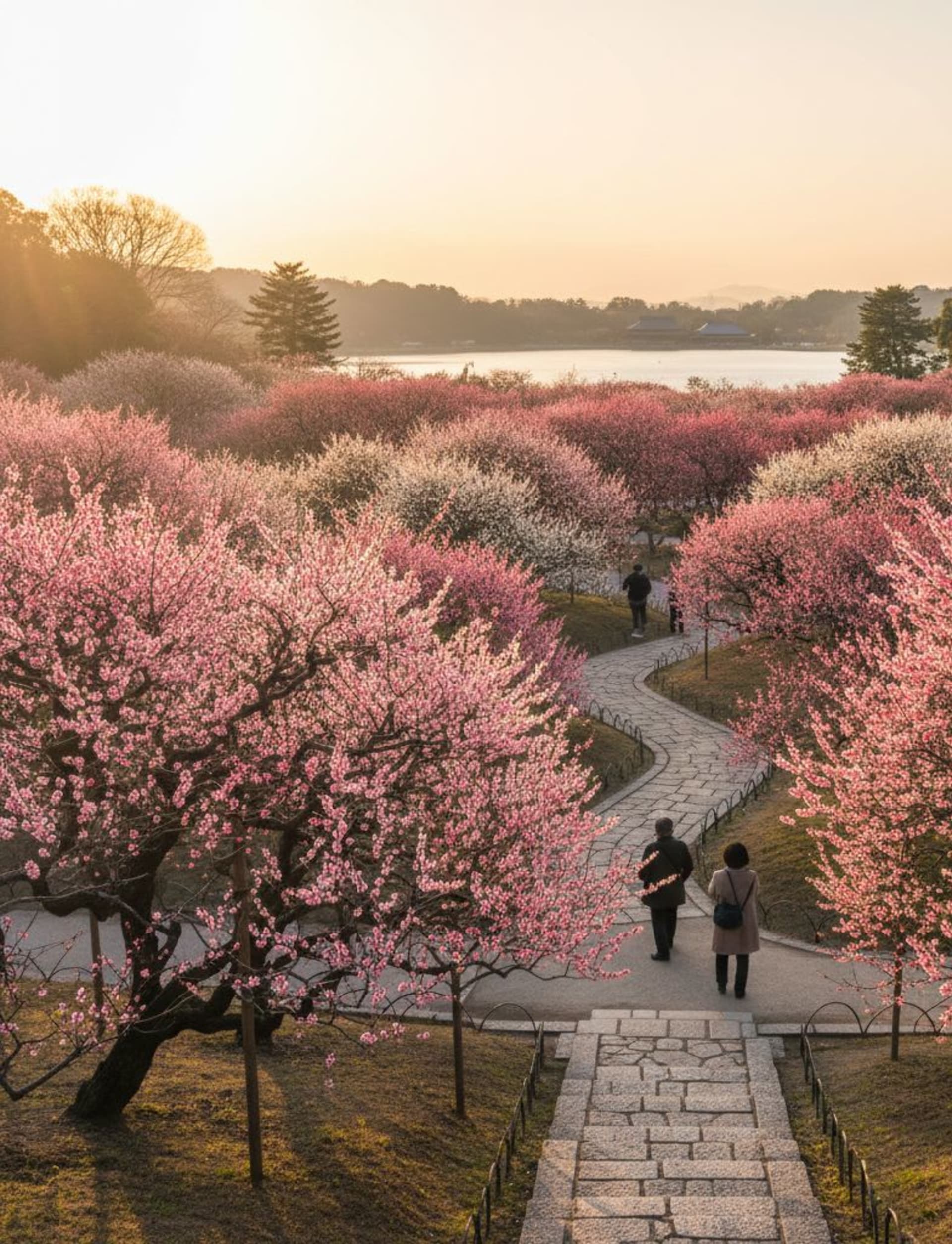
The first blooms appear when frost still clings to the ground. Walk through Kairakuen Garden in late February and you'll see clouds of white and pink petals against bare branches, the air sharp with cold and the faint honey-sweet scent of ume blossoms. Kairakuen holds 3,000 plum trees across more than 60 varieties , and they bloom in succession for six weeks, filling one of Japan's Three Great Gardens before the cherry blossom crowds arrive.
The Science Behind Prunus mume
Ume (Prunus mume), often translated as Japanese plum or apricot, flowers earlier than sakura because it evolved to tolerate colder temperatures. The trees break dormancy when cumulative temperatures reach certain thresholds in late winter. Early-blooming cultivars respond to chilling hours in mid-January and flower before mid-February, while mid- and late-season varieties follow sequentially into late March. White plum blossoms typically begin to bloom in late February, while red plum blossoms peak in early March , staggering the display across the garden's hundred cultivars.
Unlike cherry blossoms, which open in explosive synchrony and drop within a week, ume trees hold their flowers for two to three weeks per cultivar. The blossoms emerge directly on bare wood before leaves appear. Each flower has five petals radiating from a center packed with yellow stamens. The fragrance comes from benzyl acetate and other volatile compounds, stronger than sakura and detectable on cold mornings when the air is still.
Ume trees were domesticated in China over 3,000 years ago and reached Japan in the Nara period (710-794 CE). For centuries, ume outranked sakura in Japanese poetry and court culture. The trees produce fruit in June, which is harvested for umeboshi (pickled plums) and umeshu (plum liqueur), both Mito specialties.
When and Where to See Mito Kairakuen Plum Blossoms
The 130th Mito Plum Blossom Festival runs from February 11 to March 22, 2026 . Peak bloom varies by cultivar and winter temperatures, but mid-February to early March typically offers the densest display.
Kairakuen Garden sits on a hillside overlooking Senba Lake in Mito, Ibaraki Prefecture, about 100 kilometers northeast of Tokyo. The plum grove occupies the garden's southern "yang" section, which Tokugawa Nariaki, the 9th lord of the Mito Domain, designed in 1842 to contrast with the dark cedar and bamboo groves (the "yin" section) to the north. From the Kobuntei pavilion near the grove's center, you can see the full sweep of plum trees stepping down toward the lake.
The garden has multiple entrances. Enter through the East Gate (Higashimon) to walk uphill through the grove, or approach from Kobuntei's front gate (Omotemon) for a downhill stroll. Senba Pond Promenade along the south edge offers lake views framed by blossoms.
Kodokan, the former domain school established in 1841, holds about 800 plum trees in 60 varieties . It's a 10-minute walk north of Mito Station. The trees bloom against Edo-period architecture, and the site is less crowded than Kairakuen's main grove.
Arrive in the morning. The garden opens at 9:00 AM (6:00 AM for early risers during the festival), and soft morning light works best for photography. Weekdays are quieter. On weekends and holidays during the festival, JR Joban Line trains stop at temporary Kairakuen Station, which is directly adjacent to the garden , saving the 20-minute bus ride from Mito Station.
Your Witnessing Guide
Getting there: Take the JR Joban Line from Ueno Station to Mito Station (about 70 minutes by limited express, 2 hours by local train) . From Mito Station's north exit, catch a bus from stop 4 or 6 to Kairakuen (20 minutes). During festival weekends, Kairakuen Station eliminates the bus transfer.
Admission costs 320 yen for adults, 160 yen for children. Free before 9:00 AM and for Ibaraki Prefecture residents.
Wear layers. February mornings in Mito hover around 2-5?C, and wind off Senba Lake cuts through light jackets. Waterproof boots handle mud on unpaved paths after rain. The garden has steep sections; sturdy shoes with grip are necessary.
For photography, bring a macro lens to capture individual blossoms and stamens. A 50mm or 85mm prime lens isolates flowers against soft backgrounds. Shoot in the golden hour just after sunrise when low light warms white petals to cream and pink cultivars glow. Overcast days work well too, diffusing light evenly across the grove without harsh shadows. Settings around ISO 200-400, aperture f/2.8 to f/5.6, and shutter speed 1/250s or faster stop motion on windy days.
The festival includes evening illuminations, fireworks, and the Japan Umeshu Festival, where you can sample over 150 plum liqueur varieties . Light displays run from February 15 to March 9, 6:00 PM to 9:00 PM . Night photography requires a tripod; try long exposures (2-5 seconds at f/8, ISO 400) to capture lit trees with motion blur in the crowd.
Food stalls line the paths during the festival, selling plum-flavored sweets, hot amazake (sweet fermented rice drink), and local specialties. Sunday tea ceremonies are held outdoors by different schools of tea each week.
Why Mito's Plum Grove Matters
Tokugawa Nariaki established Kairakuen in 1842 as a garden open to commoners, feudal lords, and samurai alike , embodying the Confucian principle that rest and leisure balanced rigorous study. Mito Domain was the intellectual center of Mitogaku, a school of thought emphasizing loyalty to the emperor and national unity, and Kairakuen served as a public space where people from all classes could gather under the plum trees. This democratic ethos was radical for the Edo period and influenced later Meiji-era reforms.
The Mito Plum Blossom Festival began in 1896 when the Joban railway line between Mito and Ueno opened, and special trains carried Tokyo residents north for blossom viewing . The festival has run for 130 years, interrupted only by war and, briefly, pandemic restrictions. It draws over a million visitors annually, supporting Mito's economy and keeping traditional arts like tea ceremony, koto music, and noh theater visible to younger generations.
Ume trees anchor Mito's agricultural identity. The fruit harvest in June supplies umeboshi and umeshu producers across Japan. Varieties grown in Kairakuen are propagated for orchards throughout Ibaraki Prefecture, making the garden a living gene bank for cultivars that might otherwise disappear as commercial growers narrow to a few high-yield strains.
Climate change is shifting bloom timing. Over the past two decades, peak bloom has crept earlier by about five days. Warmer winters reduce the chilling hours some cultivars require, potentially disrupting the succession of blooms that extends the festival. Gardeners are testing cold-tolerant cultivars and adjusting planting plans as temperature patterns evolve.
This is the short version
This page shows a taste. The app has the full list of where to see this, the exact timing, and live conditions for 1,000+ natural phenomena worldwide, so you know the moment one is genuinely worth the trip.