As of Jun 17, 2026, 4:21 PM, in season, building toward peak (~June 25). Earth Exhibit tracks the live conditions and flags it the moment it is on.
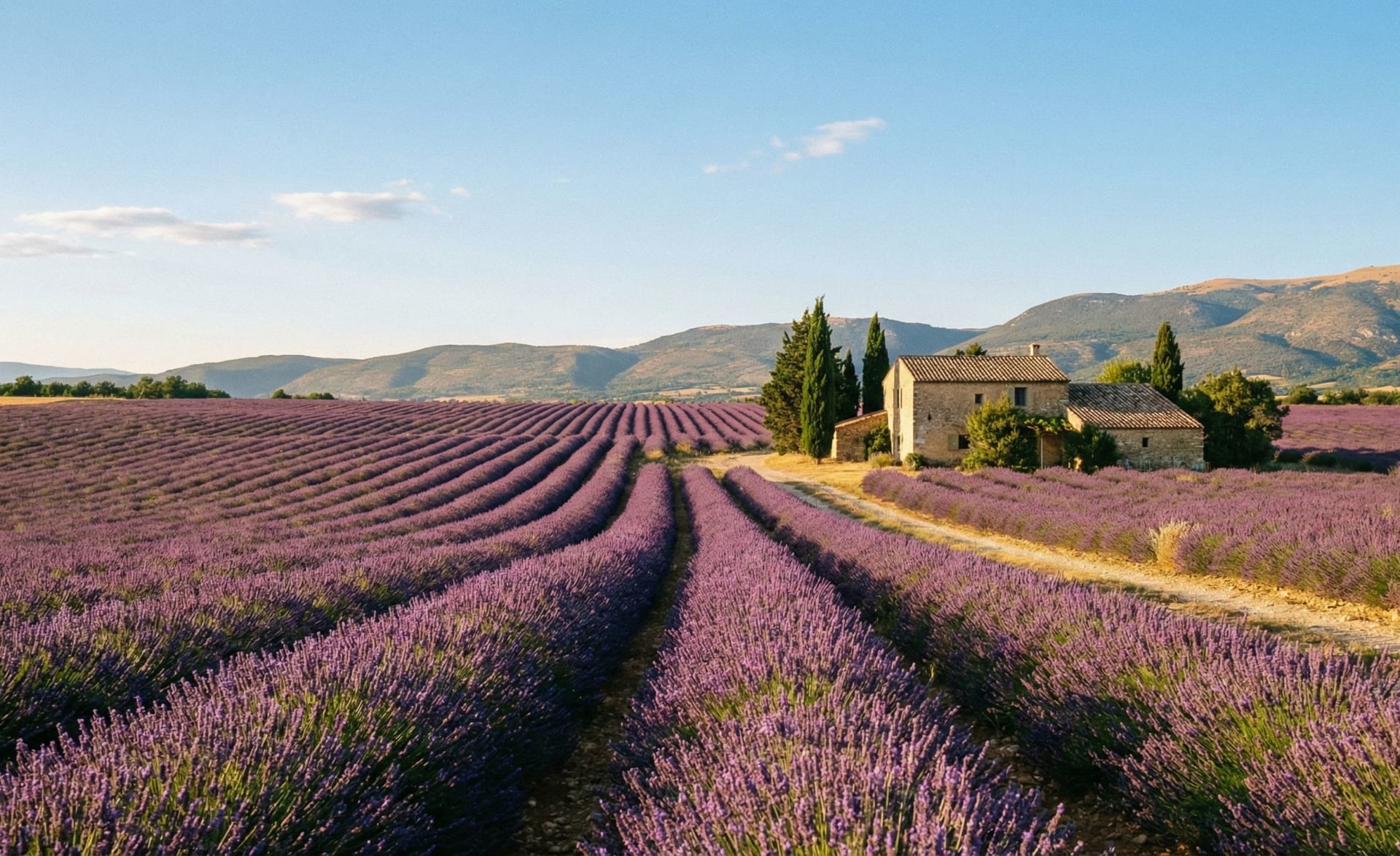
The smell hits you before the color does. You step out of the car on the D6 road crossing the Plateau de Valensole and the air is thick with it, a resinous sweetness that sits somewhere between camphor and warm honey. Then you look up, and the landscape corrects everything you thought you knew about scale. Rows of violet stretch to the horizon in every direction, converging at a vanishing point you cannot reach. The hum of several million bees fills the silence between gusts of wind. This is not a garden. This is an agricultural phenomenon operating at a territorial scale, and it has roughly three weeks left before the harvesters erase it.
The Chemistry of Purple
Two species dominate these fields, and knowing the difference will change what you look for. Lavandula angustifolia, true lavender, grows at elevations between 600 and 1,500 meters around the town of Sault. Its flower spikes are compact, its oil the finest in the world, and its color a deep, saturated blue-violet. Below 600 meters, on the broad clay-limestone plateau of Valensole, you will find Lavandula x intermedia, commonly called lavandin. This is a sterile hybrid of L. angustifolia and its cousin L. latifolia, and it is a workhorse. A single lavandin plant produces roughly ten times more essential oil than true lavender, though perfumers consider the oil less refined.
The purple you see comes from anthocyanin pigments concentrated in the petals. These same pigments color blueberries, red cabbage, and autumn maple leaves, though in lavender they express in a narrow band of blue-violet that shifts slightly depending on soil pH and sun exposure. The essential oils, which give lavender its scent, are a separate system entirely. Linalool and linalyl acetate, the two dominant compounds, are manufactured in tiny glandular hairs called trichomes on the surface of each flower. Rub a bloom between your fingers and you are crushing those trichomes, releasing volatile compounds the plant evolved to repel herbivorous insects and shield tissue from ultraviolet radiation. The irony is that this chemical defense is exactly what makes lavender valuable to humans.
Systematic cultivation in Provence began in the 1920s and 1930s, but wild lavender has been harvested across these limestone hills for centuries before that. The industry reached its peak acreage in the latter half of the twentieth century. Since the 1990s, a bacterial disease called stolbur phytoplasma (Candidatus Phytoplasma solani), spread by the planthopper Hyalesthes obsoletus, has devastated fields across the region. Combined with shifting rainfall patterns and hotter summers, lavender acreage in Provence has declined by roughly 50% since then. What you are seeing when you visit is not a static postcard. It is a crop under pressure.
When and Where to Stand
The bloom window is narrow and unforgiving. Core bloom runs from mid-June to mid-July, with some variation by elevation and cultivar. Lower-altitude lavandin on the Valensole plateau tends to peak in the last week of June. Higher-altitude true lavender around Sault blooms slightly later, often peaking in the first two weeks of July. By late July, the harvesters move in. Once cutting begins, a field can go from full bloom to stubble in a single afternoon.
Three locations anchor any visit.
Plateau de Valensole (43.800N, 6.050E) is the largest lavender-growing area in France, covering approximately 800 square kilometers of high plateau between the Verdon gorge and the Durance valley. The fields here are vast, flat, and uninterrupted. This is where you feel the scale. Roads cut through the plateau in long straight lines, and you can pull over almost anywhere to walk into the rows. Be aware that these are working farms. Stay on the edges unless you have permission.
Abbaye Notre-Dame de Senanque (43.928N, 5.187E) is a twelfth-century Cistercian abbey set in a narrow valley north of Gordes. The lavender rows planted in front of its stone facade create what is arguably the most photographed lavender scene in the world. The composition is perfect, the light pools into the valley in predictable ways, and the contrast of grey stone against purple bloom is why this image circulates endlessly. Arrive before 7:00 AM or expect crowds. The parking area fills quickly by mid-morning in peak season.
Sault Plateau (44.093N, 5.408E) sits at higher elevation and offers a different character entirely. The lavender here is true L. angustifolia, the fields are smaller and more fragmented, and the surrounding landscape of oak forest and limestone ridge gives each patch a wilder, less manicured quality. Sault holds its annual lavender festival in mid-August, though by then most fields have already been cut. The town itself is a working agricultural community, not a tourist stage set, and that honesty is part of its appeal.
Witnessing and Photographing the Bloom
Golden hour is non-negotiable. The quality of light in early morning and late evening does things to purple that midday sun cannot. Under direct overhead light, lavender fields look flat and monochrome. Under raking side-light, every row casts a shadow, the color deepens unevenly, and the fields gain a three-dimensional texture that photographs as something close to what your eyes actually perceive.
Use the lavender rows as leading lines. Position yourself at the end of a row and drop to a low angle so the plants fill your foreground and the rows converge toward a distant point. A wide-angle lens exaggerates this perspective and communicates scale. Switch to a telephoto at 100mm or longer to compress rows into abstract bands of color. A polarizing filter is essential here. It deepens the blue sky, increases contrast against the purple, and cuts the haze that often hangs over the plateau in summer heat.
Bring a tripod for the low-angle work. Bring sun protection, because the plateau has no shade and the reflected heat off limestone soil is fierce. Bring water. Bring insect repellent, because the bees working these fields are not aggressive but they are everywhere, and you will be standing still in their workspace. Comfortable walking shoes matter more than you expect. The soil between rows is uneven, baked hard, and full of small stones.
One detail worth chasing: include bees in your frame. A sharp bee on a lavender spike, caught mid-work with pollen baskets loaded, connects the visual beauty to the ecological function. Lavender honey is a significant regional product, and the relationship between the fields and their pollinators is part of the story. A photograph without bees is a landscape. A photograph with bees is an ecosystem.
Here is the friction: the smell cannot be photographed. Fragrance is half the experience, and it will not survive the transfer to screen. The volatile oils saturate the air most intensely in mid-morning as temperatures rise, and again in late afternoon as they fall. Stand in a field at 10:00 AM with your eyes closed and you will understand something about this place that no image can carry.
The Bigger Picture
Lavender fields are not wilderness. They are agriculture, shaped by economics, disease, climate, and human decisions about what is worth growing. The 50% decline in acreage is not an abstraction. Drive through Provence and you will see abandoned fields, rows gone woody and sparse, land converted to wheat or solar panels. The stolbur phytoplasma continues to spread. Resistant cultivars are being developed, but adoption is slow and expensive.
What makes this phenomenon worth tracking is precisely that tension. The bloom is spectacular and annual, but it is not guaranteed at this scale indefinitely. Each June, the question is not only where the lavender is blooming but how much of it remains. The fields you photograph this year may not be the same fields that exist in five years.
There is also a quieter ecological layer. The lavender bloom supports pollinator populations across the region, feeding honeybees, wild bumblebees, and dozens of solitary bee species during a period when many other flowering plants have already set seed. The fields function as a seasonal refueling station for insects that go on to pollinate other crops and wild plants. When a lavender field disappears, the gap in the pollinator calendar is felt beyond its borders.
Visiting during peak bloom means witnessing a system in motion: the chemistry of anthocyanins producing color, the trichomes releasing scent, the bees converting nectar to honey, the farmers calculating when to harvest for maximum oil yield. It is all happening simultaneously across 800 square kilometers of plateau, and it will all end in the same two-week window when the cutting machines roll through.
Stand at the edge of a Valensole field at golden hour and let the scale of it settle over you. Count the rows. Lose count. That is the point.
This is the short version
This page shows a taste. The app has the full list of where to see this, the exact timing, and live conditions for 1,000+ natural phenomena worldwide, so you know the moment one is genuinely worth the trip.