As of today, out of season, returns ~September. Earth Exhibit tracks the live conditions and flags it the moment it is on.
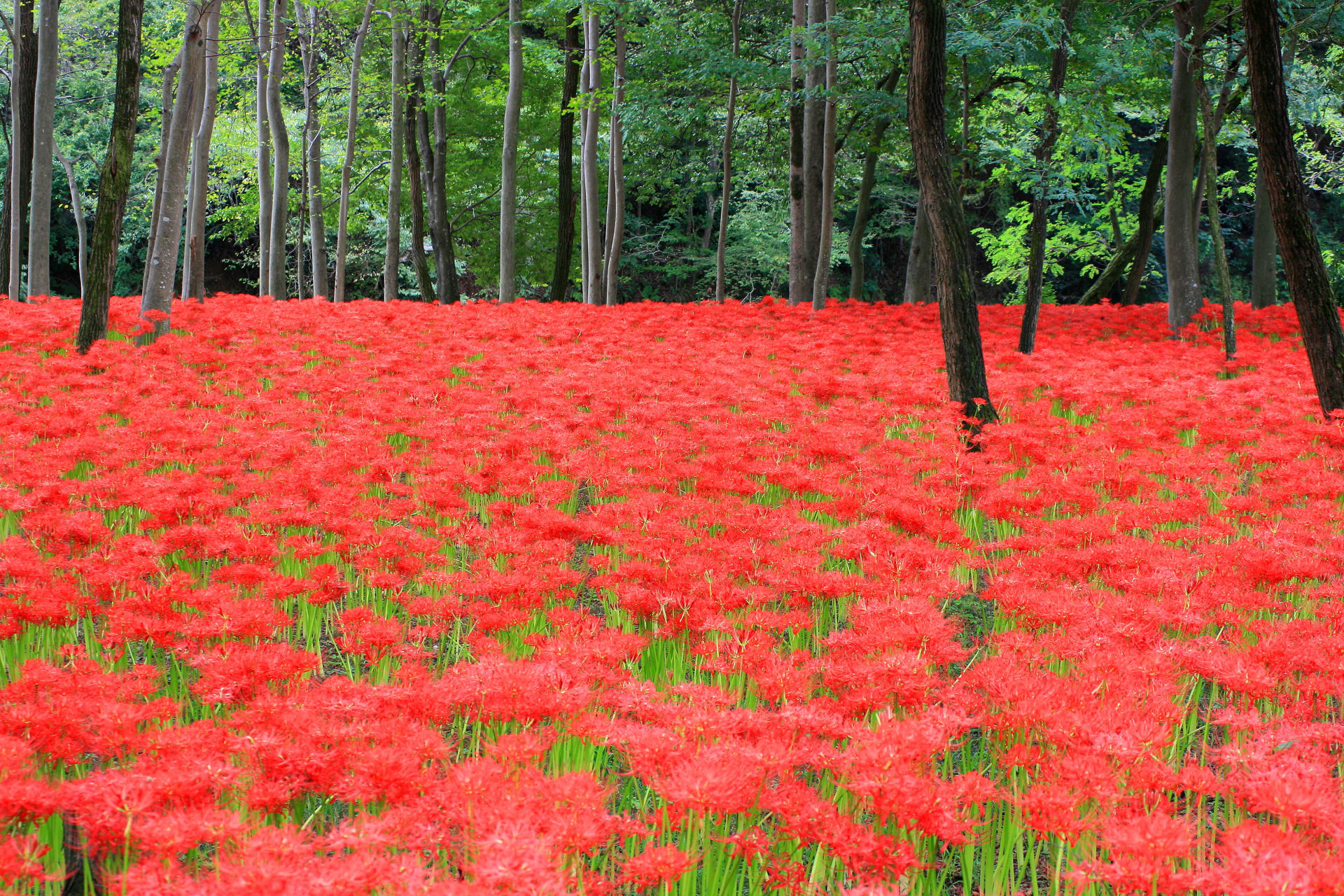
The forest floor doesn't fade into crimson. It erupts. One week the understory along the Koma River is green and unremarkable. Ten days later, five million red spider lilies punch through the soil, flower first, no leaves, just stem and flame-red petals bent backward like spider legs reaching for the canopy. The Japanese call them manjushage here at Kinchakuda, and when they bloom in late September, the riverside forest turns into the largest red spider lily colony in Japan.
The Science Behind Lycoris Radiata
Red spider lilies, scientific name Lycoris radiata, bloom from mid-September to early October. The timing is no accident. They typically start to bloom around the Autumn equinox , triggered when soil temperatures drop and the first heavy rains arrive after summer's heat breaks.
The plant's life cycle runs backward from most flowering species. Blooms emerge on naked scapes, leafless stalks that rise 30 to 70 centimeters from underground bulbs. Only after the flowers wilt do the strap-like leaves appear, persisting through winter and spring before dying back in summer. This reverse phenology is why another Japanese name, higanbana, references the autumn equinox, higan, when the flowers reliably appear.
Bulbs of all Lycoris species contain the alkaloid poison, lycorine, which causes vomiting, diarrhea, convulsions, and sometimes death in humans and other animals.
The lilies are purposefully planted near rice fields in order to deter mice and other animals from invading the rice paddies; the poisonous bulbs are thought to keep the unwanted critters away. This toxicity made them useful boundary markers and pest deterrents throughout rural Japan, which is why you see them lining roadsides and field edges even today.
The flowers themselves are architectural. Six petals curl backward in tight spirals. Long stamens extend outward like insect antennae, giving the bloom its spider-like silhouette. Each flower lasts only days, but the bulbs produce multiple blooms in sequence, extending the display across two weeks when conditions cooperate.
When and Where to See Kinchakuda's Spider Lilies
The festival runs from mid-September through early October, but exact dates shift year to year based on weather. Due to this year's intense heat, blooming is expected to be delayed. In recent years peak bloom has slid later, sometimes not arriving until the final days of September or the first week of October.
The equinox flower field is divided into 2 parts, allowing a progressive blooming. Thus, one side of the park is the 1rst to bloom, then the 2nd part follows a few days later, depending on the weather conditions. This staggered planting extends the window when at least part of the display is at peak. Check the official Kinchakuda website for real-time bloom updates before committing to a travel date.
The park sits in Hidaka City, Saitama Prefecture, an hour north of Tokyo. 15 minute walk from Seibu Ikebukuro Line's Koma Station. From Ikebukuro Station, take an express train on the Seibu Ikebukuro Line toward Hanno. Transfer at Hanno to the local line and ride two stops to Koma Station. Total travel time is about 75 minutes one way.
Exit Koma Station and follow the crowd. During festival weeks you won't need a map. The walking path to the park follows the Koma River through farmland and small villages. The route is flat and paved.
The entry fee is 500 yen. That is the charge for adults, there is no charge for children under 16 years old. The park opens at 7am, though the official festival hours run 9am to 4:30pm. Arriving at opening beats the tour buses by three hours.
Your Witnessing Guide
Go on a weekday. Due to its overwhelming popularity, the park becomes heavily crowded during peak season, making it less enjoyable for those seeking a peaceful experience.
The parking lot is always extremely busy during the prime viewing period, even on a weekday. It is not uncommon to have to wait to get into the car park and to queue to get back out! Weekend crowds can number in the tens of thousands. Weekday mornings offer the only chance at relative solitude.
Early mornings are best for photography and avoiding crowds. The forest canopy filters direct sunlight until around 10am, creating soft, even lighting on the forest floor. Shadows are minimal. Colors saturate without blowing out highlights. By noon the light turns harsh and contrast becomes unmanageable.
Bring a wide-angle lens to capture the carpet effect, where millions of blooms create a continuous red plane beneath the green canopy. A macro lens lets you isolate individual flowers against blurred backgrounds. Tripods are prohibited during festival hours to prevent trail congestion, so shoot handheld or brace against trees. ISO 400 to 800 handles the low forest light without excessive noise. Aperture around f/5.6 keeps flowers sharp while softening distant trees.
The terrain is flat but you'll walk 2 to 3 kilometers on packed dirt trails that turn muddy after rain. Wear closed-toe shoes with grip. September can still hit 28 degrees Celsius with high humidity. Carry water. The park has minimal shade outside the lily zones.
They have festival stalls, throughout the festival period, in the open courtyard in the middle of the spider lilies. There are usually about 20 stalls. Expect lines. Cash only. Bring small bills.
The bulbs are toxic. Do not touch them. Do not let children or dogs near them. The bulbs of the red spider lily are poisonous; for safety, please admire the flowers without touching them. Stay on marked paths. The flowers are delicate and the soil compacts easily under foot traffic.
Why It Matters
While the festival is a popular celebration, the red spider lily holds a complex place in Japanese culture, where it is traditionally associated with death, the afterlife, and final goodbyes. The timing of the bloom, coinciding with the autumn equinox when families visit ancestor graves, reinforces this connection. The flowers appear on temple grounds and cemetery edges throughout Japan.
But at Kinchakuda the association feels less somber. The sheer density of the display, five million flowers packed into 22 hectares of riverside forest, creates something closer to spectacle than memorial. The color is too saturated, too aggressive, too alive to read as funerary.
The site's name, Kinchakuda, means "pouch field" for the horseshoe bend in the Koma River that creates a near-island of land. In the 700s refugees from the Korean kingdom of Goguryeo settled in the peninsula. The fertile, flat land on the banks of the Koma River was perfect for growing rice. These crops have gradually been abandoned in modern times, but spider lilies began to emerge in the 1960s. Former rice terraces, no longer economically viable, were left fallow. The lilies spread.
The flowers are treasured by local people, and a park was opened for the benefit of the general public. What was agricultural abandonment became ecological opportunity. The triploid form of Lycoris radiata in Japan is sterile and spreads only through bulb division, so the colony expanded slowly over decades. Local residents divided and transplanted bulbs to speed the process.
Today the display draws 300,000 visitors during the three-week bloom window. That volume of foot traffic stresses the ecosystem. Park management rotates access to different zones year to year, allowing trampled areas to recover. Some sections are permanently closed to visitors to preserve bulb health.
The phenomenon is ephemeral by design. Each flower lasts three to five days. The entire colony peaks for less than two weeks. Miss the window and you see dirt. The brevity is what makes it worth the crowds.
This is the short version
This page shows a taste. The app has the full list of where to see this, the exact timing, and live conditions for 1,000+ natural phenomena worldwide, so you know the moment one is genuinely worth the trip.