As of today, out of season, returns ~February. Earth Exhibit tracks the live conditions and flags it the moment it is on.
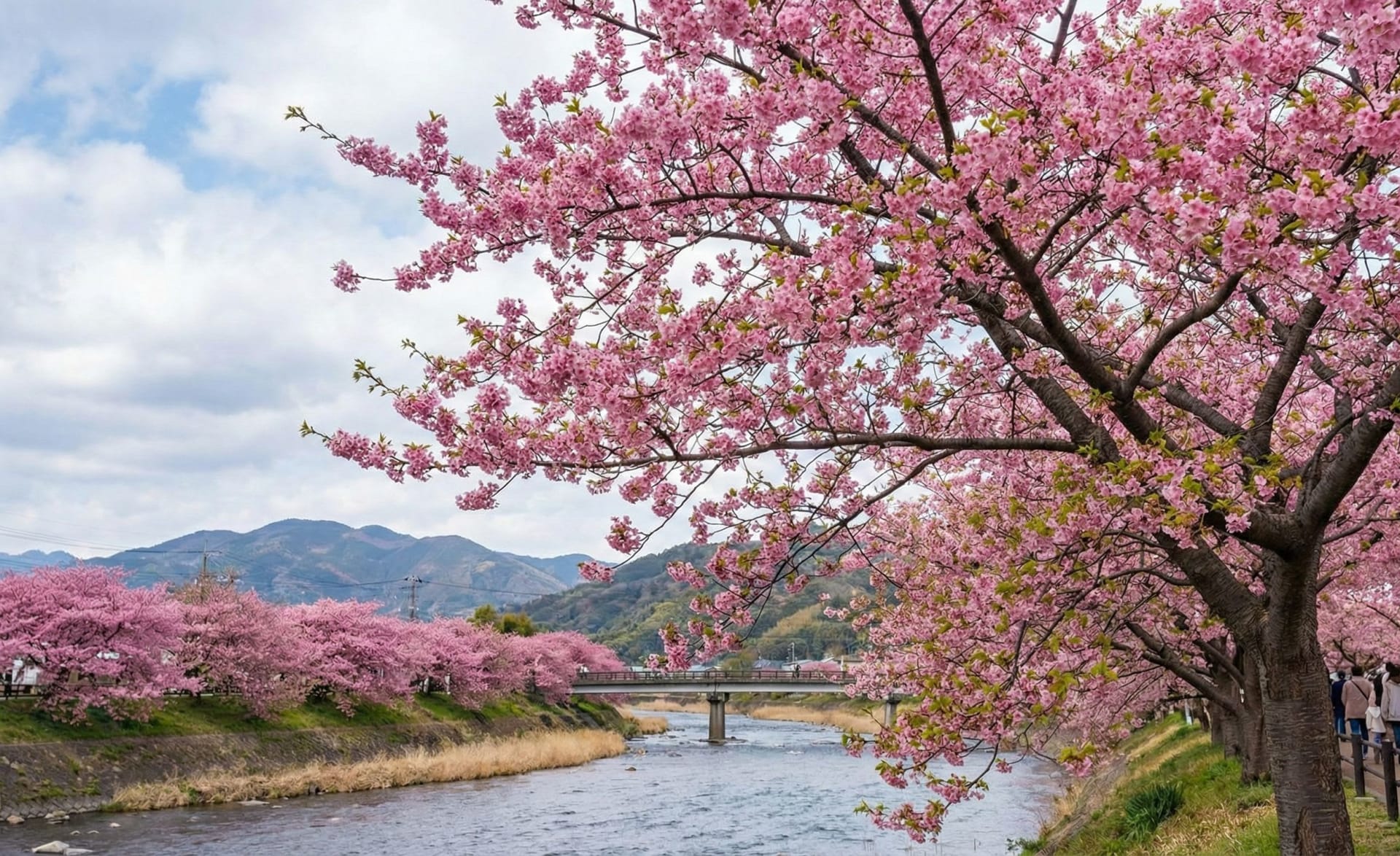
The Kawazu River is quiet at dawn in mid-February. No wind, no birdsong, just the sound of water moving over stone. Then the sun clears the ridge and the entire riverbank ignites. Eight hundred Kawazu zakura trees light up in saturated magenta, their reflections doubling the spectacle in the water below. This is Honshu's first cherry bloom, arriving a full month before Tokyo's famous Somei-yoshino varieties open, and it peaks right now.
The Science Behind Kawazu Zakura
Kawazu zakura was discovered by chance in the 1950s along the Kawazu River, later becoming the town's symbol as trees were systematically planted across the area . The cultivar is a natural cross between the early-blooming Oshima cherry and the Himawari cherry , producing flowers that are larger and more deeply pigmented than standard cherry blossoms.
The Pacific Ocean's warm Kuroshio Current moderates winter temperatures on the Izu Peninsula, creating ideal conditions for early bloom . While most cherry cultivars require sustained cold dormancy followed by rapid spring warmth, Kawazu zakura begins its flowering cycle in late January, capitalizing on the peninsula's mild coastal microclimate.
Unlike typical cherry varieties, Kawazu zakura opens at a slow pace, giving the trees a viewing window of about one month rather than the standard seven to ten days . Each flower stays viable for three to four weeks, meaning visitors have flexibility in timing that standard cherry viewing does not permit.
When and Where to See Kawazu Zakura
The 2026 Kawazu Cherry Blossom Festival runs February 7 through March 8 . The original Kawazu zakura tree (planted in the 1950s) reached full bloom by February 11, 2026, while key festival locations including Sasahara Park, Toyoizumi Bridge, and the riverside rows peaked between February 16 and 21 .
The main viewing corridor stretches approximately four kilometers along the Kawazu River from Hamabashi Bridge upstream, lined with nearly 800 trees . Two sections stand out: the stretch from Kinomiya Bridge to Oarikon 1 Hida Bridge, and the area from Hamabashi Bridge to Tatebashi Bridge. These zones concentrate the densest plantings and the festival's food stalls.
The database lists three primary locations: Kawazu River Promenade (the main festival stretch), Kawazu Station Street and Sakura Dori (immediately accessible from the train station), and Nanadaru (Seven Waterfalls) viewing area in the northern mountains. Trees near the Seven Waterfalls bloom later than riverside plantings due to higher elevation , making them a backup if you arrive in late February.
From Tokyo, take the JR Tokaido Shinkansen to Atami (40 minutes from Tokyo Station), then transfer to the Izu Kyuko Line to Kawazu Station (total time around two hours). The Odoriko Limited Express runs directly from Tokyo Station to Kawazu , eliminating the transfer but adding 30 minutes to the journey. By car, the drive takes 2.5 hours.
Morning light is non-negotiable for photography. The trees line the east bank of the river, meaning morning sun hits them directly while backlighting the water. By 10am on festival weekends, footpaths become congested. Arrive by 7am or wait until after 4pm.
Your Witnessing Guide
Yellow rapeseed flowers bloom beneath the cherry trees along the riverbank, creating a pink-and-yellow layering effect unique to this location . A macro lens (100mm or longer) captures individual flower details against contrasting backgrounds. Standard cherry blossoms are pale pink to white; Kawazu zakura's deep magenta demands different exposure compensation. Meter for the flowers directly and underexpose by one-third stop to preserve color saturation.
Evening illuminations run from 6pm to 9pm during the festival, lighting select riverbank sections and reflecting off the water . A tripod is mandatory for low-light work. ISO 800, f/2.8, and shutter speeds around 1/30 second handle the artificial lighting, but bring a cable release to eliminate camera shake.
The area around Kawazu Station sees the heaviest crowds; walking upstream toward Mine Onsen reduces congestion substantially. Reserve train seats in both directions to avoid standing for two-plus hours .
The riverbank path is paved but narrow in sections. Rain makes stones slippery. Comfortable walking shoes handle four kilometers better than fashion boots. February mornings on the Izu Peninsula hover around 8C, warming to 15C by afternoon. Layer a fleece under a windproof shell. The database recommends bringing water, sunscreen, a hat, and picnic supplies; food stalls cluster near the station but thin out upriver.
Drones are prohibited during festival periods. The river runs through residential areas, and low-altitude flying disrupts both residents and the estimated two million annual visitors.
Why It Matters
Cherry blossom season compresses Japan's horticultural calendar into a two-week window from late March through early April. Hotels book solid months in advance, transportation strains, and prime viewing locations become shoulder-to-shoulder. Kawazu zakura sidesteps the entire bottleneck. By blooming in February, it offers a preview of spring before the main season begins, spreading visitor pressure across a longer timeline.
The festival attracts almost two million visitors annually , yet the experience remains more relaxed than peak-season viewing in Tokyo or Kyoto. The Izu Peninsula lacks the density of urban hanami (flower-viewing) sites, and the month-long bloom window prevents the frantic rush that defines standard cherry season.
The cultivar's extended bloom period also serves as a climate indicator. Cherry phenology (the timing of flowering) responds directly to winter and early-spring temperatures. Warmer-than-usual March and April temperatures in 2026 pushed standard cherry varieties to bloom earlier than average , but Kawazu zakura's January-February window makes it less sensitive to late-winter warming. Monitoring its bloom dates over decades provides baseline data for tracking climatic shifts in coastal Japan.
This is the short version
This page shows a taste. The app has the full list of where to see this, the exact timing, and live conditions for 1,000+ natural phenomena worldwide, so you know the moment one is genuinely worth the trip.