As of today, out of season, returns ~March. Earth Exhibit tracks the live conditions and flags it the moment it is on.
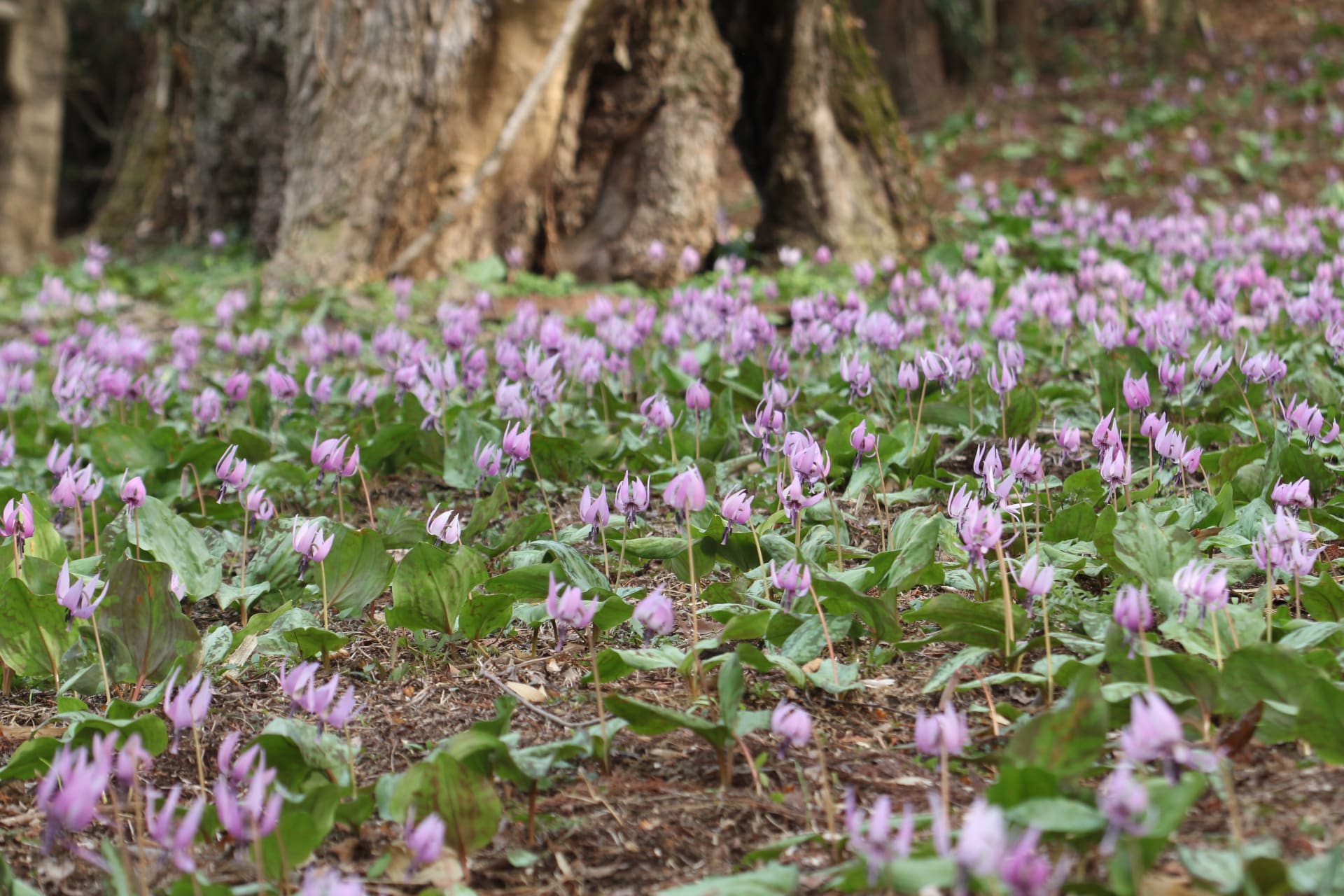
The forest floor is still littered with last autumn's beech leaves when the first katakuri push through. By mid-March, the woodland understory has transformed. Hundreds of nodding mauve blooms blanket the slopes, each flower bending on a reddish stem, petals curled backward to expose dark purple stamens. Erythronium japonicum blooms April to June in woodlands , but the peak display compresses into three weeks, maybe four if the weather cooperates. Miss that window and you'll find nothing but mottled leaves retreating toward summer dormancy.
The Science Behind Katakuri's Brief Window
Katakuri needs to grow into a 7 to 8 year old plant before it finally blooms , making every flowering individual you see on the forest floor a veteran. The bulb sits underground through winter, accumulating stored energy. When soil temperatures rise and snowmelt saturates the humus layer, the shoot emerges. The plant blooms before the surrounding trees leaf out and cover the area with shade, at which point only the roots, rhizomes and bulbs remain underground . This sprint strategy defines spring ephemerals: complete your entire reproductive cycle before the canopy closes and cuts off 90 percent of available sunlight.
The flowers bear six lanceolate-shaped petals ranging from light purple to violet, with petals curling backward to reveal large dark purple anthers and stamens . The nodding orientation protects pollen from rain while making nectar accessible to early-season pollinators. Native bees and flies visit flowers for both nectar and pollen during the brief time these flowers are blooming . Some Erythronium species host specialist mining bees, though research on Japanese katakuri pollinators remains limited.
The mottled leaves aren't just ornamental. Two elongated leaves sit at the base of the stem just above an underground bulb, with elliptical to lanceolate shapes averaging 10 to 12 centimeters in length and a mottled forest green to light green appearance . Those patterns may help with light capture under the dappled conditions of early spring, though the mechanism is still debated.
When and Where to See Katakuri Carpets
March through April is your window. Southern Honshu populations peak in late March, central sites around Mount Takao hit their stride in early April, and northern colonies in Nikko and Shirakami-Sanchi lag by a week or two depending on snowmelt. The best time to see katakuri is from late March to late April .
Mount Takao Woodland Slopes (35.6254126, 139.2437385): The mountain is located within metropolitan Tokyo and takes only 50 minutes and 430 yen to reach from Shinjuku by train . By mid-March you'll spot early bloomers, with April marking the peak of spring blossoms from violets and wildflowers to cherry blossoms . Katakuri colonies cluster on the north-facing slopes along Trail 6. The trail follows a stream valley, cool and shaded even in midday. Trail 6 offers a peaceful, shaded ascent through a lush forested valley, with hikers ascending directly up the stream bed via stepping stones . As of early 2026, part of Trail 6 is temporarily inaccessible for downhill hiking due to construction, and Trail 4 is closed , so check current access before heading out.
Senjogahara and Nikko Woodland Edges (36.7772479, 139.4442998): Higher elevation pushes the bloom window into mid-April. Katakuri here favor the beech forest margins where light penetration is stronger. Access requires a car or regional bus from Nikko Station. Trails can be muddy through late April.
Shirakami-Sanchi Beech Forest Margins (40.50363979999999, 140.0187685): This UNESCO World Heritage site hosts katakuri at the northern edge of their range. Expect peak bloom from late April into early May. Access is more challenging, involving trailhead drives and longer hikes into protected forest zones. The reward is seeing katakuri under old-growth beech canopy, the way these forests have looked for centuries.
Morning is best. By noon and hot temperatures, flowers start to wilt . The blooms open fully in morning light, then close slightly as the day warms. Overcast conditions extend viewing quality into afternoon.
Your Witnessing Guide
Footwear matters. Trails are uneven, often muddy from snowmelt and spring rains. Waterproof hiking boots with ankle support beat trail runners here. The database recommends comfortable shoes and water, but be more specific: bring boots that can handle slick mud and exposed roots.
Camera settings for woodland light: The forest floor in early spring is a mixed-light nightmare. Dappled sun creates hot spots and deep shadows within the same frame. Shoot in RAW. Start at ISO 800, f/4 to f/5.6 for enough depth of field to render a small cluster sharp, and let shutter speed fall where it must (you'll likely need 1/60 to 1/125 second). A macro lens (90mm to 105mm) lets you isolate individual blooms, while a 24-70mm handles wider colony shots. Bring a circular polarizer to cut glare off waxy leaves, but expect to lose a stop or two of light.
Respect the colonies. This woodland plant is vulnerable since it has a very short season and is slow-growing, needing to grow into a 7 to 8 year old plant before blooming . The plant's slow-growing nature has caused it to be overharvested before it can replenish populations . Stay on marked paths. Step off trail to frame a shot and you're crushing nonflowering juveniles or compacting soil over dormant bulbs. Several prefectures rate katakuri at near threatened or vulnerable-endangered status .
Pack a hat for exposed sections between forest patches, sunscreen, water, and a field guide if you want to identify companion species. Picnic supplies work well since many sites lack food vendors. A lightweight rain shell is smart insurance given spring weather volatility.
Why Katakuri Matters
Spring ephemerals anchor temperate forest food webs. They provide early-season nectar and pollen when few other resources exist, supporting pollinators emerging from winter dormancy. The brief bloom synchronizes with mining bee flight periods, creating a tight mutualism. Without early nectar sources, those bee populations crash, which cascades through the ecosystem.
Katakuri is strongly connected to Japanese culture, symbolizing transience and the fleeting beauty of nature because it blooms only for a brief period . Katakuriko, a starch that bears the name of this plant, originally refers to starch from the E. japonicum bulb, but because of its small quantity this starch is no longer common and potato starch has taken its place . The cultural memory persists even though the practice has vanished.
The plant is not farmed and has been harvested from wild colonies by poachers, probably not by seekers of starch sources but by wildflower enthusiasts or traffickers . Commercial cultivation is rare. The plants are complicated to grow, take years to bloom, and are sold at luxury prices . This makes wild populations the primary source for anyone wanting to see them, which intensifies pressure on remaining colonies.
Climate shifts are already altering bloom timing. Warmer springs push peak bloom earlier by several days compared to records from the 1990s. If the trend continues, katakuri may bloom before key pollinators emerge, breaking the synchrony that has sustained both species for millennia. Monitoring programs at Mount Takao and Nikko are tracking these shifts, but the data is only a decade deep.
This is the short version
This page shows a taste. The app has the full list of where to see this, the exact timing, and live conditions for 1,000+ natural phenomena worldwide, so you know the moment one is genuinely worth the trip.