As of today, out of season, returns ~November. Earth Exhibit tracks the live conditions and flags it the moment it is on.
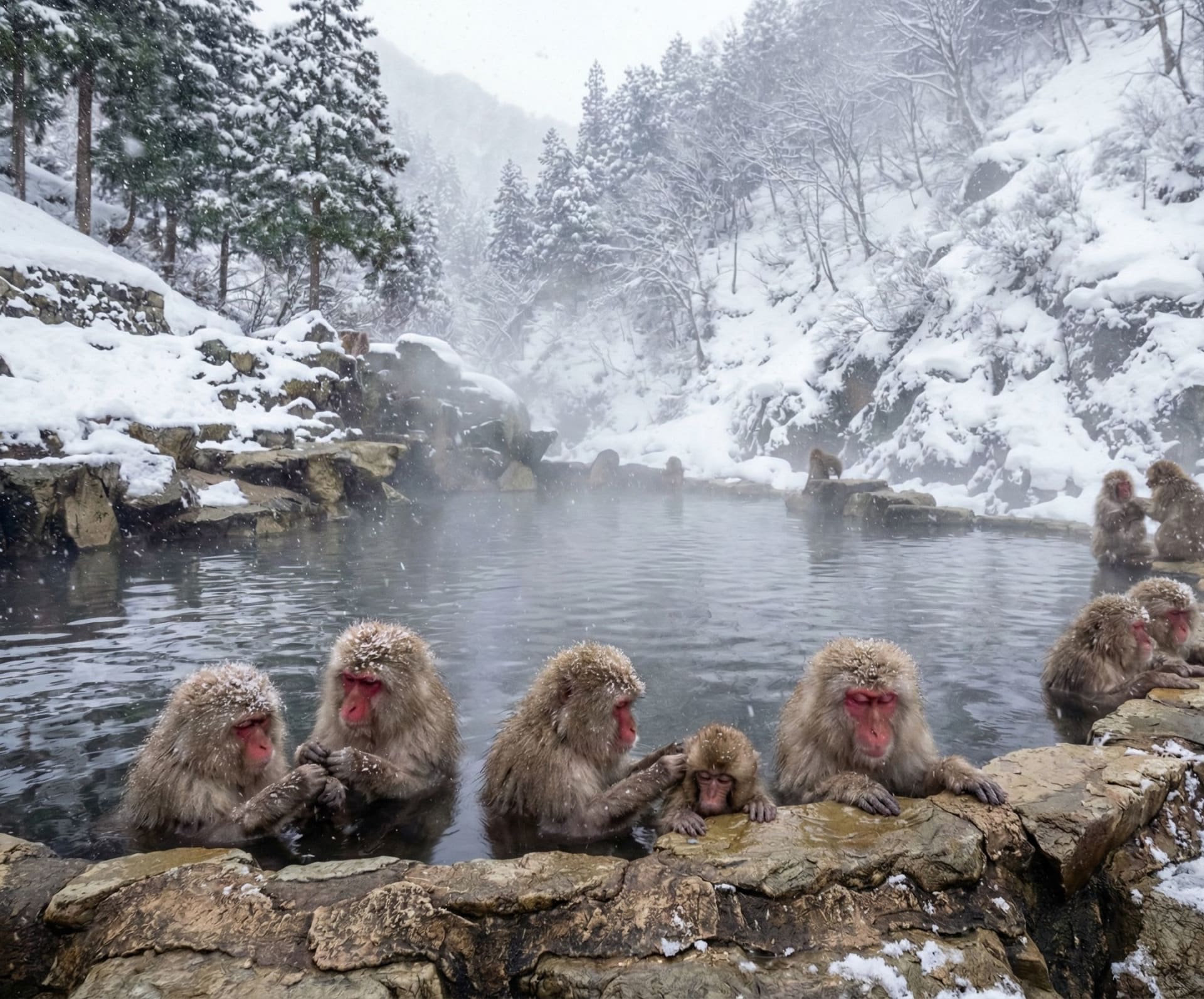
Steam rises from the surface of a 42C pool in a narrow volcanic gorge. Snow falls in fat, slow flakes, collecting on the rocks, on the bare branches of the Japanese elms, and on the fur of a Japanese macaque who sits chest-deep in the water with her eyes half closed. Her infant clings to her head, the only dry part of its mother still above the waterline. Around them, two dozen more macaques are packed into the pool, grooming, dozing, bickering quietly over position. The air temperature is negative ten. The gorge smells of sulfur. You are standing three meters away, and nobody, human or primate, seems particularly concerned about the arrangement.
This is Jigokudani Monkey Park in Nagano Prefecture, Japan (36.73N, 138.47E), and this is the only place on Earth where wild primates have figured out, entirely on their own, that sitting in a hot spring beats freezing.
The Science of a Learned Behavior
Japanese macaques (*Macaca fuscata*) hold a distinction that most people don't think about: they are the northernmost-living non-human primates on the planet. While most primate species cluster around the tropics, *M. fuscata* ranges across Honshu, Shikoku, and Kyushu, enduring winters that would kill their equatorial relatives. The Jigokudani troop pushes that range to an extreme. Their home valley sits at roughly 850 meters of elevation in the mountains of Nagano, where winter air temperatures regularly plunge to minus 15C and snow accumulates over a meter deep.
The hot spring bathing behavior that has made this troop famous is not instinctive. It is culturally transmitted, a learned behavior that began with a single individual in 1963. A young female wandered into the outdoor onsen pool at a nearby ryokan, found the hot water agreeable, and kept coming back. Other troop members watched, followed, and within a few years the behavior had spread throughout the group. Park staff, recognizing both the tourism potential and the need to keep monkeys out of hotel facilities, constructed a dedicated pool fed by the same natural geothermal water. The troop adopted it. Sixty-three years later, their descendants still soak daily through the winter months.
Thermoregulation research conducted on the Jigokudani troop has confirmed what the monkeys seem to already know. Core body temperature measurements show that bathing macaques maintain internal temperatures of approximately 37C even when ambient conditions would otherwise force dangerous heat loss. The pool water, fed by volcanic springs, stays around 42C year-round. For a 10-kilogram primate with wet fur in a subzero wind, the energetic math is stark: soaking is not a luxury, it is a survival strategy that reduces the caloric cost of thermoregulation.
But access is not equal. Dominant females get the best positions in the pool, the spots closest to where the hot water enters, where the temperature is highest and the current keeps the water fresh. Lower-ranking individuals sit at the periphery or wait their turn on the rocks. Males, who are larger and carry more insulating body mass, bathe less frequently than females. Social hierarchy dictates who soaks and for how long, and researchers have documented stress hormone levels (fecal glucocorticoids) that correlate with bathing access. The pool is not a communal paradise. It is a social arena with clear winners and losers, and the politics of position play out in real time in front of every visitor who stands at the railing.
The troop currently numbers approximately 160 individuals, a population large enough to sustain complex social dynamics but small enough that regular observers can recognize individuals by face and posture. Several generations have now been born into the bathing tradition. Juveniles learn by watching their mothers, entering the water tentatively at first, then with increasing confidence. This is cultural transmission in the strictest primatological sense: a behavior invented by one individual, spread by observation, and passed down through generations without genetic encoding.
When and Where to See Them
The core bathing season runs from December through February, when cold temperatures drive the monkeys into the water most reliably. November and March offer good chances as well, particularly during cold snaps, but midwinter is when the spectacle is most consistent and most visually dramatic. Fresh snowfall on the rocks and fur creates the contrast that defines the iconic imagery of this site.
The park is open year-round, and monkeys are present in the valley in every season, but summer visitors will see macaques foraging and socializing on the hillsides rather than soaking. The hot spring pool sits largely empty when the weather is warm. If you are coming specifically for the bathing behavior, plan your visit between mid-December and late February.
Getting there requires a short journey from Yudanaka Station (36.74N, 138.42E), the terminus of the Nagano Electric Railway line from Nagano city. From Yudanaka, the base town of Shibu Onsen (36.73N, 138.43E) sits within walking distance and offers traditional ryokan accommodations where you can soak in the same geothermal water the monkeys use, just in separate facilities. From the trailhead near Kanbayashi Onsen, a roughly 1.6-kilometer forest trail leads up through cedar and snow to the park entrance. The trail is flat but can be icy. Waterproof boots with grip are essential, not optional.
Park hours are typically 9:00 AM to 4:00 PM in winter, though arrival times for the monkeys themselves are not guaranteed. The troop descends from the surrounding mountains to the pool area on their own schedule. On heavy snow days they tend to arrive early and stay long. On mild days they may wander. The park staff do not control the animals. What you see depends on the day, the weather, and the monkeys' collective mood.
Photography and Witnessing Guide
Arrive as early as the park opens. The first hour after opening typically has the fewest visitors and, if snow has fallen overnight, the freshest conditions. By midmorning on weekends and holidays, the viewing area around the pool can become crowded, and the shooting angles narrow considerably.
A telephoto lens in the 70-200mm range is the standard recommendation, and for good reason. You can stand close to the pool, sometimes within two or three meters, but the most compelling compositions (a macaque's face in close-up with steam rising around it, a mother nursing an infant at the pool's edge, the subtle expression of a grooming pair) require reach. A 100-400mm gives even more flexibility if you are willing to carry the weight up the trail. Bring a rain cover for your camera body. The combination of falling snow, rising steam, and occasional monkey splashes will find every unsealed gap in your gear.
Never use flash. The park rules prohibit it, and beyond the rules, a flash burst directed at a wild primate at close range is disruptive and stressful. Natural light is better anyway. Overcast snow days produce soft, even illumination that reveals texture in wet fur and steam. Direct sun, when it appears in the narrow gorge, creates harsh contrast that is harder to work with.
The best frames come from patience, not from rapid-fire shooting. Wait for the behavioral moments. A yawn that shows the full canine display. A juvenile climbing onto a resting adult's head. Two females grooming each other with meticulous, focused attention. A lone male sitting at the edge of the pool with snow accumulating on his crown, staring at nothing. These moments happen constantly, but they require you to stop moving, stop adjusting settings, and simply watch until the composition presents itself.
Gear checklist: warm insulating layers (you will be standing still for extended periods in subzero conditions), waterproof boots with aggressive tread for the icy trail, hand warmers inside your gloves (cold fingers fail at manual focus), and a lens cloth for clearing condensation when you move between the cold air and the warm zone near the pool.
One practical note: the monkeys are wild but habituated. They will walk past you, between your legs, across your camera bag. Do not touch them, do not feed them, and do not block their path. The park's coexistence model works because visitors respect the boundaries. The monkeys tolerate humans because, for sixty-three years, humans at this site have earned that tolerance.
The Bigger Picture
The Jigokudani troop represents something more significant than a tourist attraction. They are a living case study in primate cultural innovation, the kind of behavioral flexibility that primatologists once assumed was unique to great apes. A single macaque's decision to enter warm water in 1963 created a tradition that has now persisted across multiple generations, altering the troop's daily patterns, social structures, and survival strategies.
Cultural transmission in non-human primates forces a question that science is still working through: where does instinct end and culture begin? The Jigokudani macaques do not bathe because their genes tell them to. They bathe because their mothers did, and their mothers' mothers did, tracing back to one curious juvenile who tried something new. That chain of social learning, unbroken for over six decades, is culture by any functional definition.
The phenomenon also intersects with climate. As winters in central Honshu fluctuate in severity and duration, the bathing season's timing and intensity shift in response. Warmer winters mean fewer days of deep cold, which means fewer days of sustained bathing. The behavior is a thermoregulatory response, and if the thermal pressure diminishes, the cultural practice may eventually weaken. Monitoring the Jigokudani troop is, in a small but real way, monitoring how a culturally transmitted survival behavior responds to a changing environment.
For now, in February, in a sulfur-smelling gorge in Nagano, a macaque sits in hot water while snow lands on her eyelashes, and she does not flinch. She was born into this. She learned it by watching. And three meters away, so were you.
This is the short version
This page shows a taste. The app has the full list of where to see this, the exact timing, and live conditions for 1,000+ natural phenomena worldwide, so you know the moment one is genuinely worth the trip.