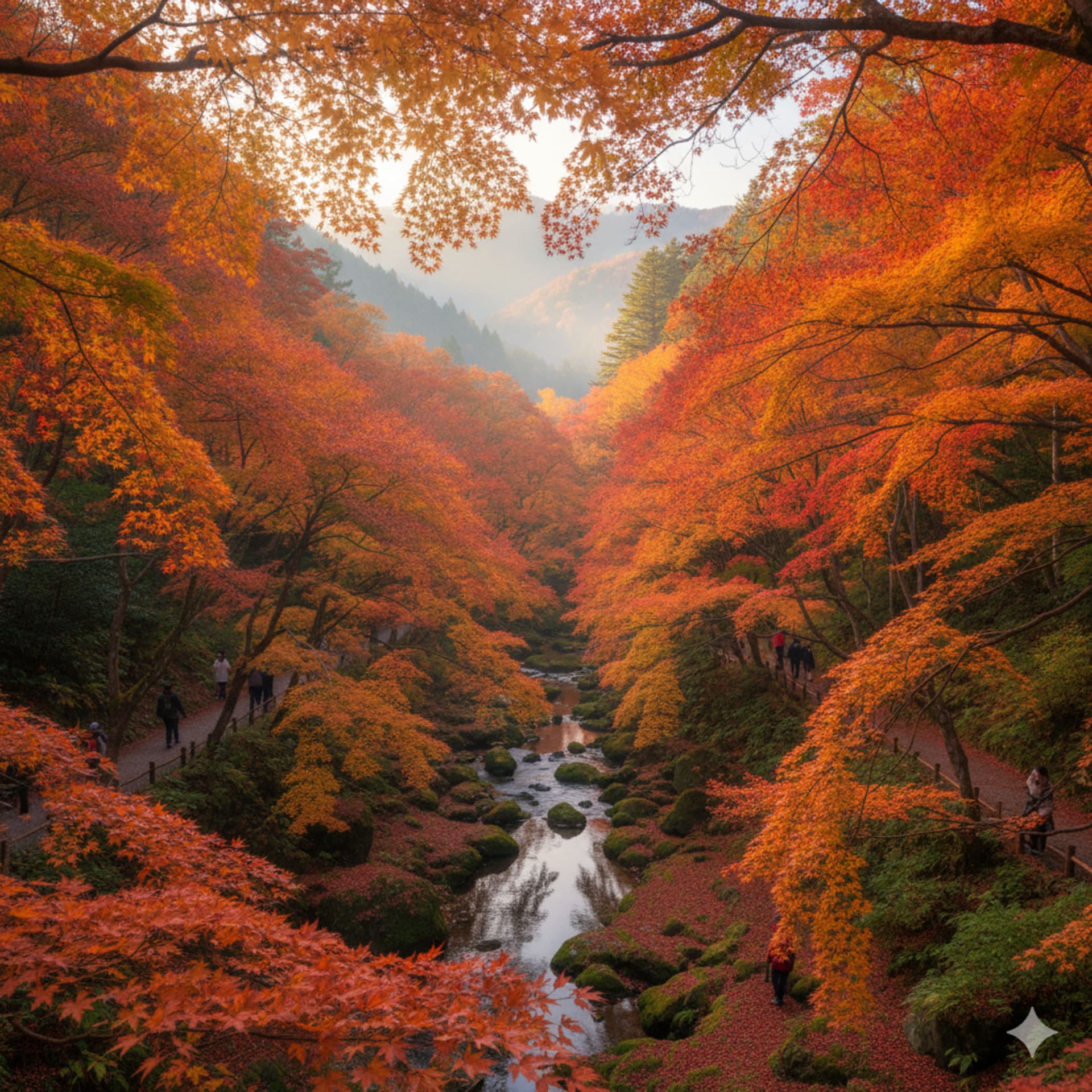
The bridges at Tofuku-ji Temple sit 20 meters above a valley floor. Look down in late November and what you see is not ground, but an ocean of crimson. Two thousand Japanese maple trees pack the ravine below, their canopies overlapping so tightly that the soil disappears. The leaves glow like coals, and when wind moves through the valley, the whole mass shifts from scarlet to burgundy as light catches different angles. You are here during koyo season, when Kyoto transforms into Japan's autumn pilgrimage site.

The Chemistry Behind the Crimson

Japanese maple (Acer palmatum) leaves turn from green to red through simultaneous chlorophyll degradation and anthocyanin accumulation . This process unfolds in three stages: a slow chlorophyll breakdown over 20-30 days, a rapid anthocyanin surge across 20 days, then an accelerated chlorophyll collapse in the final 10-20 days . The primary pigment is cyanidin-3-O-glucoside, accumulating 28-fold in semi-red leaves and 131-fold in fully red leaves compared to green foliage .

Temperature drives the timing. Peak color arrives when minimum temperatures drop to 8 degrees Celsius or lower, and progression accelerates at 5-6 degrees . Warmer autumns delay the show. In 2025, Kyoto's colors peaked late November into early December due to warm, dry conditions . For 2026, forecasters predict similar timing.

The reds serve a purpose beyond beauty. The light screen hypothesis suggests anthocyanins protect cells losing chlorophyll from photo-oxidative damage by absorbing blue wavelengths of sunlight .

When and Where to See Kyoto's Maple Season

Peak season runs mid-November to early December , but this window shifts 1-2 weeks depending on the year. Check the Japan Meteorological Agency koyo forecast before you book flights. Individual sites reach their best viewing at different times within that window.

Tofuku-ji Temple (34.9761, 135.7747) holds the most famous view in Kyoto. About 2,000 maple trees fill Sengyokukan Valley, and Tsutenkyo Bridge offers a panorama of their crimson canopy . The 100-meter covered walkway becomes extremely crowded when colors peak, usually mid to late November . Arrive by 8:00am during the special autumn viewing period (8:30am opening from November 9 to December 1) . Entry costs 1,000 yen during peak season. The 10-minute walk from Tofukuji Station (JR Nara Line, 2 minutes from Kyoto Station) is straightforward once you pass the station exit.

Tofuku-ji does not offer autumn illumination , so visit at dawn for soft light and manageable crowds.

Eikando Zenrin-ji (35.0142, 135.7939) competes for the title of best temple colors. This temple holds the largest number of maple trees in Kyoto . Evening illuminations run November 15 to December 10, 17:30 to 21:00 (last entry 20:30), costing 700 yen . Hojo Pond shows the most vivid reds, though green patches remain even at peak . Stay in the Gion or Higashiyama districts to walk back after the illumination ends.

Arashiyama District (35.0094, 135.6722) offers riverside views. Mount Arashiyama itself peaks slightly later than Togetsukyo Bridge, showing rusty oranges and browns that brighten as color advances . The bamboo groves provide contrast but do not change with season.

Kiyomizu-dera Temple (34.9948, 135.785) pairs wooden architecture with hillside maples. The main hall terrace looks out over a sea of color. Evening illuminations run late October to early December. Expect large crowds at this UNESCO site.

Nanzen-ji Temple (35.0111, 135.7933) favors calm over spectacle. Tenjuan Garden, a sub-temple with Edo-period rock and pond design, features maple trees, moss, and stone lanterns along winding paths . Combine this with Ginkaku-ji and the Philosopher's Path for a half-day walking route through quieter autumn scenery.

Your Witnessing Guide

Timing your visit: Book 2-3 months ahead. Kyoto fills completely during koyo season, and accommodation prices surge. Weekdays see smaller crowds than weekends. Peak typically falls around November 20 to early December in Kyoto , but 2026 forecasts suggest early December based on 2025 patterns.

Getting there: Fly to Osaka Kansai (KIX, 15 minutes to Kyoto by limited express) or Tokyo (2.5 hours to Kyoto by shinkansen). Get a Kansai Area Pass or load an ICOCA card for buses and trains. Kyoto Station serves as the transit hub. Bus 208 connects multiple temple sites, but consider renting a bicycle for flexibility. Roads are well-maintained, and parking is widely available.

What to bring: A camera with good low-light capability if you plan illuminations. Set ISO 800-1600, aperture f/2.8-f/5.6, shutter speed 1/60-1/125 for handheld shots. A tripod helps for pond reflections but may not be permitted on crowded bridges. Portable battery packs keep devices alive through long days. Wear layers for cool mornings (10-15 degrees Celsius) that warm by afternoon. Comfortable walking shoes matter, as temple grounds have uneven paths and stairs. Some temples require shoe removal, so slip-ons save time. Carry a small umbrella for sudden rain.

Best light: Early morning (7:00-9:00am) offers soft illumination and fewer people. Late afternoon (3:00-5:00pm) brings golden hour warmth that intensifies reds. Overcast days saturate colors by eliminating harsh shadows. Evening illuminations create reflections in ponds but require patience with crowds and tripod restrictions.

Navigation: Download a koyo forecast app to track which sites are peaking on which days. The Japan Meteorological Agency updates forecasts weekly during season.

Why Kyoto's Maples Matter

Temple gardens preserve maple genetics cultivated over centuries. Many of Tofuku-ji's trees date back generations, selected for color intensity and timing. The relationship between temple culture and maple cultivation runs deep. Monks planted these trees to mark seasonal transitions, tying Buddhist concepts of impermanence to the ephemeral brilliance of autumn leaves.

Kyoto's koyo season generates significant tourism revenue but strains infrastructure. Temple staff at popular sites manage bottlenecks by restricting photography on bridges and limiting entry during peak hours. The tension between access and preservation grows each year as visitor numbers climb.

Climate warming shifts timing. Autumn colors depend on temperature, with warmer years bringing later peaks . The 2025 season ran 1-2 weeks behind historical averages. If this pattern continues, peak windows may migrate into mid-December, compressing the overlap between northern and southern Japan's autumn.

Culturally, momijigari (autumn leaf hunting) carries weight comparable to spring's cherry blossom viewing. Families travel across prefectures to witness peak color. Seasonal foods appear: matsutake mushrooms, chestnuts, maple leaf tempura (actual fried leaves, lightly battered). The practice connects contemporary Japanese life to centuries of seasonal observation.

These maples are not wilderness. They exist because people tended them, pruned them, replaced them when they died. The gardens look spontaneous but follow deliberate design principles refined over generations. That collaboration between human intention and natural process produces the scenes you witness in November.

Track live conditions for this and 590+ phenomena on the Earth Exhibit app: https://earthexhibit.com

Track This Phenomenon Live

The Earth Exhibit app monitors real-time conditions for this and 590+ natural phenomena worldwide. Get alerts when conditions peak near you.