As of today, out of season, returns ~August. Earth Exhibit tracks the live conditions and flags it the moment it is on.
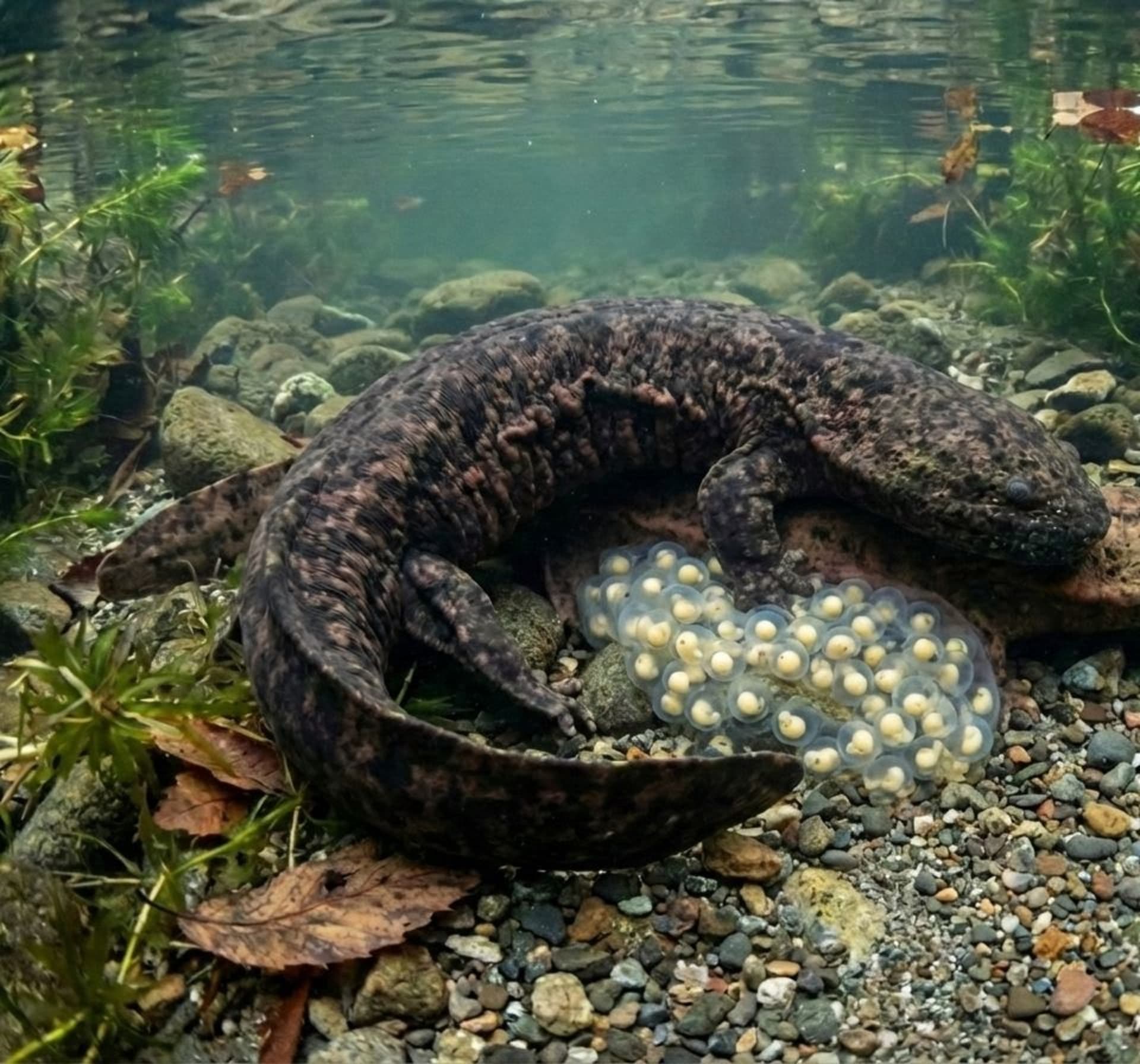
You wade into the Hino River at 9pm, headlamp beam cutting through the dark. The water is cold, 15 degrees Celsius from snowmelt upstream. Your guide stops at a half-submerged boulder and signals silence. Then you see it: a wrinkled snout the width of a dinner plate, dark eyes like pinpricks, a body that stretches back into shadow for a meter and a half. Andrias japonicus. The Japanese giant salamander. And you are standing three feet from a den-master guarding 500 eggs in the narrow breeding window that opens every August.
This is the third-largest salamander in the world, reaching up to 1.5 meters in length. Outside of captive facilities, wild sightings require luck, timing, and a willingness to be in cold mountain streams after dark. August to September is when males occupy burrows along stream banks for breeding and nesting, and for a few weeks each year, ethical tour operators in Okayama and Hyogo prefectures offer guided nocturnal observations at known nesting sites.
The Science Behind Japanese Giant Salamander Breeding
During late summer breeding season, adults migrate upriver looking for dens: caverns or burrows, each containing a single underwater entrance.
The largest, most dominant male in a territory will occupy the den and defend it. These males, called den-masters, are the key to the entire reproductive strategy. Multiple females may enter the den and spawn with the male, each typically laying a clutch of 400 to 600 eggs.
What separates this species from most other salamanders is the intensity of paternal care. Tail fanning, agitating, and egg eating have been identified as parental care behaviors, with tail fanning providing oxygenated water for the eggs. The den-master remains with the eggs for 12 to 15 weeks, using his tail to circulate oxygen-rich water over the developing embryos. Den masters consume eggs and larvae that show signs of failed fertilization, death, or water mold infection, a behavior termed "hygienic filial cannibalism" that increases the survivorship of remaining offspring by preventing mold from spreading.
The species relies entirely on cutaneous respiration. The smooth skin acts as a respiratory surface for gas exchange, where oxygen enters the body and carbon dioxide is released, with flaps of skin, or wrinkles, increasing the surface area for this respiration. This is why the salamanders are confined to cold, fast-flowing streams where dissolved oxygen is abundant. Water temperature and flow rate dictate survival.
Males become territorial and aggressive during breeding season. Large males often kill smaller rivals in defense of spawning pits. Fights leave scars, but the animals heal fast. When threatened, Andrias japonicus expels a secretion that smells like the Japan pepper plant, which quickly hardens to a gelatinous substance in the open air. The evolutionary role of this defense remains unclear, but it is potent enough to give the species one of its local names: "Osanshouo," which translates to "giant pepper fish."
When and Where to See Japanese Giant Salamander Breeding
Breeding occurs annually, beginning around late August or early September. The peak activity window is mid-August through mid-September, though males may remain at nest sites into October as eggs develop.
The best wild viewing sites are in Okayama and Hyogo prefectures. The Hanzaki Center in Maniwa, Okayama, offers access to nearby rivers where guided nocturnal tours operate during breeding season. The center has tanks where you can see live salamanders in captivity, and they are bigger than you expect. Entry is free, though as of early 2026, English translations were still being developed.
Nichinan Town Hall in Tottori coordinates with local conservation groups to organize seasonal viewing tours. These require advance booking and are capped at small group sizes to minimize disturbance. Expect to wade into shin-deep water, move slowly, and remain silent for extended periods.
For guaranteed sightings without the uncertainty of wild encounters, Kyoto Aquarium maintains a breeding population and offers year-round viewing. The tradeoff is obvious: you see the animal, but you miss the cold water, the dark, the silence, and the thrill of knowing the salamander could vanish downstream at any moment.
Breeding habitat, where spawning nests and juveniles are most common, tends to be in relatively small and lotic habitats in the upper tributaries of streams. Access is difficult. Many nesting sites are remote, reached only by hiking narrow trails through cedar forests, then wading upstream for 30 minutes in the dark. This is not a phenomenon you can see from a paved viewpoint.
Best time of night is after 8pm, when salamanders emerge from dens to feed or patrol territory. Tours typically run from 8pm to 11pm. Salamanders are nocturnal, usually sleeping underneath stream rocks during daylight hours. Daytime sightings are possible but rare.
Your Witnessing Guide
Gear up for cold, wet conditions. Water temperature in mountain streams hovers around 12 to 16 degrees Celsius even in late summer. Waterproof boots with good ankle support are required; riverbeds are slick with algae and unstable stones. Long pants protect against submerged branches and leeches. Insect repellent is critical. The same cold, oxygenated water that salamanders need also breeds clouds of gnats and mosquitoes.
Bring a red LED headlamp. Red light is less disruptive to nocturnal amphibians than white light, and guides enforce this strictly. A waterproof camera capable of shooting at ISO 3200 or higher is necessary for low-light conditions. Set your aperture to f/2.8 or wider, shutter speed to 1/60 or slower, and expect grain. The salamander will not pose. You get one chance before it retreats into the den.
Patience is the primary requirement. You may stand in cold water for 30 minutes waiting for a salamander to emerge. You may see nothing. Because of the difficulty in finding nesting sites of Andrias japonicus in nature, even experienced guides cannot guarantee sightings. Weather affects activity: heavy rain increases flow and reduces visibility, while drought concentrates salamanders in deeper pools but makes them more cautious.
Work only with ethical guides who follow strict non-disturbance protocols. Andrias japonicus became a federally protected species under the "special natural monument" designation in 1952. Touching, handling, or disturbing nesting sites is illegal and can result in heavy fines. Guides should maintain at least two meters from dens and limit observation time to under 10 minutes per site.
Why It Matters
The Japanese giant salamander is a key umbrella species currently listed as Vulnerable by the IUCN Red List, and the population size has been declining for close to a century.
Concrete banks have deprived habitats suited for nesting sites, and dams block migration paths and have caused habitat fragmentation. With ongoing climate change, it is predicted that frequency and intensity of rainstorms in Japan will increase, which will likely destroy stream banks more frequently.
Recent research found that salamanders undergo a marked dietary shift as they grow, transitioning from feeding mainly on aquatic insects to preying on fish, frogs, and crabs once they exceed 62 cm in length, elevating their trophic position to apex predators in their ecosystem. They structure river food webs. Remove them, and the cascade affects everything from insect populations to algae growth.
Introgressive hybridization between the native Japanese giant salamander and the introduced Chinese giant salamander is one of the major conservation challenges. In Kamo River in Kyoto Prefecture, studies from 2011 to 2013 found that 95% of captured giant salamanders were hybrids. Genetic purity is disappearing faster than habitat.
The salamander appears in Japanese folklore as "hanzaki," a creature so tough it survives being cut in half. It is said that it is still alive even if its body is cut in half, so it is called that way in this area. The reality is less dramatic but more impressive: these animals live 50 years or more, heal from severe injuries, and have survived with minimal evolutionary change for millions of years. They are older than the Japanese archipelago itself.
Seeing one in the wild during breeding season connects you to a lineage that predates most of the species we think of as ancient. The breeding window is short, the access is difficult, and the populations are shrinking. Track live conditions for this and 940+ phenomena on the Earth Exhibit app: https://earthexhibit.com
This is the short version
This page shows a taste. The app has the full list of where to see this, the exact timing, and live conditions for 1,000+ natural phenomena worldwide, so you know the moment one is genuinely worth the trip.