As of today, out of season, returns ~October. Earth Exhibit tracks the live conditions and flags it the moment it is on.
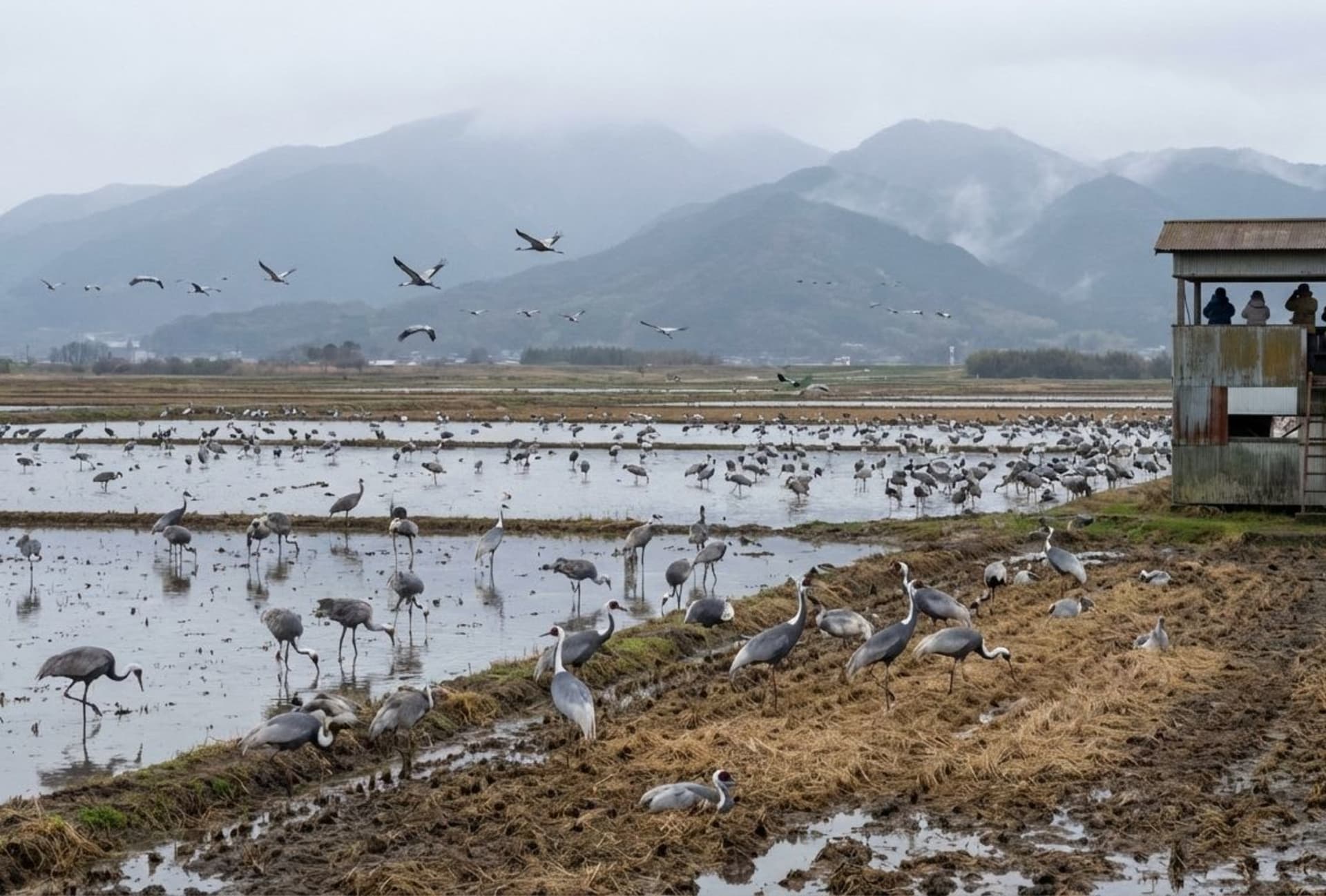
The rooftop deck opens at 6:30am. You arrive in darkness. Then, as first light breaks over the Izumi Plain, the feeding truck rolls out across the paddies. What happens next is one of the densest congregations of cranes on Earth. Over 15,000 hooded and white-naped cranes lift off in waves, thousands of birds flooding the sky in a bugling, chaotic rush toward breakfast. The sight is unique to Izumi , and the season opened in late October.
The Science Behind the Izumi Migration
Cranes migrate from Siberia, China, and Mongolia to the Izumi Plain from mid-October through March , escaping the Siberian winter for the mild coastal climate of southern Kyushu. Hooded cranes breed in marshes from Lake Baikal to the mid and upper Amur River , while white-naped cranes nest in similar wetland territories across northeast Asia. By early winter, about 80% of the world's hooded crane population winters at Izumi . The white-naped crane is nearly as dependent: over 60% of the global population spends winters here .
The cranes arrive riding north and northwest winds. Over 30% of the world's hooded cranes gather in the Zeya-Bureya Plain in Russia's Amur Province during spring and autumn staging , a critical stopover before the final push to Kyushu. Once at Izumi, they settle into a predictable rhythm. Cranes sleep standing in shallow water, where rippling warns them of predators . At dawn, they fly to feeding grounds. At dusk, they return to roost. Repeat for four months.
The cranes forage on rice plants, wetland weeds, potatoes, frogs, snails, and grasshoppers, supplemented by about 70 tonnes of wheat, brown rice, and soybeans provided by local volunteers . Volunteer rangers drive vans along rice field tracks each morning, spreading grain, and in late January add blocks of frozen fish for protein before the spring migration .
When and Where to See the Cranes
The season runs mid-October to March , but peak numbers occur from December to January . The first cranes arrive in late October, numbers peak in mid-December , and by mid-March, birds begin returning to their breeding grounds .
Two primary viewing zones exist at Arasaki, both part of the 245-hectare protected paddies. The Crane Observation Center (32.102829, 130.275071) sits at the western feeding zone. The center operates between November and March each year , opening at 9am, but rooftop deck access starts at 6:30am . Admission provides access to the second-floor gallery and open roof, offering panoramic views of the feeding grounds .
The crane area divides into the west area (Nishi Kantaku) around the observation center and the east area (Higashi Kantaku) across the river . Both zones receive daily grain. Cranes fly first from the west roosting site to the east side, then later return to the west side , creating two daily flight windows.
The Municipal Izumi Crane Museum (Crane Park Izumi, 32.098132, 130.343496) offers educational exhibits and habitat views. From Izumi Station, the center is 20 minutes by car with on-site parking . Izumi has a shinkansen station, 25 minutes from Kagoshima City, and a local tourism bus runs to the observation ground .
Access from Kagoshima Airport takes 90 minutes by car or limousine bus.
Your Witnessing Guide
Arrive before sunrise. The most spectacular flight occurs early morning when feeding starts and cranes fly off in groups against the backdrop of sunrise . The grain-bearing truck arrives each morning at 7am , triggering mass takeoff.
Temperature matters less than you expect. Average morning temperatures in midwinter are 40-50?F, daytime highs 50-60?F, and on sunny, windless days you won't feel cold . But bring layers anyway. Wind off the paddies cuts through thin jackets.
Photography gear: A telephoto lens (300mm minimum, 400-600mm ideal) captures individual crane portraits and flight sequences. From the observation center roof, hooded cranes and white-naped cranes fly by at eye level , perfect for close flight shots. Use a fast shutter speed (1/1000 or faster) to freeze wing motion. For dawn takeoffs, start at ISO 800-1600, then drop as light increases. A tripod helps, but the roof is crowded during peak season, so a monopod offers more flexibility.
Binoculars earn their weight scanning for rarities. About 10,000 hooded cranes, 3,000 white-naped cranes, and small numbers of common cranes, demoiselle cranes, sandhill cranes, and Siberian cranes winter here . In winter 2021/2022, the census recorded 15,145 hooded cranes, 1,546 white-naped cranes, eight common cranes, four sandhill cranes, and one Siberian crane . Finding the rare species in a flock of 15,000 birds takes patience and optics.
Dress in neutral colors. Cranes tolerate human presence at the observation center but spook if you approach the feeding zones on foot. Respect barriers.
Why It Matters
The conservation status of both hooded and white-naped cranes on the IUCN Red List is vulnerable . Izumi is not just Japan's largest crane site; it's a global bottleneck. Arasaki is perhaps the most important winter refuge for hooded and white-naped cranes in the world . Concentrating 80% of a species in one 245-hectare area creates risk. Disease, habitat loss, or climate disruption could devastate the population.
The concentration at Izumi is partly success, partly loss. In the past, far fewer cranes gathered annually because they had alternative wintering destinations throughout Japan and other countries south of Russia, but as suitable habitats gradually disappeared due to land development, cranes increasingly favored Izumi . Wetlands across East Asia have vanished under rice paddies, cities, and industrial zones. Izumi persists because locals chose protection.
Cranes started arriving in Izumi in the 1700s after a land reclamation project under the Shimazu clan . After the Meiji Restoration (1869), cranes were hunted, and by 1890 none came to Izumi, but they returned in 1895 with the establishment of game protection laws, and in 1923 ornithologist Uchida Seinosuke persuaded the railway to route around the migration grounds . The crane was designated a protected species in 1895, a national monument in 1921, and a special natural monument in 1952 .
The Kagoshima Crane Protection Society, formed in 1962, manages crane protection with cooperation from local farmers and a junior high school Crane Club that has conducted yearly crane counts for over 60 years, spanning three generations of families . The society creates artificial roosts, provides supplemental food, and monitors for disease. From November 1, 2025, to March 8, 2026, the Izumi Crane Overwintering Site Utilization Adjustment designates entry routes and strengthens epidemic prevention measures .
Cranes pair for life. They perform elaborate courtship dances, leaping into the air, calling to each other, and bowing their heads, and both parents help raise chicks . Each crane you see at Izumi likely traveled the same migration route with its mate for years, returning to the exact paddies, roosting in the same shallow pools. The fidelity is behavioral and spatial.
The morning feeding rush is chaos, but beneath it runs precision. Thousands of birds navigating shared airspace without collision. Parents teaching juveniles the schedule. Mates staying within sight of each other in a crowd of 15,000. It's not a random spectacle. It's a choreographed survival strategy refined over centuries, and you can watch it unfold from a rooftop in rural Kyushu every winter morning at 7am. Track live conditions for this and 940+ phenomena on the Earth Exhibit app: https://earthexhibit.com
This is the short version
This page shows a taste. The app has the full list of where to see this, the exact timing, and live conditions for 1,000+ natural phenomena worldwide, so you know the moment one is genuinely worth the trip.