As of today, out of season, returns ~January. Earth Exhibit tracks the live conditions and flags it the moment it is on.
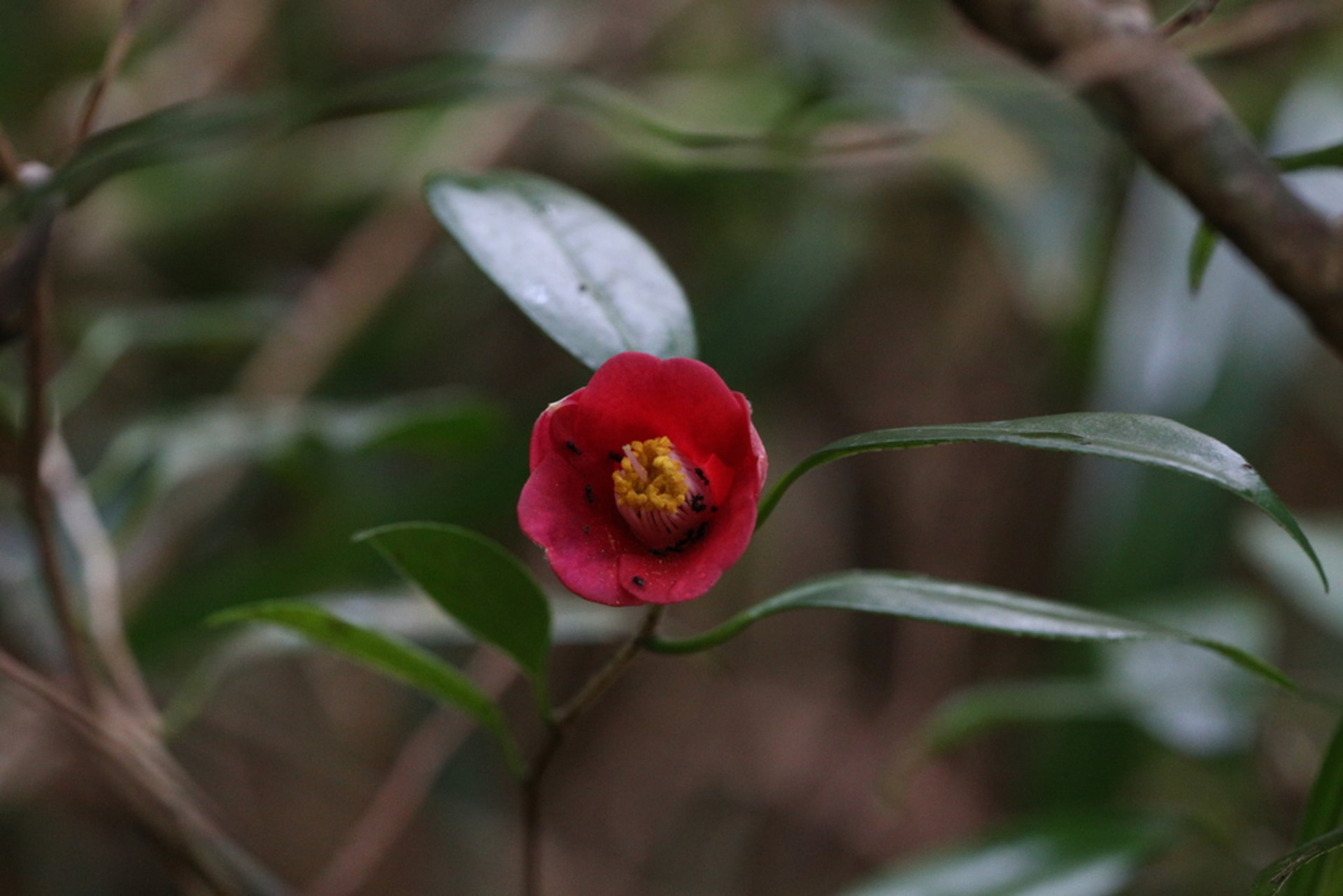
The volcanic soil crunches underfoot, black scoria mixed with pine needles, and then you notice the color. Pink everywhere. Single-petaled Oshima camellia (Camellia japonica var. oshimensis) flowers carpet the roadsides, climb the slopes of Mount Mihara, and line every garden wall in Motomachi. The island holds roughly three million camellia bushes, and from late January to late March they transform Izu Oshima into what might be Japan's largest winter flower display.
The peak hits in late February. That is when you go.
The Science Behind Izu Oshima Camellia Bloom
Camellia japonica evolved to flower when most plants go dormant. The species produces blooms from December through April across Japan, but the Oshima variety concentrates its display in a tighter window. The flowers are simple compared to cultivated garden camellias: five to seven petals, white to deep pink, with a dense yellow stamen cluster at the center. No doubled petals, no frills.
The volcanic soil plays a role. Mount Mihara last erupted in 1990, and before that in 1986 when lava flows forced the evacuation of ten thousand residents. The eruptions leave behind mineral-rich basalt and scoria, slightly acidic, well-draining. Camellias thrive in these conditions. The trees grow wild on coastal slopes and in the inland forests, mixing with Japanese black pine and evergreen oak. Islanders have cultivated them for centuries, originally for camellia oil pressed from the seeds.
The bloom timing follows temperature cues. Early buds open in January, but late February to mid-March brings the peak, when the greatest density of flowers appears across the island . By early April, petals litter the ground and cherry blossoms (sakura) begin to open, briefly overlapping.
When and Where to See Izu Oshima Camellia Bloom
February and March are your target months. An annual festival runs from late January to late March , with the heaviest flower concentration arriving in the middle weeks of that window.
Four sites anchor the display:
Oshima Park and Tsubaki Plaza (34.7611689, 139.4345532) is the festival headquarters. The park holds International Camellia Garden of Excellence status and grows over a thousand camellia varieties in its collections. The camellia museum sits here, along with a zoo (free admission) and walking trails through cultivated groves. Folk dance performances happen on Saturdays, Sundays, and holidays during the festival . Local artisans sell camellia oil, the pressed seed oil used for cooking and cosmetics. From Okata Port, the park is 12 minutes by car; from Motomachi Port, 20 minutes.
Motomachi Tsubaki Park (34.7637154, 139.4328439) clusters gardens and wild stands near the main ferry terminal. This is your first camellia encounter if you arrive by boat at Motomachi Port. The density is high here, with trees planted along walkways and erupting in semi-wild patches on the slopes above town.
Mount Mihara South Slope Camellia Area (34.7310356, 139.3922369) scatters flowers across the volcanic flanks. You hike through hardened lava fields from the 1986 eruption, black rock and ash, and the camellias grow in pockets where soil has accumulated. The contrast is stark: pink blooms against black desert.
Konyama Coastal Camellia Road (34.7705583, 139.3743724) runs along the northern shoreline. Trees line the road for several kilometers, offering coastal views with Pacific waves crashing below. The wind is fierce here. Flowers get battered, petals torn, but the display holds.
Anytime during daylight works for viewing, though morning light (before 10am) offers the best photography conditions with softer shadows. The island holds no light pollution concerns, so sunset and dusk bring rich color saturation.
Your Witnessing Guide
Getting There: From Tokyo, you have two options. Fly from Haneda (HND) to Oshima Airport (OIM) in 30 to 40 minutes. Alternatively, take the high-speed jetfoil from Takeshiba Ferry Terminal (about two hours), or the car ferry from the same port (five to seven hours) . The overnight car ferry departs Tokyo in the evening, arriving at dawn. Jetfoils also run from Atami (one hour). During the Camellia Festival, additional weekday ferry service operates from Kurihama Port to handle visitor volume.
Ferries dock at either Motomachi or Okata Port depending on wind and current conditions. The port is announced each morning. Ask your hotel or check with the ferry company.
On the Island: Public buses connect the ports, Oshima Park, and major villages. Service is infrequent (hourly at best), so rental cars or taxis are more efficient. The island circuit is roughly 50 kilometers, manageable in a half-day if you stop at key sites. Rental bikes exist but February wind makes cycling unpleasant.
Gear Checklist:
- Layered clothing (wind is constant, temperatures range from 5C to 15C)
- Windproof jacket (coastal gusts exceed 30 km/h)
- Sturdy hiking shoes if you plan Mount Mihara trails
- Macro lens for flower detail shots (50mm to 105mm focal length)
- Circular polarizer to cut glare on sunny days
- Field guide to camellia varieties if you want to identify cultivars at Oshima Park
- Water bottle (limited water sources on trails)
- Sunscreen and hat (UV is strong even in winter)
Photography Settings: For wide shots of hillside blooms, use f/8 to f/11 for depth of field, ISO 200, shutter speed 1/250 or faster to freeze wind motion. For individual flower portraits, open up to f/2.8 or f/4, ISO 100, and use a fast shutter (1/500 or higher) to handle shake from gusts. Overcast days simplify exposure and reduce harsh shadows on white petals.
Safety: The island gets cold and windy in February. Hypothermia is a risk if you hike unprepared. Mount Mihara trails cross loose volcanic rock; ankle injuries happen. Bring a headlamp if you plan late afternoon hikes, as sunset comes around 5:30pm and trails are unlit. Ferry schedules depend on sea conditions. Rough weather cancels sailings, stranding visitors for an extra day. Budget an extra night or travel on a flexible schedule.
Why It Matters
Camellia oil extraction and windbreak forests for crop protection make the trees essential to islanders' livelihoods . Seeds are harvested, cold-pressed into oil used for cooking and hair care. The oil is shelf-stable, with a high smoke point around 252C, suitable for tempura frying. Cosmetic applications center on hair conditioning; the oil penetrates hair shafts without leaving heavy residue.
The windbreak function matters on a volcanic island where typhoons and winter gales batter exposed slopes. Camellia trees, with their dense evergreen foliage and deep root systems, stabilize soil and deflect wind from vegetable plots and homes. After eruptions, camellias are among the first woody plants to recolonize lava fields, their seeds dispersed by birds.
Three gardens on Oshima hold International Camellia Society recognition: Tokyo Metropolitan Oshima Park, Tokyo Metropolitan Oshima High School, and Tsubaki-Hana-Garden. The designation acknowledges collections with over a thousand cultivated varieties, many hybridized from the local Oshima stock. Rare forms exist here, including kinkacha, a yellow-petaled variant almost unknown elsewhere in Japan.
Cultural threads run deep. The 1960s folk song "Anko Tsubaki wa Koi no Hana" by Harumi Miyako popularized the island's camellia identity nationwide. Anko is the Oshima dialect word for young women, and during the festival, volunteers dressed in traditional checkered kimono and pink aprons still send off ferries at the port, a tradition tied to that song. The Camellia Queen contest and marathon (held in early March) extend the festival's community role.
Climate change may shift bloom windows. February temperatures have risen roughly 0.8C over the past three decades, nudging peak bloom earlier. By 2040, projections suggest the peak could move into mid-February or even late January, compressing the traditional festival schedule.
This is the short version
This page shows a taste. The app has the full list of where to see this, the exact timing, and live conditions for 1,000+ natural phenomena worldwide, so you know the moment one is genuinely worth the trip.