As of today, in season, building toward peak (~July 1). Earth Exhibit tracks the live conditions and flags it the moment it is on.
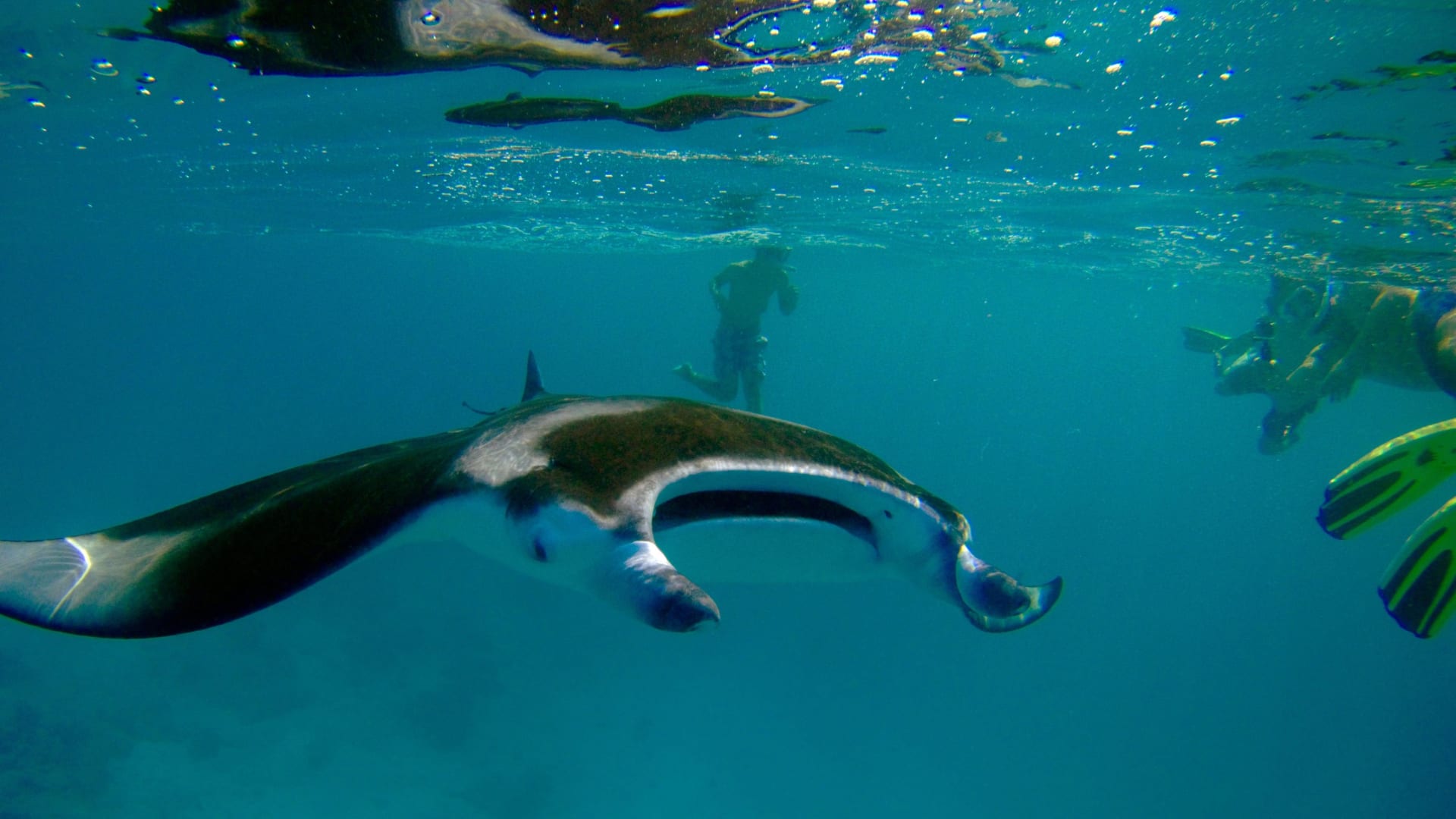
You drop into Kabira Bay at 9am, water temperature 28?C, visibility 25 meters. The boat captain points northwest. Fifteen meters down, a coral outcrop the size of a small car sits on white sand. Two cleaner wrasse dart around its edges. Then the shadow appears: a reef manta ray (Mobula alfredi), four meters wingtip to wingtip, gliding in a slow circle overhead. It banks, unfurls its cephalic fins, and settles into a hover above the coral. The wrasse get to work. Ishigaki Island hosts a healthy population estimated at 300+ individuals circulating around the local islands, regularly congregating at cleaning stations and feeding points, mostly found in the scenic Kabira Bay area. From July through October, your odds of seeing this exceed 90 percent.
The Science Behind Manta Cleaning Stations
Reef manta rays (Mobula alfredi) are the primary species around Ishigaki, though giant oceanic manta rays (Mobula birostris) have also been spotted around the Okinawa region, especially Yonaguni and Miyako islands, but are much rarer. These rays are filter feeders that consume zooplankton by swimming with their mouths open, funneling water over gill rakers that trap prey particles. But plankton-rich water also means parasites. Manta Scramble, located off the coast of Ishigaki's Kabira Bay, is known to divers worldwide as a cleaning station where manta rays gather to have their bodies cleaned.
The cleaning stations at Kabira Bay sit at 10 to 15 meters depth, coral mounds on sandy bottoms where small fish (cleaner wrasse, butterflyfish) remove parasites, dead skin, and mucus from visiting mantas. The rays slow to near-stationary hovers, sometimes opening their mouths and gill slits to allow cleaners inside. Based on photo-identification from 11,111 sightings over 2,209 observation-days between 1987 and 2009, a total of 305 individuals have been identified, with 80.5% of sightings concentrated at Kabira Bay. The rays return repeatedly, identifiable by unique ventral spot patterns.
The blessings of the Kuroshio Current bring nutrient-rich water that carries plankton, the food of manta rays. Numerous cleaning stations where small fish clean the bodies of manta rays attract them through this habit. Water temperature and environment remain warm throughout the year, providing comfortable conditions.
When and Where to See Ishigaki Mantas
Peak manta season is between June and November, especially the July to September period. September and October push encounter rates above 90 percent, coinciding with breeding behavior when multiple mantas appear simultaneously. Aggregations of reef manta rays can be observed regularly and predictably at Kabira Bay and in the Yonara Channel between the months of May to October, with a peak between September and early October. As of early 2026, operators report consistent sightings through the prime window.
Kabira-Ishizaki Manta Scramble is the most famous site. The depth is relatively shallow (10 to 15 meters), making it possible to observe manta rays even while snorkeling. Boat access takes 10 to 15 minutes from Kabira. Currents can be moderate to strong depending on tidal phase. Local rules limit the site to five dive boats at once to reduce disturbance.
Manta City Point sits 300 meters from Manta Scramble, also in Kabira Bay. Slightly deeper at 15 to 20 meters, it's dive-only. The site features a smaller reef with dense cleaner fish populations. Reef manta rays can be observed aggregating in groups of up to 14 animals swimming slowly over the two known cleaning stations (Manta City and Manta Scramble).
Yonara Channel, between Iriomote and Kohama islands, is for advanced divers only. The channel runs 25 to 30 meters deep with strong currents. Mantas cruise through rather than hovering at cleaning stations.
Best time of day: Morning dives from 8 to 11am offer peak visibility and manta activity. Water clarity averages 20 to 30 meters during summer months. Plankton density influences feeding behavior, but cleaning station visits occur throughout daylight hours.
Fly into Ishigaki Airport (direct flights from Tokyo Haneda, Osaka Kansai, Naha). Kabira Bay sits 30 minutes by car on the island's northwest coast. Multiple dive operators run daily trips when sea conditions allow. Typhoons approach Ishigaki two to three times annually during summer, typically closing ports for three to four days. The seasonal north wind starts to bring dry air in autumn, and the scorching hot weather of summer ends. At Kabira manta point, there are days with numerous mantas, and sightings of over a dozen at the same time have been reported during autumn.
Your Witnessing Guide
Certification requirements: Open Water certification required for diving Manta Scramble and Manta City. Snorkeling requires no certification. The shallow depth at Manta Scramble (10-15m) makes it accessible to novice divers, though moderate currents require basic buoyancy control.
Gear checklist:
- Mask with wide field of view (mantas approach from above and sides)
- Reef-safe sunscreen only (chemical sunscreens damage coral)
- Rash guard or 3mm wetsuit (water temps 26-30?C in season)
- Wide-angle lens for cameras (full-frame 16-35mm or fisheye to capture 4-meter wingspans)
Camera settings for video: 4K 30fps, ISO 200-400 in bright conditions, 60fps if you want slow-motion. For stills: ISO 200-400, f/8-f/11 for depth of field, 1/125-1/250 shutter speed. Strobes rarely needed in Kabira's clear water; natural light from 8-11am is sufficient. Shoot upward to silhouette mantas against the surface, or position yourself at cleaning station level for eye-to-eye angles.
Manta encounter protocol: Do not touch, chase, or block the path of manta rays. Do not position yourself directly above cleaning stations (this scares away cleaners and disrupts the behavior). Maintain three to five meters distance. Control your breathing to minimize bubbles near hovering mantas. Stay low and still; mantas are curious and may approach you, but sudden movements cause them to leave. Never enter cleaning stations or chase or block their path, never touch manta rays, and always leave them a few meters (3 to 5m) of space to evolve freely in all directions.
Safety considerations: Typhoon season overlaps peak manta season (July-October). Check forecasts before booking. North winds from November onward create rougher sea conditions and reduce access to Kabira sites. Most operators require participants to be at least 10 years old for diving, 12 for certification courses. No upper age limit, but moderate fitness required for boat ladders and currents.
Why It Matters
The area holds the largest known aggregation of reef manta rays in Japan that occurs year-round. Ishigaki's mantas are part of a resident population that researchers have tracked for decades. The ventral spot patterns on each individual remain stable across years, allowing scientists to monitor population health, site fidelity, and breeding success.
Reef manta rays are classified as vulnerable globally. Threats include entanglement in fishing gear, illegal hunting for gill rakers (sold in traditional medicine markets despite no proven efficacy), boat strikes, and microplastic ingestion. Climate change impacts zooplankton populations, their primary food source. Low reproductive rates compound vulnerability: females give birth to a single pup after roughly a year of gestation, with two to five years between births.
Ishigaki has implemented local protection measures, including boat limits at cleaning stations and no-touch rules enforced by dive operators. The encounter economy provides financial incentive for conservation; dive tourism generates more long-term revenue than consumptive fishing. 305 individuals identified between 1987 and 2009 represent a small, fragmented population that depends on habitat protection.
Culturally, manta rays hold significance across Pacific island communities. In Okinawan tradition, rays are seen as messengers between the sea and sky. Local dive operators emphasize stewardship, training guides in manta behavior and non-intrusive observation techniques. The Kabira cleaning stations have become a model for sustainable marine wildlife tourism in Japan.
The mantas you see at Kabira Bay in July are likely the same individuals researchers photographed in 1987. They return because the coral mounds, the cleaner fish, and the Kuroshio Current create conditions worth crossing ocean basins to reach. Track live conditions for this and 940+ phenomena on the Earth Exhibit app: https://earthexhibit.com
This is the short version
This page shows a taste. The app has the full list of where to see this, the exact timing, and live conditions for 1,000+ natural phenomena worldwide, so you know the moment one is genuinely worth the trip.