As of today, out of season, returns ~November. Earth Exhibit tracks the live conditions and flags it the moment it is on.
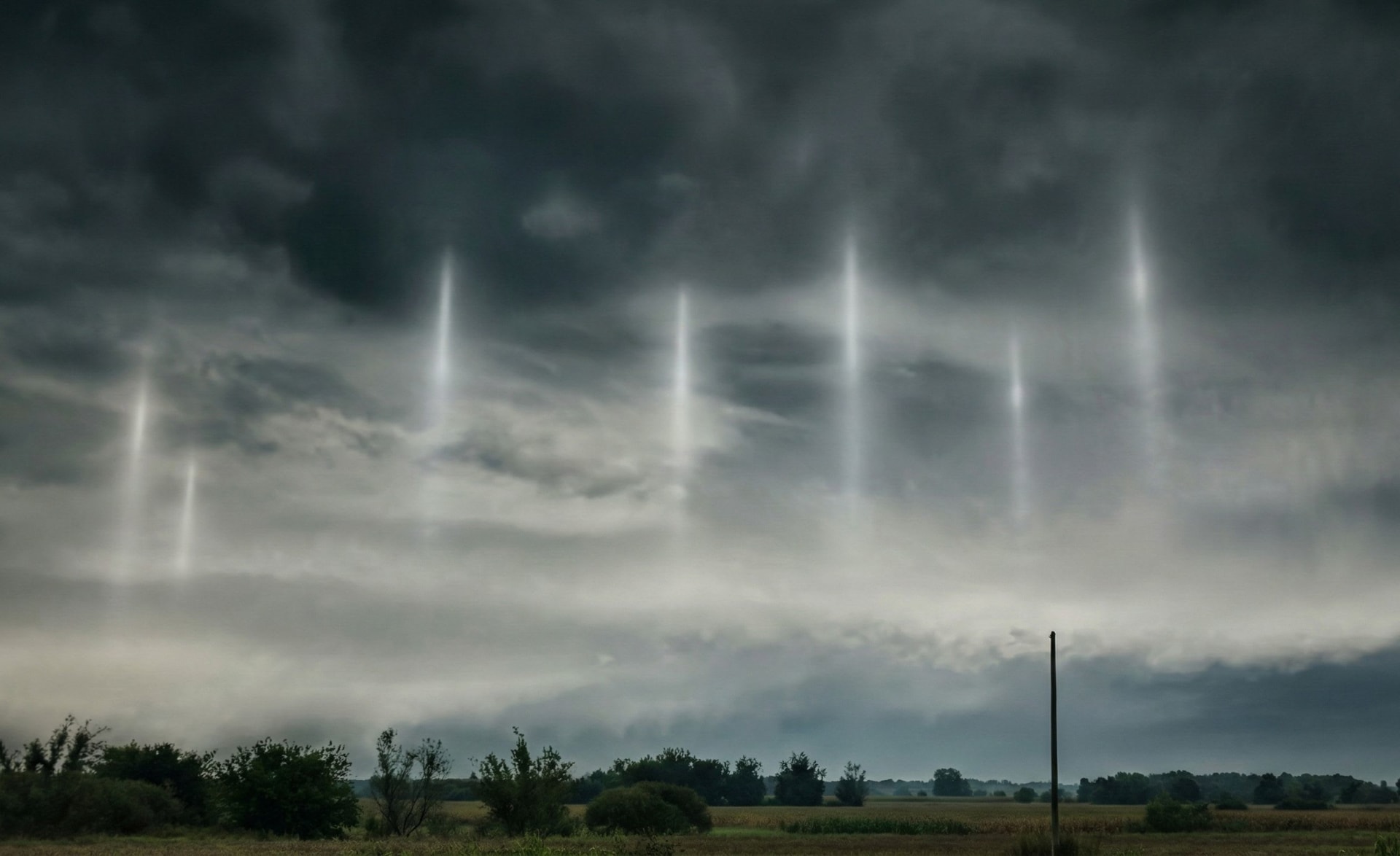
The seawall is slippery with frost. Beyond the dark harbor, you count nine fishing boats bobbing in Mikuriya Bay, their isaribi lamps ablaze to lure squid up from the depths. Then you glance up and freeze. Nine columns of white light stand vertically above each boat, ruler-straight, stretching three stories into the black sky as if someone sliced the night with laser beams. The air temperature reads minus 8 Celsius. You have just walked into one of coastal Japan's rarest optical tricks.
At Mikuriya Port in Tottori Prefecture, the combination of squid-fishing lights and winter cold occasionally produces isaribi kochu, vertical light pillars formed when flat ice crystals suspended in calm air reflect boat lamps back to shore. The effect is so uncommon that locals who have lived here for a decade report seeing it only three or four times. Peak season runs December through January, when Sea of Japan temperatures drop low enough and pressure systems stay calm enough to suspend hexagonal ice plates above the harbor.
The Science Behind Isaribi Light Pillars
Light pillars are optical illusions created by reflection, not physical columns of illumination shooting skyward. The mechanism requires three elements: a strong light source positioned below you, hexagonal plate-shaped ice crystals floating horizontally in the air, and atmospheric stillness.
Isaribi, the Japanese term for fishing fire, refers to the high-intensity lamps fishermen mount on boats to attract squid and other photophobic species to the surface at night. These lamps output enough lumens that, under the right conditions, their light bounces off ice crystals forming in the layer of air above the sea.
The crystals responsible are flat hexagonal plates, typically forming at temperatures between minus 10 and minus 20 Celsius. In calm, high-pressure weather, these plates fall through the air with their broad faces oriented horizontally, acting as millions of tiny mirrors. Each crystal reflects a fraction of the boat light. Because the crystals are suspended at various heights between the harbor and several hundred meters up, the collective reflection stretches into a vertical column from your perspective on shore.
The pillar is not located above the boat. It is an optical effect, visible only from certain angles. Walk 100 meters down the seawall and the pillar's apparent position shifts. The color of each pillar matches the light source, so the white-blue glow of modern LED isaribi lamps produces pale blue pillars, while older incandescent bulbs cast yellow columns.
Crucially, the phenomenon requires no precipitation. If snow or freezing rain is falling, turbulence disrupts the horizontal orientation of the crystals and the pillars vanish. The sweet spot is clear skies, sub-zero calm, and enough moisture in the air for ice crystals to nucleate without forming clouds.
When and Where to See Isaribi Light Pillars
The isaribi kochu season at Mikuriya Port peaks from December into late January, when cold continental air masses settle over the Sea of Japan and overnight temperatures drop below minus 5 Celsius. The harbor sits on the northwest coast of Tottori Prefecture in the small town of Daisen, about 40 minutes by car west of Tottori City.
Two viewing locations offer clear sightlines. The first is the Mikuriya Fishing Port itself, where a public seawall allows you to stand within a few hundred meters of the active boats. Access this spot by driving to the small harbor district and parking near the Osakana Center Mikuriya, a local fish market. The second is the Mikuriya Harbor Promenade, a raised viewing platform about one kilometer east that provides a wider panorama of the bay and better framing for photography.
Timing is everything. Squid boats depart around dusk and operate through the night, with the brightest isaribi activity between 10pm and 2am. The light pillars themselves appear only on nights when temperature, humidity, and atmospheric pressure align. You cannot predict this more than a few hours in advance. Local weather forecasts sometimes list "ice crystals" in the overnight conditions, a useful signal, but most sightings are opportunistic.
If you are traveling from outside Tottori, fly into Tottori Airport or take the JR San-in Main Line to Tottori Station, then rent a car. Public transit to Mikuriya Port is limited and does not run late enough for nighttime viewing. Drive west along Route 9 toward Daisen, then follow local roads to the harbor. The trip from Tottori City takes 30 to 50 minutes depending on traffic and exact port access points.
Nearby Nariishi Beach in Kotoura Town, 12 kilometers east, also reports occasional light pillar sightings from the same fishing fleet. The phenomenon has been documented at other Sea of Japan ports, including Shimonoseki, but Mikuriya has gained attention for the clarity and frequency of its displays relative to other coastal towns.
Moon phase matters less here than it does for aurora viewing, but a dark sky helps. Avoid nights with a full moon if you want the pillars to stand out sharply against the black sky. Cloud cover kills the effect entirely, so check the forecast for clear conditions before making the drive.
Your Witnessing Guide
Dress for extended exposure to sub-zero coastal wind. Layer a base layer, insulating mid-layer, and windproof shell. Bring a wool hat, insulated gloves, and non-slip boots rated for ice. The seawall and promenade surfaces freeze slick on pillar nights, and harbor edges have no guardrails. A headlamp is essential, but use a red filter or keep it pointed at the ground to avoid disrupting fishing operations. White lights shone at boats interfere with the isaribi and draw complaints from fishermen.
For photography, the stationary nature of light pillars makes them easier to shoot than aurora. Use a tripod and cable release. Start with f/4 to f/8, ISO 200 to 400, and shutter speeds between 6 and 20 seconds. The pillars do not move, so longer exposures pull out more detail without motion blur. A wide-angle lens captures multiple pillars in one frame. A telephoto (70-200mm) isolates individual columns and compresses the perspective to emphasize their height.
Bring a thermos of hot tea and hand warmers. You will be standing still for long periods, and coastal wind accelerates heat loss. A folding stool keeps you off the frozen ground if you are waiting for pillars to develop.
Safety considerations: stay clear of active fishing piers and do not enter restricted port areas. Fishing boats move in and out of the harbor throughout the night, and dock workers may be present. The phenomenon is weather-dependent, so do not count on seeing pillars on any given night. Some winters see only one or two strong displays. Patience and flexibility are required.
Water and snacks are hard to source near the port after dark, so pack what you need before leaving Tottori City. The nearest convenience store is a 10-minute drive inland.
Why It Matters
Isaribi kochu sits at the intersection of traditional fishing practice and atmospheric physics. Squid fishing with light attraction dates back centuries along the Sea of Japan coast, but the recognition of the light pillar phenomenon as a distinct optical event is more recent. The term isaribi kochu itself reflects local awareness of the connection between fishing culture and rare sky optics.
The pillars also serve as a visible indicator of atmospheric conditions. Their appearance signals high-pressure systems, calm air, and temperatures cold enough to form plate ice crystals without precipitation. For meteorologists and atmospheric optics enthusiasts, sightings provide real-time data on ice crystal formation in coastal microclimates.
Culturally, the phenomenon has gained traction on Japanese social media, with viral posts from Mikuriya Port in May 2024 drawing millions of views and sparking speculation about alien activity before the science was explained. This attention has brought modest tourism interest to Daisen, a town better known for Mount Daisen and its ski resorts than for its harbor.
Ecologically, the isaribi themselves play a role in the local squid fishery, which supports the regional economy. The lights exploit the phototactic behavior of Japanese flying squid and firefly squid, drawing them to the surface where they are netted. The sustainability of this fishery is tied to seasonal squid migration patterns and Sea of Japan water temperatures, both of which are shifting as the climate warms.
The pillars themselves are not threatened in a conservation sense, but their occurrence is tightly coupled to specific temperature windows. Warmer winters with fewer nights below minus 5 Celsius could reduce the frequency of ice crystal formation, making the phenomenon even rarer than it already is.
This is the short version
This page shows a taste. The app has the full list of where to see this, the exact timing, and live conditions for 1,000+ natural phenomena worldwide, so you know the moment one is genuinely worth the trip.