As of today, out of season, returns ~October. Earth Exhibit tracks the live conditions and flags it the moment it is on.
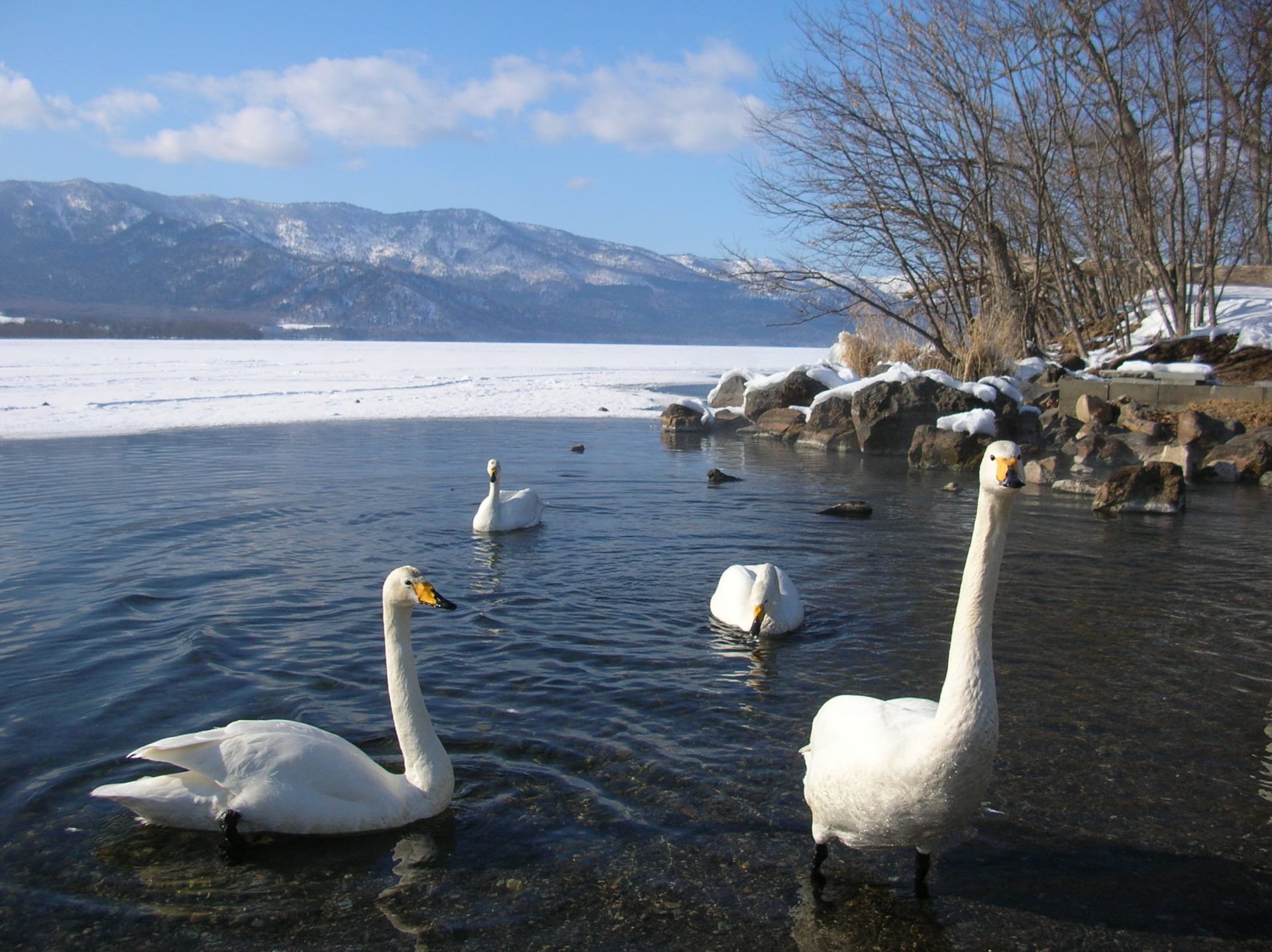
The sound arrives first. A resonant whooping that carries across frozen paddies in the pre-dawn dark. Then the sky fills with white. Thousands of whooper swans (Cygnus cygnus) lift from Hyoko Lake in synchronized waves, their 2-meter wingspans catching the first light as they head to the surrounding rice fields to feed. The first birds arrived on October 7, 2025 , but the spectacle peaks now, mid-winter, when more than 5,000 swans turn this 281-hectare reservoir in Niigata Prefecture into one of Japan's premier birding destinations.
The Science Behind Hyoko Whooper Swan Migration
Whooper swans are large, trumpet-voiced birds that migrate south from Siberia each winter, gracing lakes and wetlands from Hokkaido to northern Honshu . The species travels between 1,000 and 2,000 kilometers from breeding grounds along the Indigirka and Kolyma Rivers in Russia's Arctic tundra, following the East Asian flyway through staging areas on Sakhalin and the lower Amur River before fanning out across Japan.
Adults measure around 140 cm in length with a wingspan of 205 to 235 cm and can weigh up to 12 kg , making them among the largest flying waterfowl in the Northern Hemisphere. The bill is mostly yellow with a distinct triangular patch pointing toward the tip, unlike the smaller tundra swan whose yellow area is rounded and reduced . Juveniles wear gray plumage that whitens over their first winter, and their pinkish bills darken to adult coloration by spring.
Their loud, resonant "whoop-whoop" call carries far across frozen lakes , a sound that gave the species its English name. These calls serve multiple purposes: maintaining flock cohesion during migration, coordinating take-offs from roosting sites, and reinforcing pair bonds. Whooper swans mate for life, with pairs returning to the same wintering sites year after year.
Hyoko offers what long-distance migrants need most. The reservoir, created in 1639 as an agricultural water source, remains partially ice-free through winter. Surrounding rice paddies provide spilled grain and crop stubble, and the site's designation as a Ramsar wetland in 2008 ensures protection from disturbance. The first flocks migrate from Siberia in early October and stay until late March, with peak numbers around late November exceeding 5,000 swans .
When and Where to See Hyoko Whooper Swan Migration
The core viewing season runs December through February. Swans begin arriving early October, and by the end of November they reach about 5,000 birds . Numbers hold steady through mid-winter before the northward migration begins in March.
Dawn is the magic hour. The swans roost on the lake overnight, then lift off in coordinated groups between 6:00 and 7:30 AM to feed in the rice paddies west and south of the reservoir. The morning flight is loud, chaotic, and involves hundreds of birds in the air simultaneously. They return to the lake in late afternoon, typically between 3:30 and 5:00 PM, for evening feeding and to roost. Both flights offer photography opportunities, but morning light is cleaner.
Three viewing areas provide different perspectives:
Hyoko Bird Sanctuary Observation Deck (37.9252282, 139.0595498) sits at the main visitor area on the lake's eastern shore. Two observation huts with large windows offer sheltered viewing. The site includes binoculars for loan, toilets, parking, and an information center (Tel: 0250-62-2690) with maps showing current swan locations. Feeding occurs here at 9 AM, 11 AM, and 3 PM daily, a tradition dating to 1954 when Juzaburo Yoshikawa became Japan's first person to successfully feed wild swans.
Hyoko North Shore Hide (37.8383791, 139.2374523) offers a quieter vantage with fewer visitors and better angles for photographing swans on the water. The 30-minute walk from Suibara Station means most tour groups skip this spot.
West Bank Rice-Field Viewpoints (37.1242424, 138.5295277) place you among the feeding birds. Park along farm roads and walk the field edges. Swans tolerate observers at 30-meter distances here, unlike at the lake where they're more wary. Morning is best; afternoon feeding happens closer to the lake.
Access: Fly into Niigata Airport (KIJ) or take the Joetsu Shinkansen to Niigata Station. From there, Hyoko is 40 to 70 minutes by car depending on route and snow conditions. Regional buses run seasonally, but schedules are irregular. From Suibara Station on the Uetsu Main Line, the lake is about a 30-minute walk . A rental car offers the flexibility to move between viewing sites and reach the paddies.
Roads ice over. December through February brings snow that can close rural routes temporarily. Check road conditions before dawn departures. Parking at the main observation deck fills by 8 AM on weekends; arrive at 6 AM or earlier for the best light and parking.
Your Witnessing Guide
Temperatures at Hyoko hover between minus 5 and 5 degrees Celsius December through February. Wind off the lake drops the effective temperature by 5 to 10 degrees. Layer: base layer, insulated mid-layer, windproof outer shell. Insulated, waterproof boots are non-negotiable; you'll stand on frozen ground or muddy field edges for an hour or more. Bring hand and toe warmers.
Binoculars (8x42 or 10x42) let you study bill patterns, watch social interactions, and identify the occasional tundra swan mixed into the flocks. A spotting scope on a tripod is overkill unless you're serious about distinguishing species, but it does allow you to scan distant fields.
For photography, a camera with at least 400mm equivalent focal length is the minimum. The swans tolerate approach to about 30 meters in the fields, closer if you sit still, but flight shots demand reach. Settings for morning flight: ISO 800 to 1600, shutter speed 1/2000s or faster to freeze wing motion, aperture f/5.6 to f/8 for depth of field across multiple birds. Expose for the white plumage; the histogram should push right without clipping. Autofocus tracking (continuous AF with subject detection if your camera has it) handles the erratic flight paths better than single-point focus.
The pre-dawn cold drains batteries fast. Carry two spares and keep them in an inner pocket against body heat. Memory cards fail in extreme cold; bring backups.
Do not approach roosting swans on the lake. Stay on designated paths and behind barriers at the observation deck. In the fields, watch from field edges or farm roads; do not walk into planted areas. The Ministry of the Environment advises against feeding or handling wild birds to maintain natural behavior and reduce disease risks . The organized feeding at the observation deck is monitored and uses appropriate food; do not offer bread, snacks, or other human food.
Swans hiss and may strike with their wings if you approach a nest or cornered bird. Give them space. Parents with gray-plumaged juveniles are especially protective.
Why It Matters
Hyoko was registered as a Ramsar site on October 30, 2008 , recognizing its international importance as wetland habitat. Japan's Ramsar wetlands such as Hyoko, Izunuma-Uchinuma, Tofutsu, and Utonai play vital roles in protecting wintering flocks . The site supports not just whooper swans but tundra swans, northern pintails, Eurasian wigeons, tufted ducks, and common pochards, with more than 100 bird species in 31 families confirmed.
Satellite tracking studies have mapped the migration routes these swans follow. Birds wintering at Hyoko breed along the middle reaches of the Indigirka and lower Kolyma Rivers, more than 4,000 kilometers north. They stopover at coastal wetlands in Sakhalin, the mouth of the Amur River, and the northern shores of the Sea of Okhotsk. The same individuals return to Hyoko each winter, navigating by landmarks, magnetic cues, and social learning from older birds in the flock.
The species faces pressure from habitat loss at stopover sites, agricultural conflicts (farmers sometimes view them as crop pests), and avian influenza. The species is globally stable but faces local threats from habitat alteration, agricultural conflicts, and avian influenza . Monitoring wintering populations helps biologists track the health of breeding populations in remote Arctic Russia where ground surveys are difficult.
Hyoko was the first feeding ground for swans in Japan and is protected by the government . Local residents take pride in the swans' return each autumn. The "Uncle Swan" tradition, feeding the birds daily and calling "Koi, Koi!" (Come, come!), has passed through generations since 1954. It's an unusual example of intentional wildlife feeding that, when carefully managed, supports both conservation goals and community connection to migratory species.
For birders, Hyoko offers a chance to study swan behavior at close range. Watch how pairs maintain contact through soft vocalizations, how juveniles practice flight skills under parental supervision, and how flocks coordinate take-offs with escalating calls. You'll notice the rigid social hierarchy: older pairs claim prime feeding spots, younger birds wait at the edges, and lone birds without mates forage in the least productive areas.
This is the short version
This page shows a taste. The app has the full list of where to see this, the exact timing, and live conditions for 1,000+ natural phenomena worldwide, so you know the moment one is genuinely worth the trip.