As of today, out of season, returns ~December. Earth Exhibit tracks the live conditions and flags it the moment it is on.
The boat engine cuts out three miles west of Tokashiki Island, and suddenly the only sound is water lapping against the hull. Then you hear it: a long, low exhale like a subway vent releasing pressure, followed by a plume of mist catching the subtropical sun. Forty meters off the port side, a dark back the size of a minibus rolls through the surface, and then the tail stock lifts, the flukes rise dripping against a pale winter sky, and a 14-meter humpback whale slides back into the East China Sea without so much as a splash. Thirty seconds later, the hydrophone the guide has dropped over the side picks up the singer. A male, somewhere below, cycling through a phrase of moans and cries that has been evolving across this population for decades. You are sitting in one of the most reliable whale-watching corridors on Earth, and the season has barely started.
The Science of Okinawa's Winter Visitors
Humpback whales (Megaptera novaeangliae) are among the longest-distance migrants of any mammal. The individuals that appear off Okinawa each winter have traveled roughly 5,000 to 8,000 kilometers from summer feeding grounds in the cold, krill-rich waters near the Kuril Islands, the Sea of Okhotsk, and the Aleutian chain off Alaska. They arrive carrying months of accumulated blubber, because they will not feed again until they return north. From January through March, these whales live entirely off stored energy, devoting every calorie to breeding, calving, and nursing.
The Kerama Islands, a cluster of about 20 islands and reefs roughly 40 kilometers west of Naha, offer exactly the conditions humpbacks need for reproduction. Winter water temperatures hold between 22 and 24 degrees Celsius, warm enough to support newborn calves that lack the thick blubber layer of adults. The seafloor around the Keramas rises to relatively shallow shelves, and the islands themselves create protected channels where mothers can nurse calves away from open-ocean swells and large predators.
The breeding population using the Kerama grounds is estimated at 1,000 to 2,000 individuals. That number has been climbing. Japan banned commercial whaling of humpbacks in 1963, and international protections under the IWC moratorium followed in 1966. The recovery has been slow (humpback females produce only one calf every two to three years, after an 11-month gestation), but the trend lines are moving in the right direction, and the Kerama population reflects that broader Pacific recovery.
Male humpbacks produce some of the most complex vocalizations in the animal kingdom. A single song can last 10 to 20 minutes and is built from repeated phrases arranged into themes. All males in a given population sing roughly the same song in a given season, but the song changes over time, with new phrases introduced and old ones dropped. Researchers from Okinawa Churashima Foundation have been recording these songs for years, and the Kerama population's repertoire shows influence from both the Ogasawara (Bonin Islands) breeding group and populations further into the western Pacific. The songs carry for kilometers underwater. On a calm day, if you put your head below the surface while snorkeling near Tokashiki, you can hear them without any equipment at all.
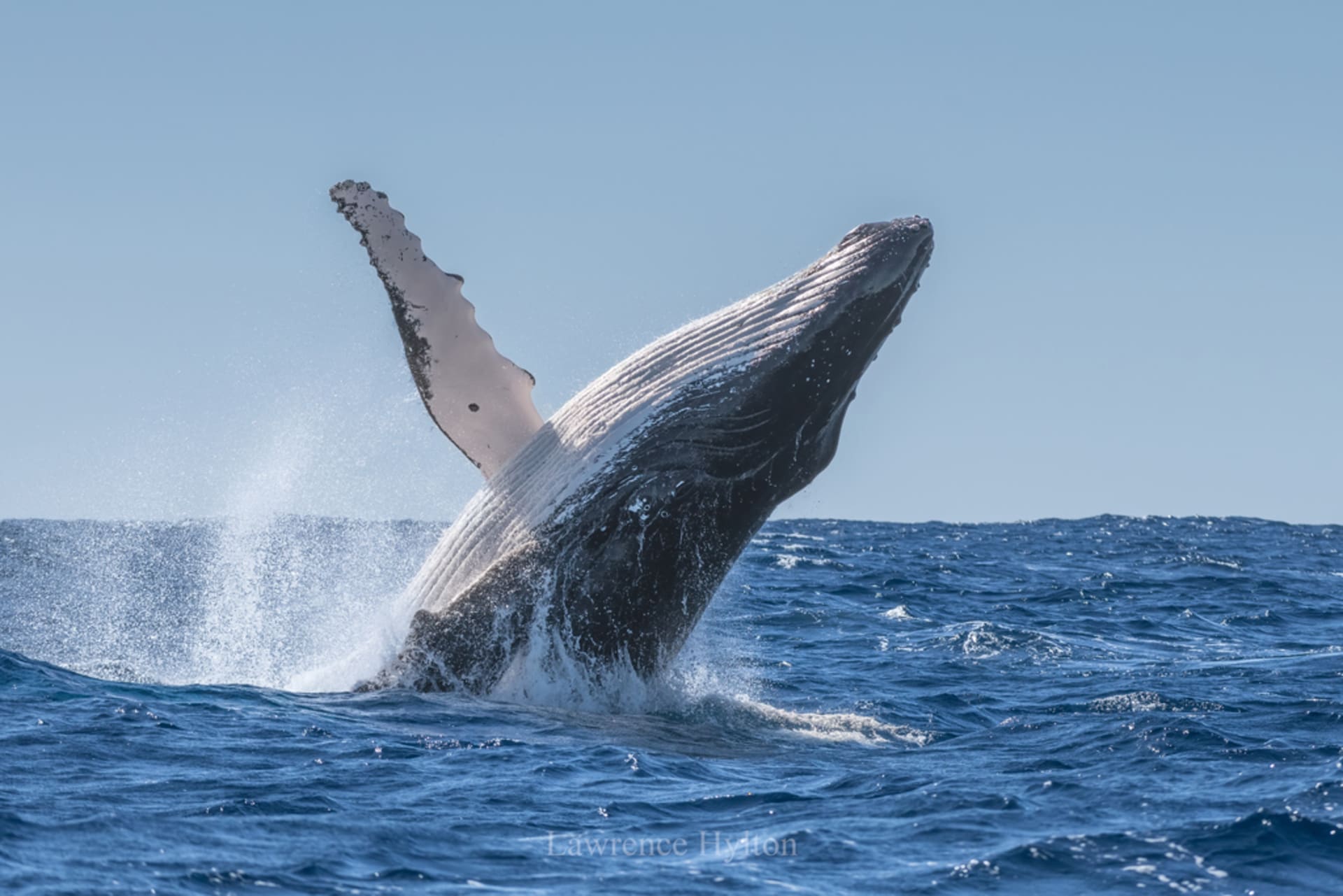
Behaviors you can expect to see from the surface include pec slapping (the whale lifts one of its enormously long pectoral fins and smacks it against the water), spy-hopping (the whale rises vertically to eye level, apparently surveying the surface world), peduncle throws (the rear half of the body is flung sideways, an aggressive or competitive display), and the iconic breach, in which a 30-ton animal launches nearly clear of the water and crashes back in an explosion of white. Breaching is still not fully understood, but it is most frequently observed in competitive groups of males or in mother-calf pairs where the calf appears to be learning through imitation.
When and Where to See Them
Peak season runs from mid-January through mid-March, with February as the statistical sweet spot. Tour operators out of Naha report sighting rates of 90% or higher during peak weeks. That is not a marketing number. The Kerama strait is narrow enough and the whale density high enough that boats rarely return empty. By late March, the adults begin their northward migration, and by April the strait is quiet again.
The primary departure point is Naha's Tomari Port (26.21N, 127.68E), where a half-dozen licensed operators run morning and afternoon whale-watching trips between January and March. The ride to the Kerama grounds takes 50 to 70 minutes depending on the vessel and sea conditions. Some tours also depart from Zamami Island (26.23N, 127.30E), which puts you closer to the core habitat and cuts transit time, though it requires an overnight stay or an early ferry from Naha.
The heart of the action is within Keramashoto National Park (26.20N, 127.36E), designated in 2014 and encompassing the waters and coral reefs surrounding Tokashiki, Zamami, Aka, and Geruma islands. The national park designation brought stricter approach regulations: licensed boats must maintain a minimum distance of 50 meters from whales (100 meters for mothers with calves) and cannot pursue animals that show avoidance behavior. These rules are enforced, and the result is a whale-watching culture that is notably respectful compared to some other global hotspots.
Water conditions matter. The East China Sea in winter is not the glassy tropical lagoon that Okinawa's tourism board photographs suggest. Wind from the north can push swells to 1.5 to 2 meters in the strait, and roughly one in five scheduled trips is cancelled or rerouted due to weather. Book multiple days if your schedule allows, and come prepared: seasickness medication (taken 30 minutes before departure, not after the nausea starts), a light windbreaker, and polarized sunglasses to cut glare on the water. The air temperature in February averages 17 to 19 degrees Celsius, comfortable in the sun but cool on a moving boat with wind chill.
Photography and Witnessing Guide
Whale photography is an exercise in patience punctuated by moments of frantic shutter work. The single most useful piece of equipment is a telephoto zoom in the 100-400mm range. Anything shorter and you are shooting distant splashes. Anything longer and the field of view is too narrow to track a moving animal from a rocking boat.
Set your shutter speed to 1/1000s or faster. Breaches happen quickly, and the difference between a sharp frame of a whale at the apex of its leap and a blurred smear of gray is entirely down to shutter speed. Use continuous autofocus (AF-C or AI Servo) and set your camera to its highest burst rate. A breach from first appearance to full re-entry lasts about 1.5 seconds. At 10 frames per second, that gives you 15 chances. At 3 frames per second, you get 4.
Watch for blows. A humpback's exhalation produces a bushy, V-shaped spout visible from several hundred meters. The blow is your early warning system. Once you see it, keep your lens trained on that spot. Humpbacks typically surface to breathe three to five times in quick succession before a longer dive, and the flukes-up dive at the end of a breathing sequence is your best opportunity for the classic tail shot against the island backdrop.
Bring a waterproof bag or dry bag for your camera gear between shooting windows. Salt spray is relentless, and a single wave over the bow can end your shoot for the day. A microfiber cloth for wiping lens elements is worth more than any filter.
For those less interested in photography, the witnessing itself is the point. Find a spot at the rail with a clear sightline, keep your sunglasses polarized, and resist the urge to watch through a phone screen. The sound of a whale breathing 30 meters away is something a phone speaker will never reproduce. Let your eyes adjust to the scale. The brain needs a few sightings before it stops trying to make the whale smaller than it is.
The Bigger Picture
The Kerama breeding ground is part of a network of humpback wintering areas scattered across the western North Pacific, from Ogasawara to the Philippines to the Mariana Islands. Genetic studies show exchange between these populations, meaning the health of the Kerama group is linked to the health of the broader western Pacific stock. The recovery is real but not guaranteed. Ship strikes, entanglement in fishing gear, ocean noise pollution from commercial shipping, and the long-term effects of warming oceans on krill availability in northern feeding grounds are all ongoing pressures.
Okinawa's relationship with these whales has shifted dramatically within a single human lifetime. Naha was once a whaling port. Today it is a whale-watching port. That transition, from extraction to observation, happened because the economics changed (a living whale generates far more tourism revenue over its 50-year lifespan than a dead whale generates once) and because public perception changed. The Zamami Village whale-watching association, founded in 1991, was among the first organized efforts to turn the Kerama humpbacks into a conservation asset. More than 30,000 people now take whale-watching tours from Okinawa each winter season, and that number supports local boat operators, guides, hotels, and restaurants across the island chain.
The whales will leave by April. They will swim north, following the warming water and the blooming plankton, back to the feeding grounds where they will spend the summer rebuilding the blubber they burned through in Okinawa's calm, warm shallows. And next January, they will come back. The cycle is old, far older than the islands' human settlement, and watching it continue, watching a calf learn to breach in the same strait where its mother learned years before, is a reminder of how much persistence is built into the living world when given enough room to operate.
This is the short version
This page shows a taste. The app has the full list of where to see this, the exact timing, and live conditions for 1,000+ natural phenomena worldwide, so you know the moment one is genuinely worth the trip.