As of today, out of season, returns ~February. Earth Exhibit tracks the live conditions and flags it the moment it is on.
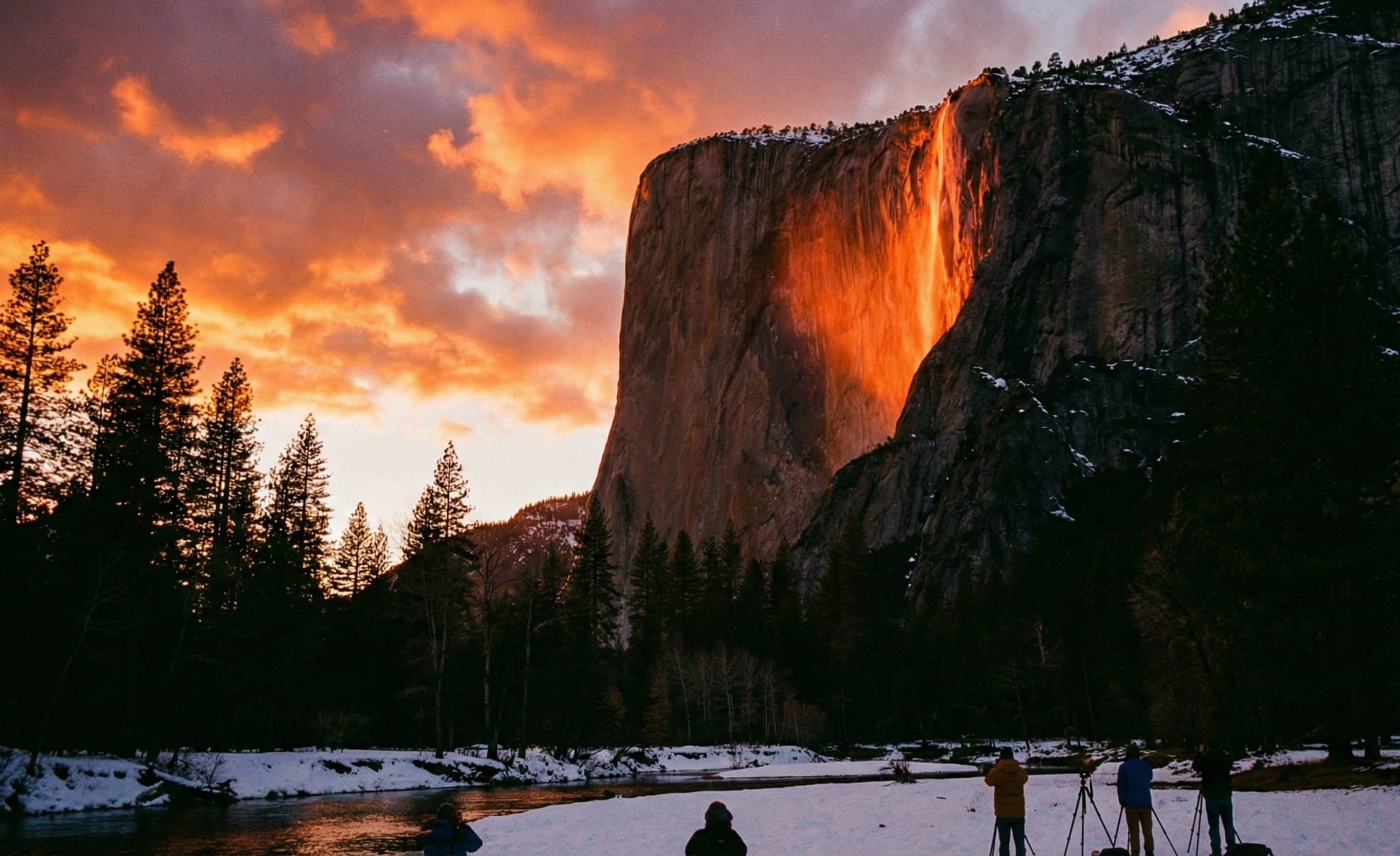
The crowd goes quiet all at once. Two thousand people standing in snow-packed meadows and along the shoulder of Northside Drive, cameras aimed at a sliver of water so thin you could lose it against the granite if you didn't know where to look. For twenty minutes nothing has happened. Horsetail Fall catches the last of the afternoon light and looks like any other winter waterfall: white, cold, unremarkable. Then, at 5:21 PM, the color shifts. A warm amber bleeds into the upper cascade. Within sixty seconds the entire ribbon of water is glowing deep orange against 3,000 feet of blue-gray cliff face, and the silence breaks into a low collective gasp. You are watching solid rock appear to pour molten lava, and it will be over in less than ten minutes.
The Optics Behind the Glow
Horsetail Fall is a seasonal waterfall on the eastern face of El Capitan, fed by snowmelt from the summit. It flows only during winter and early spring, dropping roughly 1,570 feet in two distinct tiers before vanishing into talus at the base. For most of its brief life each year, it is an anonymous trickle that most visitors never notice. What makes it extraordinary is geometry.
In mid-to-late February, the setting sun tracks along a very specific arc toward the western horizon. For a window of roughly ten days (February 16 through 24), the sun's position at sunset aligns with the orientation of El Capitan's east face at an angle that sends direct, unobstructed light across the valley and onto the thin sheet of falling water. The light has to travel through a thick wedge of atmosphere at that low angle, which strips out shorter blue and violet wavelengths through Rayleigh scattering. What remains is concentrated red and orange light, the same physics that paint sunsets, but here the light hits a moving surface of water rather than clouds. The falling droplets scatter and reflect those warm wavelengths in every direction, and against the shadowed granite the effect is startling: the waterfall appears to ignite.
Peak intensity occurs in the final two to three minutes before the sun drops below the horizon or behind ridgeline obstructions. During those minutes, the color deepens from amber to a molten red-orange that genuinely resembles flowing lava. The entire display from first hint of color to last glow typically spans eight to twelve minutes. Then the light is gone, the waterfall returns to white, and the temperature drops fast.
Three conditions must align simultaneously. The waterfall must actually be flowing, which requires enough snowpack on El Capitan's summit and temperatures warm enough to produce melt. The western horizon must be clear of clouds at sunset, because even a thin band of overcast will block the direct light that creates the effect. And the calendar must fall within that narrow February window when the sun angle is correct. Roughly 30 to 40 percent of days within the viewing window produce a good glow. Some years, persistent storm systems shut out the phenomenon entirely. Other years, low snowpack means the fall isn't flowing at all.
This is worth stating plainly: the Horsetail Firefall is not the same as the historic Yosemite Firefall, in which park concessioners pushed burning hot embers off the edge of Glacier Point each summer evening from the early 1900s until the National Park Service discontinued the practice in 1968. That was a human spectacle. This is a purely natural optical phenomenon, first widely photographed by Galen Rowell in 1973, and it shares nothing with its predecessor except the name.
When and Where to See It
The optimal viewing window runs February 16 through 24, though faint color can sometimes appear a few days on either side. Peak color shifts by a minute or two each evening as the sun's position changes. By late February the angle has moved too far north and the light no longer reaches the fall.
Two primary viewing areas offer clear sightlines to the upper fall.
El Capitan Picnic Area (37.728, -119.621) sits directly south of the fall along Northside Drive and provides the most popular vantage point. You are close enough here that a 200mm lens fills the frame nicely with room for the surrounding granite. The picnic area and adjacent meadow get packed; expect company.
Northside Drive Pullouts (37.727, -119.620) offer slightly varied angles along the road west of the picnic area. Some photographers prefer these spots for compositions that include more of El Capitan's face or foreground trees.
The National Park Service now requires reservations for vehicle access to the viewing areas during the Firefall window. This system was implemented after years of escalating crowd pressure that trampled fragile meadow vegetation, created dangerous roadside congestion, and damaged the riverbank ecosystem along the Merced. You need to secure a timed-entry reservation through Recreation.gov, and they go fast. Without one, you will not be allowed to park in the area during the event window. Plan this weeks in advance, not days.
Sunset time in Yosemite in mid-February falls around 5:20 to 5:35 PM Pacific. The glow typically begins 10 to 15 minutes before official sunset and ends right around sunset or a minute or two after.
Witnessing and Photography Guide
Here is the honest reality of the experience: you will spend three to four hours standing in the cold for roughly ten minutes of light. February evenings in Yosemite Valley hover near freezing. Snow is common on the ground. By the time the glow begins, your feet will be numb and your hands will be stiff, and you'll need to operate camera controls with precision during the most critical two minutes of the entire wait.
Dress for a winter bivouac, not a casual sunset. Insulated jacket, hat, gloves (with liner gloves underneath for camera work), warm boots, and hand warmers are not optional. Bring a folding chair if you can carry one. Pack snacks and water. A headlamp with a red mode will save you during the walk out after dark, when two thousand people are all shuffling back to the shuttle or their cars simultaneously.
Arrive early. Three to four hours before sunset is standard for securing a good position. Prime spots fill fast, and with the reservation system you cannot simply circle back for a second attempt. Stake your tripod, settle in, and wait.
For camera settings, start with ISO 100 to 400, aperture f/8 to f/11, and shutter speed around 1/30 to 1/125 second as the glow begins. A telephoto lens in the 200 to 400mm range is essential. Anything shorter and the fall will be a tiny streak lost in a massive wall of granite. Anything longer and you risk framing out the context that makes the image compelling.
As the glow intensifies in the final minutes, the light actually gets richer but the ambient exposure drops. Be ready to slow your shutter to 1/10 or even 1/4 second for those last frames. Bracket your exposures aggressively. Shoot RAW. A remote shutter release eliminates the vibration from pressing the button at those slow speeds, and a tripod is absolutely mandatory for anything beyond the widest apertures.
Cold drains batteries fast. Carry a backup battery in an interior pocket close to your body and swap it in when the original dies, which it likely will. Keep a lens cloth accessible because your breath and the cold air will fog your front element at the worst possible moment.
Vertical compositions generally work best, letting you capture the full length of the fall with El Capitan's face providing scale. But experiment during the long wait. The pre-glow period is your rehearsal.
One friction detail worth knowing: on cloudy days, the parking areas and viewing spots can still be packed with hopeful visitors. You may wait the full four hours and see nothing but a gray waterfall in gray light. The reservation is used either way. That uncertainty is part of the deal.
The Bigger Picture
Horsetail Firefall exists because of a coincidence so specific it borders on absurd. A waterfall that flows for only a few months. A cliff face oriented at precisely the right compass bearing. A sun angle that lines up for barely ten days per year. Weather that must cooperate on the exact evening you are present. Remove any single variable and the phenomenon simply does not occur.
That fragility is the point. The NPS reservation system, the meadow restoration fencing, the volunteer crews directing foot traffic in the dark: all of it exists because the first decade of the Firefall's viral popularity nearly destroyed the landscape that makes it possible. Cryptobiotic soil crusts in the meadows take decades to recover from trampling. Riverbanks along the Merced eroded measurably during peak Firefall years before crowd management was introduced. The phenomenon is a ten-minute light show. The ecosystem it depends on operates on a timeline of centuries.
What Horsetail Firefall demonstrates, perhaps more clearly than any other optical phenomenon in North America, is that the most extraordinary natural events are not performances. They are intersections of physics, geography, season, and weather that happen whether or not anyone is watching. You do not go to see the Firefall. You go to stand in the right place at the right time with the right conditions, and if the planet cooperates, you get to witness something that looks impossible. If it doesn't, you stood in a beautiful valley on a February evening, and that is still worth the cold hands.
This is the short version
This page shows a taste. The app has the full list of where to see this, the exact timing, and live conditions for 1,000+ natural phenomena worldwide, so you know the moment one is genuinely worth the trip.