As of today, out of season, returns ~November. Earth Exhibit tracks the live conditions and flags it the moment it is on.
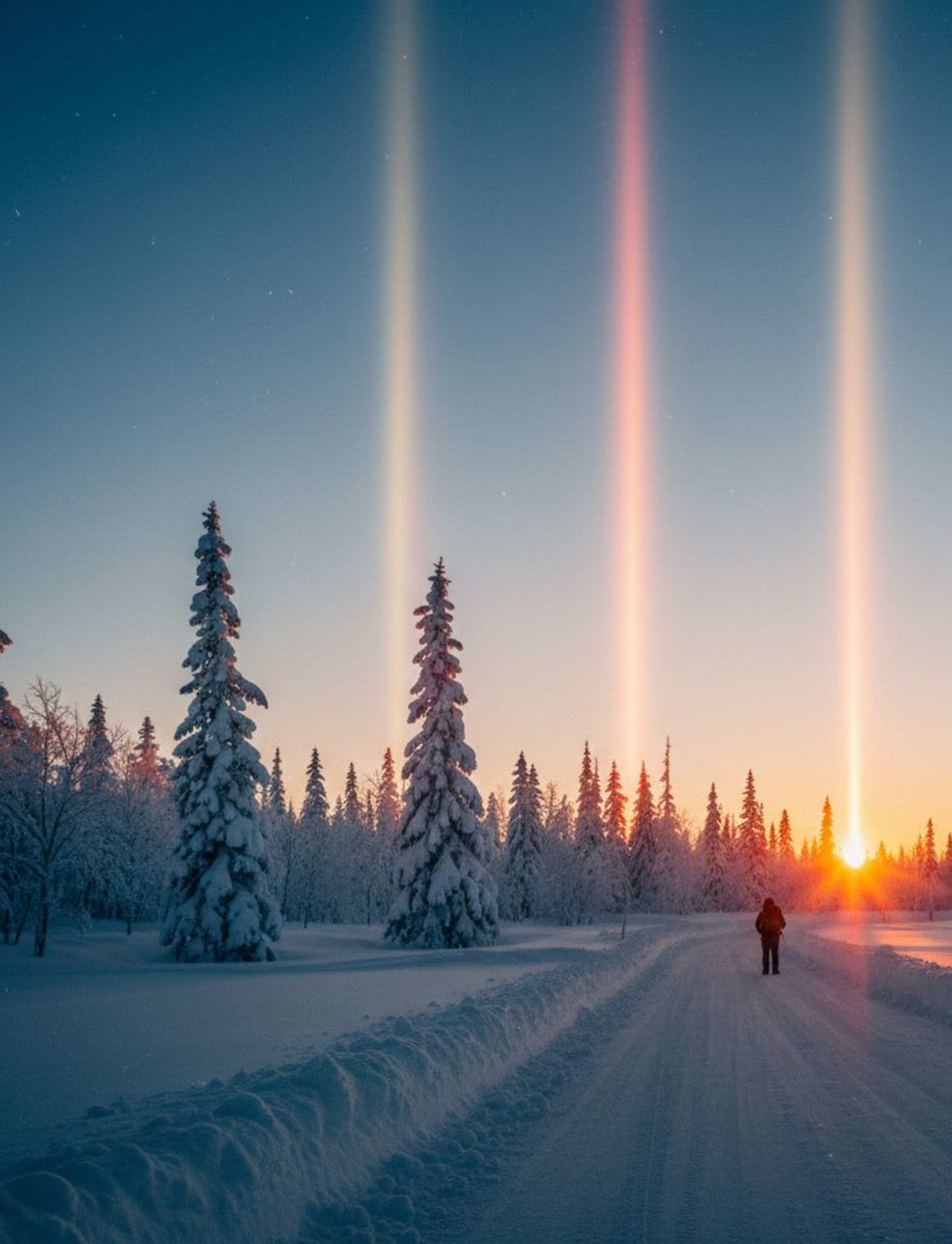
The cold hits your face before you notice the sky. You're standing in Odori Park at 6:45am, breath visible, fingers stiff inside gloves. Then someone points up. Above the winter sun, a column of light stretches vertically into the pale sky, glowing white-gold like a searchlight pointed at nothing. This is a sun pillar, a mirror image of the sun drawn by millions of ice crystals floating in stillness.
On clear mornings when temperatures drop below minus 10 degrees, flat ice crystals form in calm air.
A sun pillar is a vertical column of light that appears to come out of the top or bottom of the sun, formed when sunlight reflects off the outside of nearly-horizontal faces of large oriented ice crystals. In Hokkaido, the coldest major island in Japan, these conditions align reliably from December through February. Sapporo's urban heat mixes with Siberian air masses. The Sea of Okhotsk coastline near Abashiri freezes into drift ice fields. Both create the perfect stage for one of winter's quietest optical shows.
The Science Behind Hokkaido Sun Pillars
Hexagonal plate-shaped and column-shaped ice crystals cause the phenomenon. Plate crystals generally cause pillars only when the sun is within 6 degrees of the horizon; column crystals can cause a pillar when the sun is as high as 20 degrees above the horizon. The crystals act like tiny horizontal mirrors suspended in the air. As they wobble and drift downward, their flat faces catch sunlight at slightly different angles, each reflecting a sliver of light toward your eye.
The crystals tend to orient themselves near-horizontally as they fall or float through the air, and the width and visibility of a sun pillar depend on crystal alignment. Perfect alignment would reflect light like a single mirror. In reality, the crystals flutter as they fall, like leaves. This wobble spreads the reflected light into a vertical column rather than a single point. The more crystals present and the calmer the air, the brighter and taller the pillar appears.
The ice crystals responsible for halos are typically suspended in cirrus or cirrostratus clouds in the upper troposphere (5 to 10 kilometers), but in cold weather they can also float near the ground, in which case they are referred to as diamond dust. Hokkaido's interior gets cold enough for ground-level diamond dust, which can produce pillars even without high clouds. When both conditions occur together, the effect intensifies. The best time to observe sun pillars is at sunrise or sunset when the sun is hidden just below the horizon. Sun pillars often appear red because light from the rising or setting sun has lost much of its blue components due to scattering from air molecules before it reaches the ice crystals.
When and Where to See Hokkaido Sun Pillars
The core season runs December through February, peaking in January when Hokkaido's temperatures bottom out. A combination of cold air in the sky and radiational cooling due to lack of cloud cover resulted in temperatures like minus 18.7 degrees in the town of Bihoro, with mid-winter temperatures in line with late January and early February throughout the region. These are the mornings when pillars form.
Odori Park in central Sapporo offers the easiest access. The 1.5-kilometer park runs east-west, giving clear views of the eastern horizon at dawn. Mount Moiwa Observatory, 531 meters above the city, provides an elevated perspective where you can sometimes see pillars forming over the cityscape below. The elevation also increases your chances of encountering the ice-crystal layer directly.
Otaru Canal, 40 minutes northwest of Sapporo, frames pillars against historic red-brick warehouses. The waterfront often traps cold air, encouraging diamond dust formation. Photographers favor this location for the compositional possibilities.
The Abashiri coastline on the Sea of Okhotsk offers the most dramatic setting. The sea surface of northeastern Hokkaido becomes icy due to extreme temperature. From January to March, you can walk on the frozen sea. Here, pillars form over drift ice fields, the vertical light columns rising from a horizontal expanse of white. Access requires regional flights to Memanbetsu Airport or the Limited Express Okhotsk train from Sapporo (5.5 hours).
Dawn is optimal. The sun angle matters more than the time on a clock. In mid-January, sunrise in Sapporo occurs around 7:00am. The half-hour before and after sunrise provides the lowest sun angles. To witness a sun pillar, one must position themselves so that the sun is low on the horizon. This positioning allows for a greater angle between the observer and the ice crystals, maximizing the chances of seeing a pillar. Sunset works equally well, though morning air tends to be calmer after overnight cooling.
For a light pillar to form, the atmosphere must be calm and cold, with an absence of wind. Check forecasts for clear, windless mornings with lows below minus 10 Celsius. After a cold, clear night, arrive 30 minutes before sunrise. Pillars can appear suddenly as the sun nears the horizon and fade within minutes as the sun climbs higher or wind disrupts the ice crystals.
Your Witnessing Guide
Dress for static cold. You will stand still, watching the sky, while temperatures hover around minus 15 Celsius or lower. Base layers (synthetic or merino wool), insulated mid-layers, a windproof outer shell. Insulated boots rated to minus 20 Celsius. Two pairs of gloves: thin liners inside insulated mittens. A balaclava or neck gaiter that covers your face without fogging glasses. Hand warmers in pockets and toe warmers in boots.
For photography, use a tripod. Your hands will be too cold for steady handheld shots, and the low light demands slower shutter speeds. Set ISO between 400 and 800 to minimize noise while maintaining shutter speed. Aperture around f/8 to f/11 keeps the sun and pillar in focus without overexposing. Bracket exposures: the dynamic range between the bright sun and darker sky can be extreme. A zoom lens (24 to 105mm range) lets you frame the pillar tightly or include foreground elements like trees or buildings for scale.
Batteries drain fast in extreme cold. Carry spares inside your jacket, against your body. Let the camera acclimate gradually when moving from cold to warm to prevent condensation on the sensor and lens. Shoot RAW for maximum post-processing flexibility with white balance and exposure.
Watch for diamond dust at ground level. It looks like glitter suspended in the air, visible when backlit by streetlights or the low sun. If you see it, pillars are likely. The phenomenon is silent. No sound, no wind. Just light and cold.
Safety: Frostbite can occur on exposed skin within 10 to 15 minutes at minus 15 Celsius. Cover all skin. Ice on sidewalks and viewpoints is inevitable. Microspikes or traction cleats for boots provide grip. Avoid standing in roadways for photographs. In Abashiri, stay off sea ice unless accompanied by a guide familiar with safe routes.
Bring water in an insulated bottle. Dehydration happens faster in dry, cold air. Hot tea or coffee in a thermos helps maintain core temperature during long waits.
Why Sun Pillars Matter
Sun pillars belong to the family of halo phenomena, optical effects produced when light interacts with ice crystals in specific geometric arrangements. These are atmospheric phenomena created by the reflection and refraction of light by ice crystals in the atmosphere. Sundogs, light pillars, and other kinds of halos seen in the sky are atmospheric phenomena that occur when light is reflected or refracted by ice crystals in the atmosphere. Each type requires precise crystal shape, orientation, and sun angle. Studying them helps atmospheric scientists understand ice crystal formation, air stability, and upper-tropospheric conditions.
If conditions are right, there is the possibility of capturing diamond dust and sun pillars, winter phenomena caused by water molecules freezing where they are in the air. The occurrence of ground-level diamond dust indicates extremely cold, stable air, often associated with high-pressure systems that bring clear skies and calm winds. Forecasters use reports of these phenomena as indicators of atmospheric conditions.
Culturally, Hokkaido's winter optical phenomena connect to the island's identity as Japan's coldest, most remote frontier. The Ainu, Hokkaido's indigenous people, lived through winters far harsher than those experienced today in heated cities. While specific Ainu terms for sun pillars are not widely documented, their deep knowledge of winter weather patterns included observations of ice fog, frost formations, and atmospheric light effects. Modern Hokkaido residents still mark the winter by these occurrences, a reminder that the landscape imposes its terms.
The effect of hexagonal ice crystals in the atmosphere reflecting on the rising or setting sun creates an illusion of a brilliant column in the sky. The condition needs to be still without wind, and in an extremely low temperature. The phenomenon is ephemeral. It depends on stillness, cold, and timing. As Hokkaido warms, the frequency of conditions cold enough to produce ground-level diamond dust may decline. For now, the island's winter mornings still offer this alignment of ice, light, and silence.
This is the short version
This page shows a taste. The app has the full list of where to see this, the exact timing, and live conditions for 1,000+ natural phenomena worldwide, so you know the moment one is genuinely worth the trip.