As of today, out of season, returns ~November. Earth Exhibit tracks the live conditions and flags it the moment it is on.
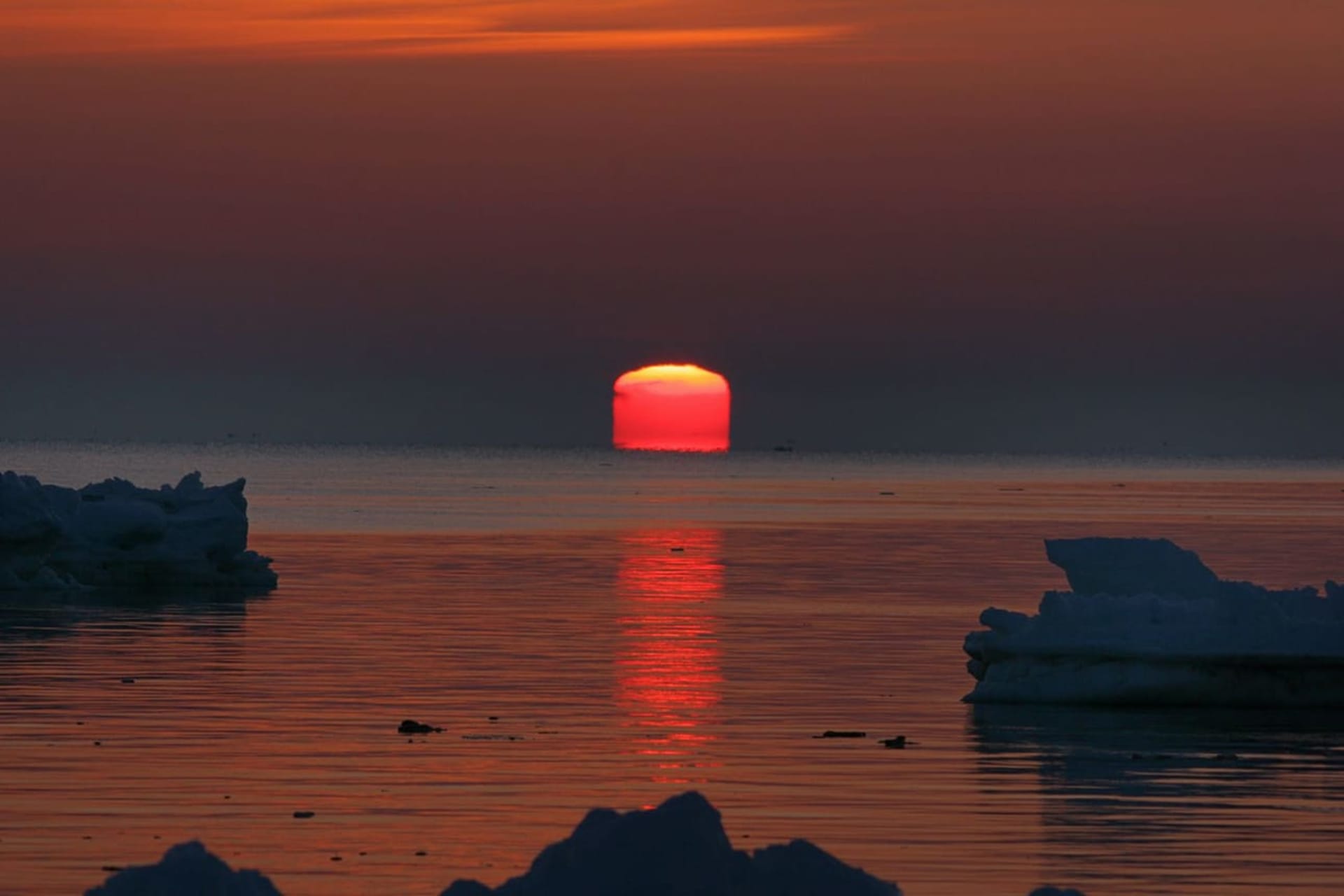
The sun does not rise round at Cape Soya. On winter mornings when the air temperature drops below -15 Celsius and the Sea of Okhotsk lies frozen and still, the solar disk climbs distorted, its edges flattened or stepped into something like a rectangle. The effect lasts three, maybe five minutes. Then the inversion breaks, and the sun returns to its familiar curve. This is the square sun, and Hokkaido's northern and northeastern coasts are among the only places on Earth where you can watch geometry overtake astronomy at dawn.
The Science Behind the Square Sun
The square sun is a superior mirage caused by light bending through air layers of sharply different temperatures in a strong thermal inversion where an atmospheric duct has formed. Winter mornings along the Sea of Okhotsk create near-perfect conditions. Dense, extremely cold air settles over the sea ice. A layer of slightly warmer air sits above it. The boundary between them is sharp enough that sunlight, traveling through progressively denser air as it approaches the horizon, bends downward in uneven ways.
In a temperature inversion, light bends down toward the denser cold air, but because our eyes assume light travels straight, the object appears higher or distorted from its actual position. When the inversion is uniform and stable, the sun stretches vertically, creating an oval or tower shape. But when the temperature gradient is uneven, with multiple thin layers stacked like a deck of cards, the sun's image breaks into segments. The top and bottom edges flatten. The sides straighten. For a few minutes, the sun looks stamped from sheet metal.
This is not an inferior mirage like the water shimmer on hot pavement. This is light bending in the opposite direction, making distant objects loom higher and distorting them into forms that seem impossible. To generate this effect, the thermal inversion must be strong enough that the curvature of light rays within the inversion layer exceeds the curvature of the Earth, and an observer needs to be within or below an atmospheric duct to see it.
When and Where to See the Square Sun
The phenomenon appears along the Nemuro Strait region, including the Notsuke Peninsula and Cape Soya. Cape Soya, at 45 degrees 31 minutes north latitude, is Japan's northernmost accessible point. The cape is just 43 kilometers across La Perouse Strait from Cape Crillon on Sakhalin Island, and on clear days you can see the Russian coast. The square sun appears here most reliably in January and February, when air temperatures plunge and sea ice forms offshore.
Rishiri Island offers another vantage. From the western shore facing the Sea of Japan, the winter sun rises over water and distant Hokkaido peaks. The cold air draining off Rishiri-Fuji (1,721 meters) mixes with maritime air to create layered inversions. The square sun here is less predictable than at Cape Soya but worth the attempt if you are already on the island for other winter phenomena.
The Shiretoko Peninsula, particularly around Utoro, produces square suns in late December through February. The Sea of Okhotsk is noted for being a factory of clouds and ice, in part due to frigid northwesterly winds blowing from Siberia, where low temperatures drop to an average of -21 degrees Celsius for January. Shiretoko's eastern coast faces directly into this cold flow, and the steep Shiretoko Range behind the coast creates localized temperature gradients that amplify the mirage effect.
Timing is tight. The square sun appears only at sunrise (and occasionally at sunset, though dawn is more reliable). You need the sun within a few degrees of the horizon and a stable inversion layer. Cloud cover ruins the effect. Even thin overcast scatters the light before it can bend properly. Check the forecast: clear skies, subzero temperatures, light winds. If a high-pressure system has sat over the region for 48 hours, conditions are good.
As of early 2026, Cape Soya hosts an annual sunrise event, Hatsuhinode in Teppen, held since 1988 to welcome visitors with fireworks, bonfires, and commemorative gifts. This New Year's tradition coincides with prime square sun season, though the mirage is never guaranteed.
Your Witnessing Guide
Get to your viewpoint 45 minutes before sunrise. The inversion is strongest in the coldest part of the night, and you want to be in position before first light. Even in summer, the winds at Cape Soya can be chilly, so in winter, bring a windproof jacket or parka. Layer heavily. You will be standing still in -15 Celsius or colder for at least 30 minutes. Insulated boots rated to -30 Celsius, expedition-weight gloves, balaclava, hand warmers in your pockets.
Binoculars help. The square sun effect is visible to the naked eye, but binoculars reveal the fine structure: the stepped layers, the way segments of the sun seem to disconnect and hover. A camera with a telephoto lens (200mm or longer) captures the distortion better than a wide-angle. Set your ISO to 400, aperture to f/8, and shoot in manual mode so the camera does not blow out the highlights as the sun brightens. Bracket your exposures. The mirage changes fast, and you want options.
During winter, the area is blanketed in snow, creating a dramatic and serene atmosphere, but access can be more challenging due to icy roads and limited public transportation. Roads to Cape Soya are plowed, but winter tires or chains are mandatory. At Cape Soya, there is a monument marking Japan's northernmost point, and the nearby settlement has facilities including the northernmost lighthouse, the northernmost filling station, and the northernmost elementary school. The gift shop near the monument opens early during the winter sunrise event but is otherwise closed until mid-morning.
For Shiretoko, base yourself in Utoro. The coast road east toward Shiretoko Cape is often closed past Utoro in winter due to snow and avalanche risk. Check the Shiretoko Nature Foundation website for road status. Rishiri Island access is by ferry from Wakkanai (summer only) or flight from New Chitose Airport near Sapporo (winter schedule is limited). Plan for ferry cancellations in rough weather.
Safety: Do not walk onto sea ice unless you are with a certified guide. Ice near the shore looks solid but can have weak patches where currents undercut it. Bring a thermos of hot liquid. Frostbite risk is real. If your fingers or toes start to hurt, that is early-stage cold injury. Get inside.
Why It Matters
The Sea of Okhotsk experiences frequent fog and strong surface inversion layers over cold patches created by tidal cooling effects, with sea fog occurrence exceeding 70 percent along the Kuril Islands in July and August. Winter inversions are even more pronounced. This makes the Okhotsk coast one of the world's most active zones for superior mirages. The square sun is the most striking, but ships and islands also loom and distort here. In Ainu tradition, the cape itself is called notetu, meaning "chin" or "nose," a reference to the land's sharp profile.
The Sea of Okhotsk is a challenging environment for obtaining in situ data in winter due to sea ice cover. That remoteness has kept the square sun relatively obscure. It does not appear in tourist brochures. Local photographers know about it. A handful of meteorology students chase it. But compared to the aurora or diamond dust, the square sun remains a specialist's phenomenon.
Climate change is altering the inversion frequency. Warmer winters mean less stable cold air masses and shorter sea ice seasons. Data from the past decade shows a slight decline in the number of clear, deeply cold mornings along the northern Hokkaido coast. The square sun is not disappearing yet, but the window is narrowing.
This is the short version
This page shows a taste. The app has the full list of where to see this, the exact timing, and live conditions for 1,000+ natural phenomena worldwide, so you know the moment one is genuinely worth the trip.