As of today, out of season, returns ~November. Earth Exhibit tracks the live conditions and flags it the moment it is on.
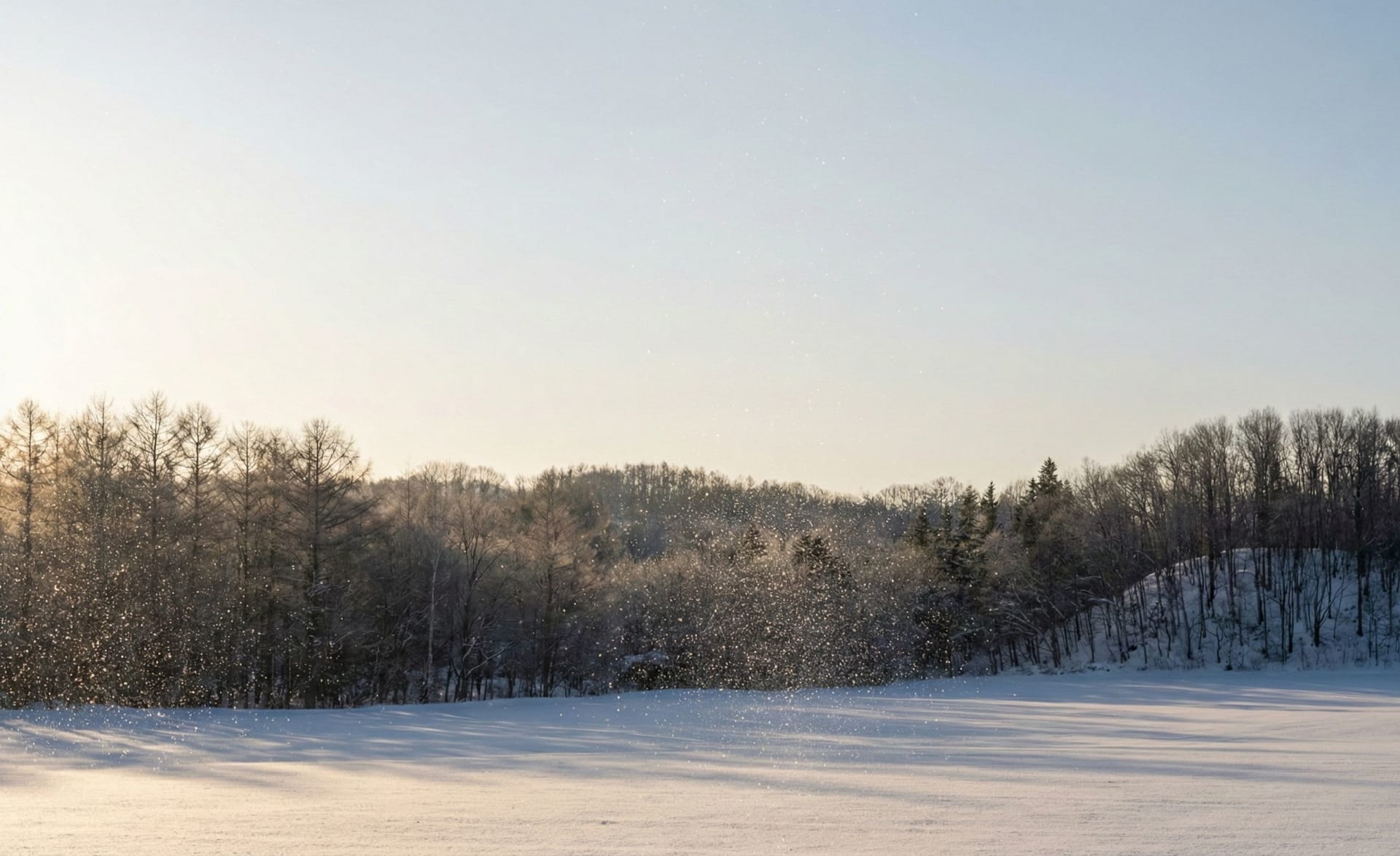
The air is so cold it bites your lungs, and when you exhale, your breath hangs suspended in front of your face. Then you notice the glitter. Billions of tiny ice crystals float at eye level across the snow-covered valley, each one catching the low winter sun and throwing back pinpricks of light. You're standing inside a cloud of diamonds that extends from your boots to the treeline.
The Science of Airborne Ice
Diamond dust is not snow. Snow falls from clouds overhead. Diamond dust forms right where you stand, in the bottom few meters of atmosphere, when the air itself becomes a crystal factory.
The requirements are strict. Temperatures must drop below -15C, with ideal conditions around -20C or colder. Wind must be nearly absent, allowing the air to sit still long enough for water vapor to crystallize without turbulence scattering the forming ice. Skies need to be clear or nearly clear, so the crystals catch direct sunlight rather than diffusing through cloud cover. Finally, you need a moisture source: a river releasing vapor into frigid air, steam from hot springs meeting arctic temperatures, or simply enough atmospheric humidity that the extreme cold can wring it out.
Under these conditions, water vapor skips the liquid phase entirely and crystallizes into flat hexagonal ice plates, typically 0.1 to 0.3 millimeters across. These crystals are small enough to remain suspended in calm air, drifting slowly downward like glitter in a snow globe. Unlike frost, which forms on surfaces, or hoarfrost, which grows on vegetation, diamond dust exists in open air. You can walk through it, breathe it, watch it sparkle in three dimensions around you.
The optical effects separate diamond dust from ordinary winter scenery. When the flat hexagonal crystals align horizontally in the air, they act as millions of tiny mirrors. Light pillars appear when the crystals reflect artificial lights or the rising sun vertically, creating columns of light that stretch from the source upward into the sky. Sun dogs (parhelia) form when crystals refract sunlight at specific angles, producing bright spots 22 degrees to either side of the sun. A 22-degree halo can encircle the sun simultaneously, a ring of refracted light painted across the sky by the same floating ice.
These are not rare alignment events. On a good diamond dust morning in Hokkaido, you can see all three at once: pillars rising from streetlights in the valley below, sun dogs flanking the rising sun, and a halo arcing overhead while the air around you sparkles like someone dumped a bag of sequins from a helicopter.
When and Where the Air Freezes
December through February defines Hokkaido's diamond dust season, with peak frequency in January when the island's interior reaches its coldest. The phenomenon requires overnight radiative cooling under clear skies, the kind of deep cold that settles into valleys and low-lying areas after sunset and refuses to lift until well after sunrise.
Rikubetsu Observatory (43.46, 143.77) sits in eastern Hokkaido's Tokachi region, a basin surrounded by low mountains that trap cold air like a bowl. This town holds Japan's official coldest temperature record: -33.2C, recorded in 1902. Modern winters still regularly push below -25C on clear January nights. The observatory grounds offer open sightlines and minimal light pollution. Diamond dust here forms predictably on calm, clear mornings, often accompanied by full halo displays.
Tokachigawa Onsen (42.93, 143.30) combines natural hot spring steam with extreme cold, creating a moisture-rich environment that feeds diamond dust formation. The riverbank along the Tokachi River releases steady plumes of warm vapor into air that can drop below -20C. This pairing of heat and cold makes Tokachigawa one of Hokkaido's most reliable diamond dust locations. Early morning walkers along the river path routinely encounter dense fields of sparkling crystals, with light pillars rising from the onsen buildings across the water.
Biei Hills and Patchwork Road (43.63, 142.43) provide the photogenic backdrop. The gently rolling farmland northwest of Biei town is famous for its quilt-like fields and scattered farmhouses. On diamond dust mornings, the low sun backlights the floating crystals against snow-covered hills, turning the entire landscape into a glowing, glittering expanse. Patchwork Road's elevated vantage points let you see the phenomenon stretch across valleys, with the crystals concentrated in the lowest, coldest air.
Shirogane Blue Pond area (43.49, 142.61) adds a surreal color contrast. The pond itself freezes solid in winter, but the Biei River continues to flow, releasing moisture into the frigid air. Diamond dust forms along the river corridor and drifts across the frozen pond surface. The combination of the pond's artificial blue color (visible even through snow and ice), the white birch forest, and the sparkling air creates a scene that looks digitally manipulated.
Access starts at New Chitose Airport (CTS), with all four locations requiring a rental car. Winter tires are non-negotiable. Rikubetsu is a 4-hour drive northeast via Obihiro. Tokachigawa sits 2.5 hours east near Obihiro. Biei and Shirogane lie 2 hours north near Asahikawa. Rail connections serve Sapporo, Asahikawa, and Obihiro, but diamond dust sites require local transport. Most observers base in Asahikawa (for Biei/Shirogane) or Obihiro (for Rikubetsu/Tokachigawa) and drive to sites before dawn.
Witnessing Guide
Timing is non-negotiable: you must be in position before sunrise. Diamond dust forms when overnight cold meets the first low-angle sunlight. The crystals need calm air, which typically prevails in the hour before and after dawn before daytime heating and wind begin. By mid-morning, rising temperatures and increased air movement destroy the conditions. Plan to arrive at your chosen site 30 minutes before local sunrise.
Check the forecast for clear skies and overnight lows below -15C. The colder, the better. Nights that bottom out at -20C or below produce the most reliable and visually impressive displays. Wind forecasts matter as much as temperature: anything above 5 kph will scatter the crystals and prevent optical effects from forming. The ideal forecast reads like a recipe for frostbite: clear, calm, and brutally cold.
Layering is survival, not comfort. Start with thermal base layers (top and bottom), add insulating mid-layers (fleece or down), and finish with a windproof outer shell. Your extremities will suffer first. Insulated boots rated to -40C, heavy mittens (not gloves), and full face protection (balaclava or neck gaiter plus hat) are mandatory. Exposed skin gets frostbitten in minutes at -20C. Bring chemical hand and toe warmers. If you start shivering uncontrollably or lose sensation in fingers or toes, retreat to a heated vehicle immediately.
Camera batteries die fast in extreme cold. Keep spares in an inside pocket against your body heat and swap them frequently. Condensation will form on lenses when you return to warm spaces, so bring lens cloths or wait for equipment to acclimate before putting cameras away. Binoculars help you spot distant optical effects (light pillars over towns, sun dogs forming as the sun rises) and examine the crystal structure up close.
The sparkling effect is directional. Position yourself so the sun is behind you or to the side, illuminating the floating crystals from an angle. Backlighting produces the most intense sparkle but risks lens flare. Side lighting reveals the three-dimensional nature of the phenomenon, showing crystals at different depths catching light at slightly different angles.
Light pillars from artificial sources (streetlights, building lights) appear most clearly just before sunrise when the sky is still dark but the air is cold enough for crystals. As the sun rises, natural pillars and halos take over. The progression from artificial pillars to solar halos over a 30-minute window provides a complete optical show.
Local knowledge: Japanese observers call diamond dust "tenshi no sasayaki" (angel whispers), a reference to the faint tinkling sound the crystals can make when drifting through tree branches or settling on hard surfaces. The name appears on local signage and weather reports during winter.
Essential gear checklist:
- Insulated boots rated to -40C
- Mittens (not gloves) plus chemical hand warmers
- Balaclava or face covering
- Multiple insulating layers
- Windproof outer shell
- Spare camera batteries in inside pocket
- Binoculars for distant optical effects
- Thermos with hot liquid
- Emergency blanket in vehicle
The Bigger Picture
Diamond dust belongs to a family of ice crystal phenomena that reveal how water behaves at temperature extremes. The same hexagonal plate structure that creates diamond dust sparkle also builds snowflakes, forms frost patterns on windows, and generates the high-altitude ice crystals responsible for halos around the moon. The difference is location: diamond dust happens at ground level, in the air you breathe, where you can walk through the physics.
Hokkaido's climate makes the phenomenon accessible. While diamond dust occurs in Antarctica, northern Canada, Siberia, and Scandinavia, these locations require expedition-level logistics. Hokkaido offers the same optical displays within a few hours' drive of an international airport, with onsen, heated accommodations, and reliable infrastructure. This is extreme cold made approachable.
The phenomenon also marks Hokkaido's cultural and ecological identity. The island's winter landscapes, shaped by Siberian air masses and the Sea of Okhotsk's influence, support cold-adapted species found nowhere else in Japan. Blakiston's fish owls hunt the same rivers that feed diamond dust. Red-crowned cranes perform courtship dances on snowy fields where morning crystals sparkle. The ice itself sustains winter tourism, from drift ice walks off Shiretoko to ice festivals in Sapporo. Diamond dust is one visible thread in a larger pattern of extreme cold shaping ecosystems and human culture.
Climate records suggest Hokkaido's coldest extremes may be moderating. Rikubetsu's 1902 record has never been matched, and recent decades show fewer nights below -30C. Whether this represents natural variability or long-term warming remains debated, but observers note that reliable diamond dust mornings, once routine throughout January, now concentrate in narrower windows. The phenomenon is not disappearing, but the margins are tightening.
For now, the physics remains simple and repeatable. Cool air below -15C. Remove the wind. Add moisture. Wait for sunrise. When those conditions align over Hokkaido's valleys and rivers, the air turns to glitter, light pillars stretch toward space, and you stand inside a cloud of ice that exists only because the world got cold enough to freeze the sky.
This is the short version
This page shows a taste. The app has the full list of where to see this, the exact timing, and live conditions for 1,000+ natural phenomena worldwide, so you know the moment one is genuinely worth the trip.