As of today, out of season, returns ~December. Earth Exhibit tracks the live conditions and flags it the moment it is on.
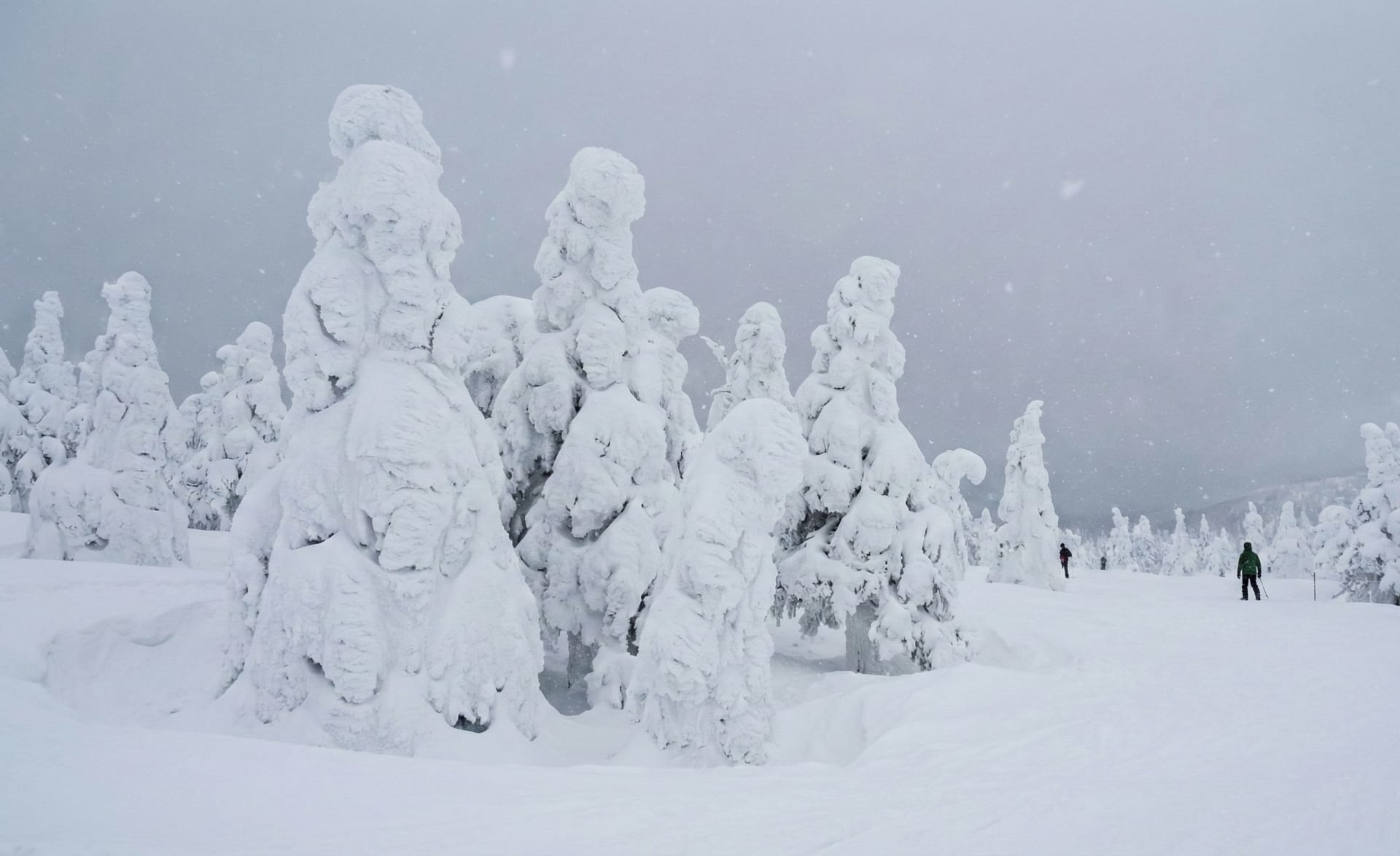
The ropeway cabin climbs through thick fog, and when you step out at 1,324 meters, the forest ahead looks nothing like a forest. White shapes loom through the mist, some hunched like bears, others rearing up three times your height. You are standing among the juhyo, the snow monsters of Hakkoda, and every gust of wind reminds you that these sculptures are still being carved.
The Science Behind the Monsters
Juhyo are not snowdrifts or avalanche debris. They are living trees encased in ice and snow, transformed by a precise sequence of atmospheric conditions that turns Aomori fir (Abies mariesii) into pale giants.
The process begins with freezing fog. When supercooled water droplets drift through air colder than -5C, they stay liquid until they strike a solid surface. The moment they touch a conifer needle or branch, they freeze instantly into rime ice. This is not the clear glaze ice you see on power lines. Rime is white, feathery, and grows in the direction opposite the wind. The windward side of a tree accumulates ice fastest, so the tree begins to lean and deform under the weight.
But rime alone does not make a snow monster. The Hakkoda Range receives some of the heaviest snowfall in Japan, often measured in meters per season. As snow piles onto the rime-coated branches, it compacts and sculpts. The tree trunk disappears beneath layers of ice and powder. Wind carves hollows and ridges. After weeks of this cycle, what remains looks more like a crouching animal or a frozen wave than anything botanical.
Individual juhyo can reach 5 to 8 meters tall, though the tree inside may be half that height. The shape depends on wind direction, snow consistency, and temperature swings. Warm spells cause partial melting and refreezing, which can smooth edges or add bulk. Cold snaps preserve fine details. By late January, the forest around Hakkoda Ropeway's summit becomes a gallery of ice sculptures, each one unique and none of them permanent.
Climate records show that juhyo formation is declining. Warmer winters mean fewer days of sustained freezing fog. Some recent seasons have produced stunted or incomplete monsters. The window to witness this phenomenon in its full sculptural glory is narrowing.
When and Where to Find Them
Peak season runs from mid-January through February, when snowfall is heaviest and temperatures stay reliably below freezing. Early January may show only partial rime buildup. By March, warmer air begins to collapse the formations, and what remains is often gray and slumped.
The most accessible viewing area is the Hakkoda Ropeway Summit Area (40.68, 140.83). The ropeway operates year-round and climbs from the base station at 670 meters to the summit station at 1,324 meters in ten minutes. From the summit, a network of groomed trails and boardwalks leads into the juhyo zone. On clear mornings, you can walk among the formations with Mount Hakkoda's ridgeline in the background. On foggy days, which are common, the monsters appear and vanish in the mist, and you rely on proximity rather than panorama.
Sukayu Onsen Area (40.65, 140.85) sits lower in the valley and offers a different perspective. The onsen itself is famous for the hiba sennin buro, one of Japan's largest mixed-gender hot spring baths. After soaking, you can hike short trails where juhyo form on roadside trees. The formations here are smaller and less dramatic than those at the ropeway summit, but the combination of steaming outdoor baths and ice-coated firs makes for a surreal contrast.
Sennin Pass ridgeline viewpoints (40.68, 140.83) are for experienced winter hikers only. The ridge offers sweeping views of juhyo fields, but avalanche danger is real, and whiteout conditions can develop in minutes. If you attempt this route, hire a local guide, carry avalanche gear, and check the Japan Meteorological Agency's snow and wind forecasts.
Morning visits offer the best light and lowest winds. The ropeway's first ascent departs around 9:00 AM. By midday, foot traffic has churned the snow, and increased wind can trigger surface spindrift that obscures detail. If you are photographing, bring a tripod and a telephoto lens. The monsters often stand 20 to 50 meters apart, and a longer focal length isolates individual shapes against the sky or fog.
Witnessing Guide
Getting there: Fly into Aomori Airport (AOJ) or take the Tohoku Shinkansen to Shin-Aomori Station. From Aomori city, the Hakkoda Ropeway base station is a 60-minute drive or bus ride. Rental cars are practical if you plan to visit Sukayu Onsen or other backcountry trailheads. JR East operates seasonal shuttle buses from Aomori Station directly to the ropeway during winter weekends.
What to bring:
- Insulated boots with crampons or microspikes. Snow on the summit trails is compacted but often icy.
- Layered clothing with windproof outer shell. Temperatures at the summit can drop to -15C, and wind chill makes it feel colder.
- Goggles or sunglasses. Sun glare on snow is intense on clear days. Fog condensation on lenses is common.
- Thermos with hot tea or soup. The summit station has a rest area, but warm liquids help when you are outside for extended periods.
- Camera and spare batteries. Cold drains lithium-ion cells fast. Keep spares in an interior pocket.
- Headlamp. If you are hiking ridgelines or visiting at dawn, bring backup light.
- Weather app and offline maps. Cell service is spotty. Download maps and check avalanche bulletins before you go.
Safety considerations: The Hakkoda Range is infamous for the 1902 military training disaster, when 199 soldiers died in a blizzard during a winter march. Modern infrastructure has reduced risk, but avalanche danger, extreme cold, and sudden weather changes remain real threats. Do not venture off marked trails without avalanche training and a guide. The ropeway shuts down in high winds, so confirm operating status before traveling.
Hakkoda versus Zao: Zao Onsen in Yamagata Prefecture is Japan's most famous juhyo destination, with night illuminations and larger crowds. Hakkoda offers a quieter, more raw experience. The monsters here form on steeper, more exposed ridges, and the lack of artificial lighting means you see them only as weather and daylight allow. If you want spectacle and amenities, choose Zao. If you want solitude and a sense of discovery, choose Hakkoda.
The Bigger Picture
Juhyo exist because of a collision between maritime moisture and continental cold. The Sea of Japan pumps moisture into winter storms, and the Hakkoda Range forces that air upward, where it cools and condenses. The same topography that creates this freeze-sculpting also makes the region one of the snowiest inhabited places on Earth. Sukayu Onsen holds the record for the deepest seasonal snowpack ever measured in Japan: 566 centimeters in 2013.
But this phenomenon is not guaranteed to persist. Climate data from the past three decades show warming winter temperatures across northern Honshu. Seasons that once produced robust juhyo now deliver patchy formations or none at all. The fog still comes, but it freezes less often. The snow still falls, but it melts before it can compact into sculpture.
Juhyo are also a reminder that ice is an active sculptor. Glaciers carve valleys over millennia. Rime and wind carve trees in weeks. The process is fast enough that you can watch it happen. Visit on a Monday, and the monsters look skeletal. Return the following weekend after a storm, and they have gained bulk and new limbs. This is geology on a biological timescale, ephemeral but no less powerful.
The phenomenon also has cultural weight. In a region where winter can isolate villages for weeks, the juhyo represent both beauty and danger. They mark the ridge where soldiers froze in 1902. They frame the hot springs where travelers have soaked for centuries. They appear in Aomori tourism campaigns and on sake labels. For locals, they are a seasonal fixture, as expected as cherry blossoms in spring. For visitors, they are proof that familiar landscapes can become alien under the right conditions.
This is the short version
This page shows a taste. The app has the full list of where to see this, the exact timing, and live conditions for 1,000+ natural phenomena worldwide, so you know the moment one is genuinely worth the trip.