As of today, past peak, season runs to ~June 20. Earth Exhibit tracks the live conditions and flags it the moment it is on.
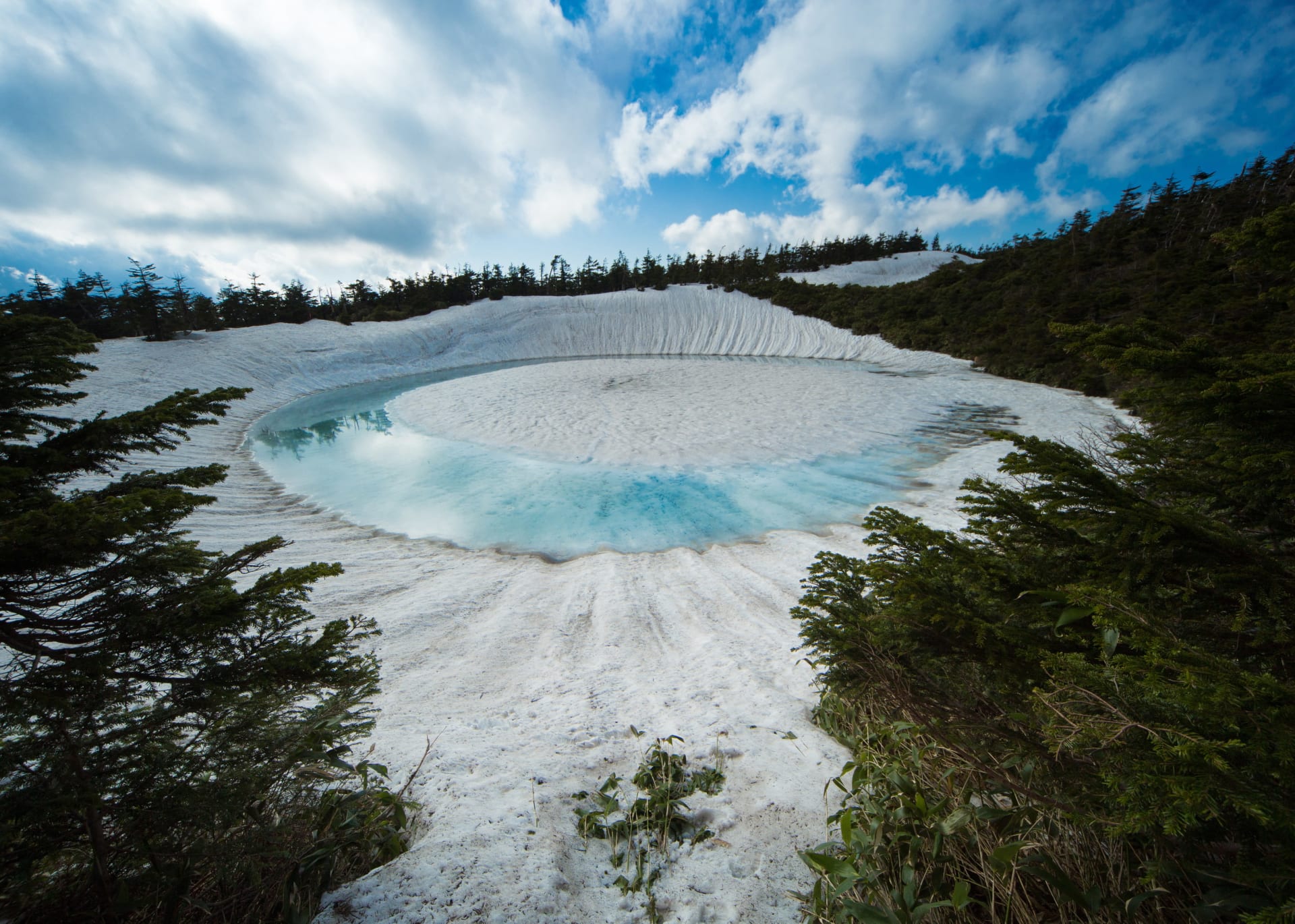
You crest the final switchback on the Hachimantai Aspite Line, step out of the car at 1,613 meters, and look down into a pond that is staring back at you. A ring of cobalt water surrounds a white snow island, and around that, another ring of darker melt, and beyond that, the frozen shoreline. The whole thing is maybe 50 meters across. From above, it looks exactly like the slit pupil of a massive reptilian eye, blue and white and ancient. This is the Hachimantai Dragon Eye, and in most years, you have roughly two weeks to see it before it blinks shut.
How a Pond Becomes an Eye
Kagami-numa, whose name translates to Mirror Pond, sits in a shallow volcanic depression near the summit of Mt. Hachimantai (39.9583N, 140.8583E) on the border of Iwate and Akita Prefectures. The pond is small, roughly 50 meters in diameter, and it freezes solid under meters of snowpack each winter. What happens in late May is a study in radial thermodynamics.
As air temperatures climb above 0 degrees Celsius in late spring, the snow surface begins absorbing solar radiation. Melt starts at the center of the pond and works outward. The reason is simple: the center of the pond retains more thermal mass from the water beneath the ice. The surrounding snowpack, resting on solid ground at the pond's edges, insulates itself and melts slower. This creates the first ring, a disc of open blue water in the middle of a white field.
As the central melt pool expands, it hits a threshold where the remaining snow forms a distinct island. The water surrounding this island reflects the sky. On clear days, the reflected blue is vivid, almost electric. On overcast days, the water turns steel gray, and the effect diminishes. A blue sky is the single most important ingredient for the Dragon Eye's most photogenic form.
The concentric pattern depends on three variables aligning within a narrow tolerance: snowpack depth (typically 3 to 5 meters at Kagami-numa by late April), air temperature progression through May, and the rate of solar warming. Too much snow, and the melt does not reach the concentric stage before June rains muddy the pattern. Too little snow, and the pond thaws uniformly without forming the distinct rings. The snowpack needs to be deep enough to persist but thin enough at the center to open early.
The "pupil" of the eye is the central snow island. As it shrinks day by day, the eye appears to dilate. Locals and meteorologists track this progression, and the phenomenon peaks when the snow island is roughly one-third the diameter of the surrounding melt ring. Once the island melts completely, the eye closes. You are left with an ordinary alpine pond.
When and Where to See the Dragon Eye
The core window runs from approximately May 25 to June 10, though the exact dates shift by a week or more depending on that year's snowfall and spring temperatures. In heavy snow years, the formation can delay into mid-June. In warm years, the eye may open as early as May 20 and collapse before month's end. The Hachimantai Resort website and local tourism boards post updates as the season approaches, often with daily photographs.
Kagami-numa is the only pond where this occurs in this form. It sits roughly 200 meters from the Hachimantai Summit parking area, which you reach via the Hachimantai Aspite Line, a mountain road that opens for the season in mid-April. The parking lot is at approximately 1,560 meters elevation. From there, a boardwalk trail climbs gently to the pond viewpoint.
The Hachimantai Aspite Line (Prefectural Route 23) is an experience in itself. The 27-kilometer road crosses the volcanic plateau between Iwate and Akita, cutting through snow corridors that can reach 6 meters high in late April. By late May, the corridor walls have shrunk, but patches of snow still line the route.
Best time of day: late morning to early afternoon. The sun needs to be high enough to illuminate the pond directly and produce the blue reflection. Before 9 AM, the angle is too low, and shadows from the surrounding terrain darken the water. After 3 PM, similar shadow issues return. Midday light, which landscape photographers normally avoid, is exactly what you want here.
Access: The nearest train station is Morioka (Iwate Prefecture) on the Tohoku Shinkansen, roughly 90 minutes from Tokyo. From Morioka, it is a 90-minute drive to the Hachimantai Summit parking area. Rental cars are the most practical option. Bus service runs during the summer season, but schedules are limited and may not align with the Dragon Eye window. Confirm the Aspite Line is open before you drive. Late-season snowstorms can close the road temporarily even in late May.
Photography and Witnessing Guide
The Dragon Eye reveals its full shape only from above. At ground level, standing on the boardwalk beside Kagami-numa, you see the rings of water and snow, but the "eye" geometry is not obvious. The revelation comes from elevation.
Drone photography captures the phenomenon best. A drone at 30 to 50 meters altitude directly above the pond produces the classic image, concentric blue and white rings forming an unmistakable reptilian iris. Check local drone regulations before flying. The area is within Towada-Hachimantai National Park, and drone use may require advance notification to the park authority. Avoid flying in high wind, which is common at this elevation.
If drones are not an option, the best ground-level shots come from the elevated boardwalk sections east of the pond, where a slight rise gives you a steeper downward angle. A wide-angle lens (16 to 24mm) captures the full pond with Mt. Hachimantai's summit ridge behind it. A telephoto (70 to 200mm) isolates the concentric rings for tighter compositions.
Camera settings: Midday sun on snow creates extreme contrast. Spot meter on the blue water, not the snow, or your highlights will blow out. Shoot at ISO 100, f/8 to f/11 for depth of field, and let shutter speed fall where it may. Polarizing filters cut glare on the water surface and deepen the blue reflection. This is one of the few phenomena where a polarizer makes a dramatic, measurable difference.
What to bring:
- Waterproof boots. The trail is muddy and slushy. Snow patches cover sections of the boardwalk even in early June.
- Warm layers and a rain jacket. At 1,600 meters, temperatures in late May hover between 5 and 12 degrees Celsius. Wind chill drops it further. Rain rolls in fast from the Sea of Japan side.
- Snacks, water, and a thermos. The summit parking area has a small rest house and vending machines, but options are limited.
- Sunscreen and sunglasses. UV intensity at this altitude, reflected off remaining snow, is high enough to burn exposed skin in under 30 minutes.
- Spare batteries. Cold and wind drain power. Keep extras in an inner pocket.
The honest friction: The trail itself is easy, a 10-minute walk from the parking lot. The difficulty is timing. You may drive 90 minutes from Morioka, arrive at the summit, and find the road closed due to fog or the eye not yet formed. Check webcams and local reports obsessively in the days before your visit. Some photographers make two or three trips before conditions align.
The Bigger Picture
The Hachimantai Dragon Eye is a product of geology and climate working on a small, specific stage. Mt. Hachimantai is a shield volcano, broad and flat-topped, with a summit plateau pocked by small crater ponds and fumaroles. Kagami-numa is one of several ponds in this volcanic field, but its particular size, depth, and exposure to wind and sun create the conditions for concentric thawing. Other ponds on the plateau melt unevenly or too quickly. Only Kagami-numa produces the eye.
The phenomenon has become a symbol of Hachimantai's identity. Tourism data shows visitor numbers to the summit area spike sharply during the Dragon Eye window, with peak days drawing over a thousand people to a parking lot designed for far fewer. Local authorities have responded by improving the boardwalk, adding signage, and coordinating with bus operators. The economic impact is significant for a rural mountain region that otherwise sees most of its visitors during ski season (November through April) and autumn foliage (October).
In Japanese folklore, dragons are water deities, guardians of rivers, lakes, and rainfall. A dragon's eye appearing in a mountain pond at the start of the wet season carries resonance beyond tourism branding. Farmers in the Hachimantai foothills historically tracked snowmelt timing as a signal for rice planting. The Dragon Eye's appearance, when water wins its annual contest with ice, marks the same seasonal pivot.
The phenomenon is also a sensitive climate indicator. Snowpack depth on the Hachimantai plateau is measured annually by the Japan Meteorological Agency, and long-term data shows a declining trend. Warmer springs mean earlier, faster melts. In some recent years, the concentric pattern has been less defined, the snow island smaller and shorter-lived. The two-week window may already be narrower than it was a generation ago. There is no guarantee it will persist in its current form as winter snowfall patterns shift across northern Honshu.
For now, though, the eye still opens each spring. The snow still melts in rings. And if you time it right, you can stand on a boardwalk at 1,600 meters in late May, look down into a pond the size of a swimming pool, and see something that looks back.
This is the short version
This page shows a taste. The app has the full list of where to see this, the exact timing, and live conditions for 1,000+ natural phenomena worldwide, so you know the moment one is genuinely worth the trip.