As of Jun 17, 2026, 4:21 PM, past peak, season runs to ~June 30. Earth Exhibit tracks the live conditions and flags it the moment it is on.
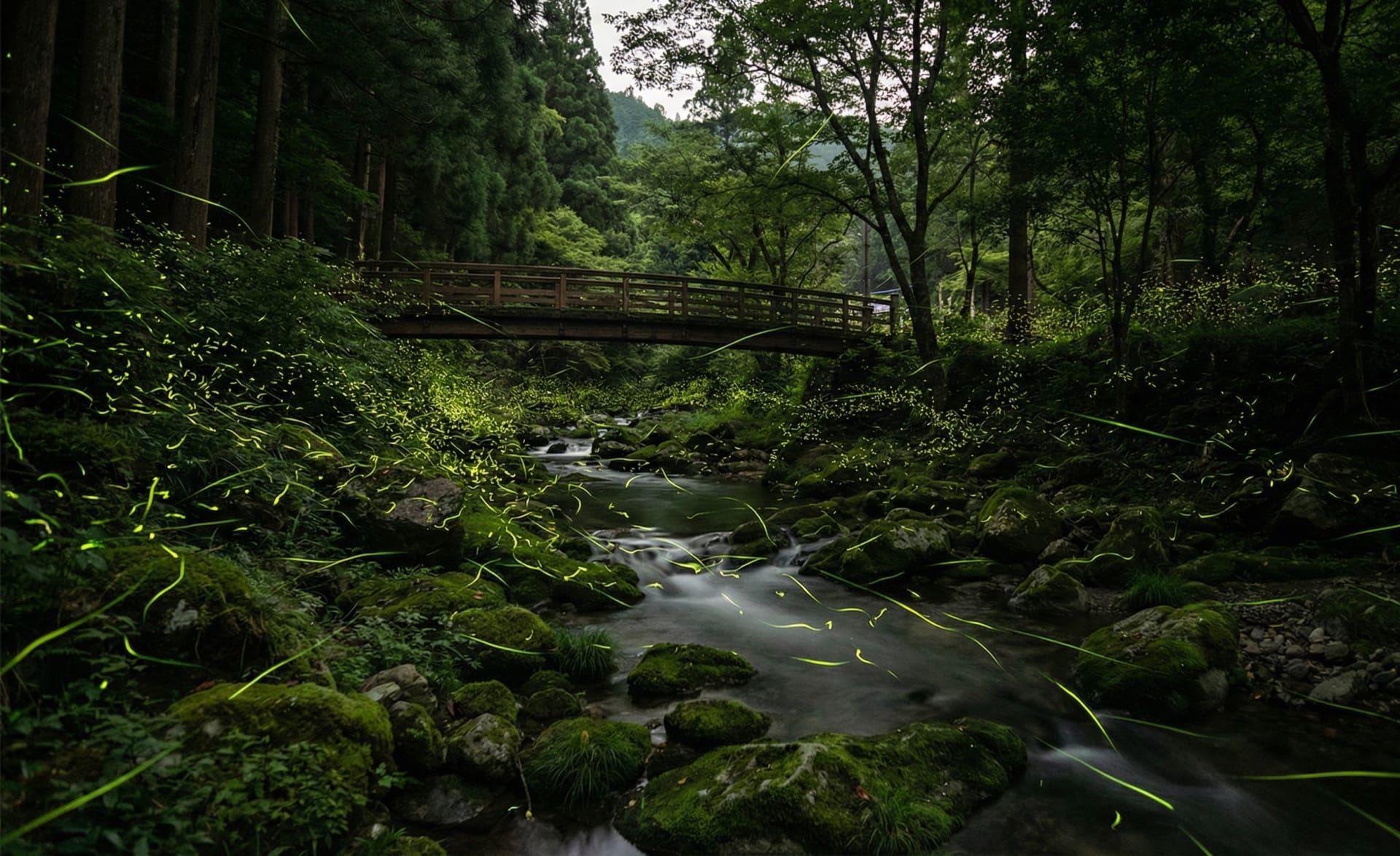
The first pulse catches you off guard. You are standing on a footbridge over a shallow stream in Tatsuno, Hyogo Prefecture, and the darkness is so total that you have lost track of where the treeline ends and the sky begins. Then a single yellow-green light blinks on, two meters above the water. Before you can fix your eyes on it, a second appears. Then a third. Within thirty seconds, hundreds of Luciola cruciata are firing in unison along both banks, their light rolling upstream in a slow wave, as if the river itself has learned to breathe. The air smells of wet stone and cedar. No one around you speaks. There is nothing to say.
This is hotaru-gari, the centuries-old Japanese tradition of firefly viewing, and the Genji firefly is its undisputed star.
The Science Behind the Synchrony
Luciola cruciata is Japan's largest firefly species, measuring roughly 15mm in body length. It belongs to the family Lampyridae and is one of approximately 50 firefly species found across the Japanese archipelago, though none command the same cultural reverence.
The light itself is produced by one of biochemistry's most efficient reactions. Inside specialized cells called photocytes, an enzyme called luciferase catalyzes the oxidation of a substrate called luciferin in the presence of ATP and oxygen. The reaction converts nearly 100% of its chemical energy into light with almost zero heat, a conversion rate that puts every human-engineered light source to shame. The resulting glow peaks at approximately 556 nanometers, placing it firmly in the yellow-green portion of the visible spectrum.
What separates Luciola cruciata from most of the world's 2,000-plus firefly species is the synchronization. Males flash in coordinated pulses, and the timing varies geographically. In western Japan (Kyushu, Shikoku, western Honshu), males flash at roughly 2-second intervals. In eastern Japan (Kanto, Tohoku), the interval stretches to approximately 4 seconds. The dividing line runs roughly along the Itoigawa-Shizuoka Tectonic Line, one of the more peculiar biogeographic boundaries in entomology. Researchers believe the difference is genetically encoded rather than learned, though the exact selective pressures remain debated.
The adult fireflies you see on a June evening represent the final two weeks of a life cycle that spans more than a year. Females lay eggs on moss near stream banks in midsummer. The larvae hatch and enter the water, where they spend roughly 10 to 12 months as fully aquatic predators, feeding almost exclusively on freshwater snails of the genus Semisulcospira. A single larva may consume dozens of snails before it is ready to pupate. In April or May, the mature larvae crawl onto land, burrow into moist soil, and form pupal chambers. Adults emerge two to four weeks later, with one purpose: to find a mate before their brief window closes.
Adult Genji fireflies do not eat. Their mouthparts are vestigial. Every flash you see is powered by energy reserves accumulated during that long aquatic larval stage, burned now in a final, luminous bid to reproduce.
When and Where to See Them
The Genji firefly season is short and punishingly specific. The core window runs from approximately May 25 through June 15, though timing shifts with latitude, altitude, and the year's weather patterns. A warm, wet spring pushes emergence earlier; a cold snap delays it. Peak activity on any given night occurs between 7:30 PM and 10:00 PM, with the strongest displays typically in the first ninety minutes after full darkness.
Ideal conditions: overcast skies (no moonlight competition), warm air (above 20 degrees Celsius), high humidity, and little to no wind. A clear, breezy night after a cold front will produce a disappointing show. A muggy, still evening after afternoon rain will light up the riverbanks.
Four locations stand out, each offering a different character of display:
Hotel Chinzanso Tokyo Garden (35.72N, 139.72E) is the most accessible site for visitors already in the capital. This historic garden in Bunkyo ward releases captive-bred fireflies each season, creating a controlled but genuinely beautiful display among manicured landscaping and stone lanterns. It is not wild, but it is real bioluminescence, and the convenience factor is unmatched.
Tatsuno, Hyogo Prefecture (34.83N, 134.55E) bills itself as the "Town of Fireflies" and has protected its Luciola cruciata population since 1924, when the Tatsuno firefly habitat was designated a national natural monument. The Ibo River corridor here supports one of the densest wild populations in western Honshu. The town holds its annual Firefly Festival in early to mid-June, drawing tens of thousands of visitors. Arrive on a weeknight if you value solitude over festival atmosphere.
Moriyama, Shiga Prefecture (35.06N, 136.00E) sits near the southeastern shore of Lake Biwa, Japan's largest freshwater lake. The firefly streams here benefit from the lake's moderating effect on local humidity. Moriyama has invested heavily in habitat restoration, cleaning agricultural runoff from feeder streams to support the Semisulcospira snail populations that Genji larvae depend on. The presence of healthy firefly populations here is a direct indicator of water quality. When the fireflies disappeared in the 1960s and 70s due to pesticide use and concrete channelization, communities across Japan took it as a warning signal. Their return, in places like Moriyama, represents decades of deliberate ecological repair.
Katagaike Pond, Imabari, Ehime Prefecture (34.08N, 132.96E) on Shikoku offers a more intimate, less touristed experience. The fireflies here flash at the faster 2-second western interval, producing a display that feels more urgent, more electric than what you see around Tokyo.
How to Photograph and Witness Genji Fireflies
Photographing fireflies is an exercise in patience, preparation, and restraint.
Never use flash. This is the cardinal rule, and at popular viewing sites, volunteers will enforce it. A single camera flash can disrupt the synchronization pattern for minutes and interfere with mating behavior. Many sites also prohibit white flashlights. Bring a red-filtered flashlight or headlamp for navigating trails, and switch it off once you are in position.
Camera settings for firefly trails: ISO 1600 to 6400, aperture f/2.8 or faster, exposure time 15 to 30 seconds. A sturdy tripod is non-negotiable. A remote shutter release or your camera's built-in timer prevents vibration during long exposures. The best results come from stacking multiple exposures in post-processing (using Photoshop, StarStaX, or similar software) to build up firefly trails while keeping noise manageable in any single frame.
The critical technical step happens before darkness falls. Arrive at your chosen spot 30 to 45 minutes before sunset and pre-focus your lens on a distant light source or high-contrast edge, then switch to manual focus and tape the ring in place. Autofocus is useless once the fireflies emerge. If your lens hunts in the dark, you will miss the peak entirely.
Beyond gear, practical comfort matters. Wear long pants and closed-toe shoes. The streamside habitats where Genji fireflies thrive also support healthy mosquito populations in June. Apply repellent before you arrive. Bring a small towel. Humidity will fog your lens. Bring a second battery. Long exposures drain power fast.
And the most important piece of witnessing advice: put the camera down for at least ten minutes. Watch with your own eyes. Let the synchronization pattern register in your peripheral vision, where your rod cells are most sensitive to the low-intensity glow. The experience of standing inside a coordinated flash, hundreds of cold lights pulsing in unison around you, does not translate to a photograph. The photograph is for later. The standing there is for now.
The Bigger Picture
The Genji firefly occupies a singular place in Japanese culture. Its name references The Tale of Genji, the 11th-century novel by Murasaki Shikibu often cited as the world's first novel, in which fireflies appear as symbols of fleeting passion and impermanence. The tradition of hotaru-gari (literally "firefly hunting," though no catching is involved today) dates back centuries, and the insect appears across Japanese poetry, painting, and seasonal vocabulary. In the old calendar, there is a microseason called hotaru hajimete tobu, "first fireflies appear," marking a precise moment in early summer.
But the Genji firefly is more than a cultural symbol. It is a bioindicator species whose presence or absence tells you something concrete about the health of a watershed. Luciola cruciata larvae require clean, well-oxygenated streams with stable populations of Semisulcospira snails. Pesticide runoff, concrete channelization, light pollution, and upstream development all destroy these conditions. When Japanese communities noticed their fireflies vanishing during the rapid industrialization of the 1950s through 1970s, it catalyzed one of the earliest grassroots environmental restoration movements in the country.
Today, dozens of municipalities across Japan maintain active firefly conservation programs, restoring natural stream banks, reducing pesticide use, managing light pollution near breeding habitat, and monitoring population counts. Some, like Tatsuno, have protected their firefly sites for a century. Others are newer converts, motivated by the tourism revenue that a healthy firefly population generates. The economics work: a good firefly season brings thousands of visitors to small rural towns that otherwise struggle to attract attention. Conservation and economic survival align.
The adult Genji firefly lives for one to two weeks. It does not eat. It converts stored larval energy into light, finds a mate, lays eggs, and dies. The brevity is part of the power. In Japanese aesthetics, the concept of mono no aware, the pathos of things, finds few better ambassadors than a cold light that burns for a fortnight and then goes dark.
Stand on that footbridge in Tatsuno on a warm June night, and you will understand the phrase without needing it translated.
This is the short version
This page shows a taste. The app has the full list of where to see this, the exact timing, and live conditions for 1,000+ natural phenomena worldwide, so you know the moment one is genuinely worth the trip.