As of today, out of season, returns ~December. Earth Exhibit tracks the live conditions and flags it the moment it is on.
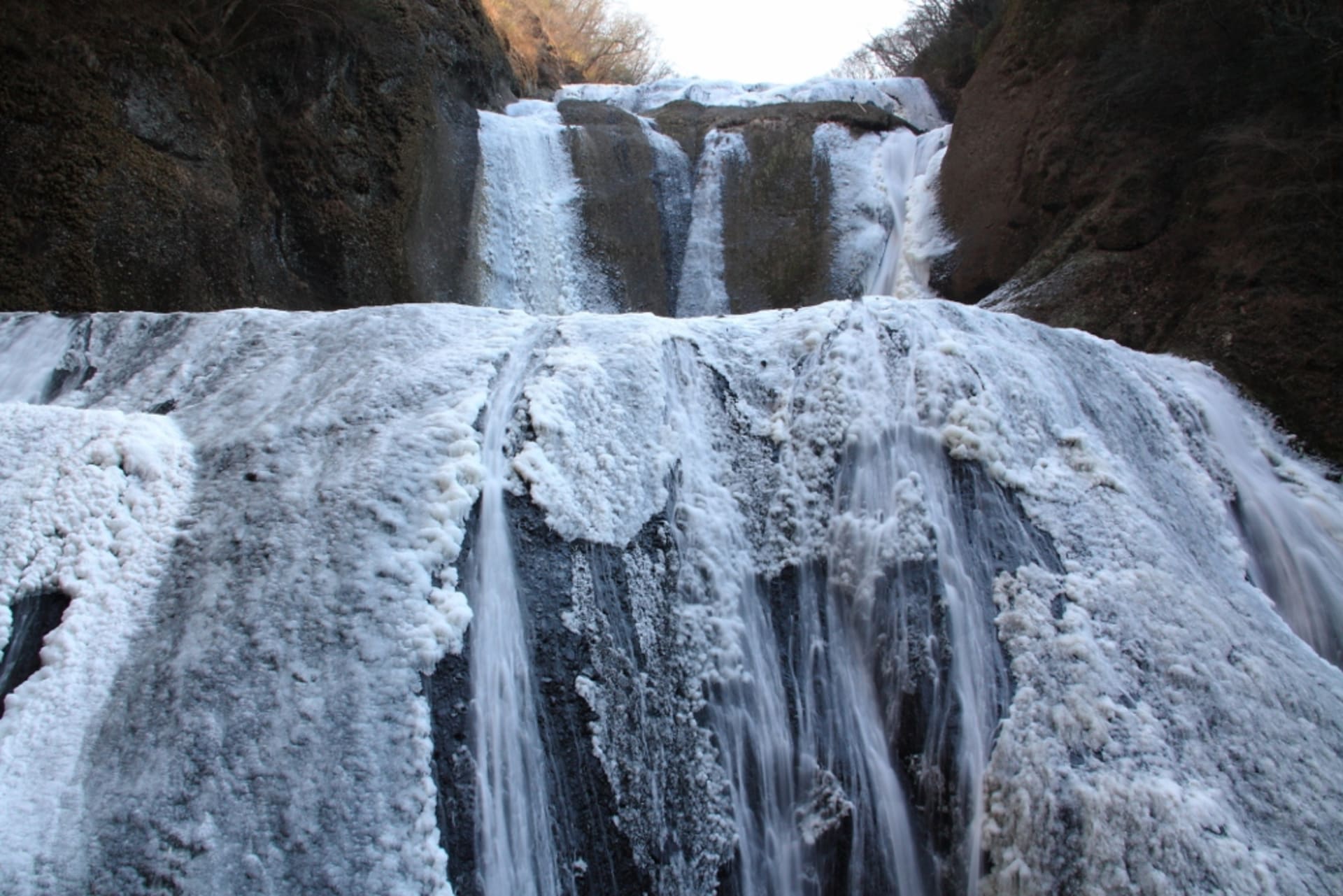
The spray hits your face before you see the source. You're standing in a tunnel carved through bedrock, and through the opening ahead, a wall of white catches the late morning sun. Not snow. Not cloud. Ice. 120 meters of it, layered in tiers where water should be falling. The roar you expect from Japan's third-greatest waterfall has been replaced by the drip and crack of a landscape mid-transformation.
This is Fukuroda Falls in winter, when temperatures in the Kuji River valley drop low enough to turn the cascade into hyobaku, an ice waterfall. But the window is narrow, the conditions fickle, and the spectacle rare enough that locals track freeze percentages like stock tickers.
The Science of a Freezing Waterfall
Fukuroda Falls doesn't freeze because it stops flowing. The 73-meter-wide, four-tiered cascade continues to move water throughout winter, but when ambient temperatures drop below -10C for multiple consecutive days, the physics shift. Water hitting rock at high velocity generates mist. That mist settles on the cliff face, freezes, and accretes. Layer by layer, the ice builds outward from the rock, forming curtains, pillars, and eventually a continuous wall.
The process is uneven. The upper tiers freeze first because they're more exposed to wind and lower temperatures at elevation. The base, fed by a constant flow of 150 liters per second, resists longer. In a typical cold winter, Fukuroda reaches 70-80% frozen. The water still flows beneath and through the ice, carving channels and creating hollow chambers that groan as they expand.
Complete freezing, where the entire face locks into a solid white curtain, happens only a few times per decade. The last 100% freeze was recorded in 2018, during a cold snap that held the valley below -12C for eight straight days. Local authorities monitor and report freeze percentages daily during peak season, and when the number climbs above 90%, visitors pour in from Tokyo, Sendai, and beyond.
The falls were reportedly discovered by Kobo Daishi, the monk who founded the Shingon school of Buddhism in the 9th century. His writings describe the cascade as a place where the physical and spiritual worlds meet, a sentiment that makes more sense when you're standing in front of a waterfall that has decided to stop time.
When and Where to Find the Ice Wall
Fukuroda Falls is located in Daigo, Ibaraki Prefecture, about 150 kilometers northeast of Tokyo. The falls sit in a narrow gorge carved by the Kuji River, surrounded by forested ridges that funnel cold air into the valley. The freeze window runs from mid-January to mid-February, with peak conditions typically falling in the last week of January.
Timing matters. A warm front can undo weeks of ice buildup in 48 hours. The best strategy is to monitor the daily freeze percentage reports published by the Daigo Tourism Association (available online in Japanese and English). When the number exceeds 80%, conditions are strong. When it hits 90%, drop everything and go.
Access from Tokyo takes roughly three hours each way. The train route involves the JR Joban Line to Mito, then a local line to Fukuroda Station, followed by a 30-minute bus ride to the falls entrance. A rental car is faster and more flexible, especially if you're planning to arrive at first light. Parking is available near the entrance for 500 yen.
The entrance fee is 300 yen, which grants access to the tunnel observation deck system built in 1979. The tunnels run through the cliffside and emerge at three different viewing platforms, each offering a distinct angle on the falls. The lower platform puts you at eye level with the base tiers. The middle platform aligns with the second cascade. The upper platform, reached by an additional set of stairs, faces the top tiers and provides the widest perspective.
Best viewing time is late morning, between 10am and noon, when the sun clears the ridgeline and hits the ice directly. The light turns the wall translucent, revealing the blue-green hues trapped inside the layers. Afternoons work too, but the falls face east, so you lose the direct illumination.
Witnessing Guide
The paths around Fukuroda Falls are paved, but in winter they're often coated in black ice. Non-slip footwear is non-negotiable. Local shops near the entrance sell clip-on ice grips for 1,000 yen if you arrive unprepared. The observation decks themselves are safe and regularly maintained, but the approach trails can be treacherous after overnight freezes.
Layer aggressively. The gorge traps cold air, and temperatures inside the tunnels often run 5-10C colder than the ambient reading. A windproof outer shell, insulated mid-layer, and thermal base layer are standard. Gloves and a hat are essential. Hand warmers are a luxury that becomes a necessity after 20 minutes of standing still to compose a shot.
For photography, bring a telephoto lens (70-200mm minimum) to isolate individual ice formations. A tripod helps if you're shooting in lower light or trying to capture the flow of water still visible at the base. The mist from the falls can coat your lens in minutes, so keep a microfiber cloth accessible and shield your gear between shots.
The falls are illuminated at night during the freeze season, typically from 5pm to 8pm. The lighting setup is subtle, using white LEDs to highlight the ice without washing out the natural tones. Night shoots require higher ISO settings and longer exposures, but the absence of crowds and the stillness of the frozen landscape make it worth the technical challenge.
Do not attempt to climb on or approach the ice. The formations are unstable, and the hollows beneath the surface can collapse without warning. Several accidents have occurred over the years when visitors ignored barriers to get closer. The observation decks provide more than enough proximity for any reasonable viewing or photographic goal.
If you're visiting on a weekend or holiday during peak freeze conditions, expect crowds. The lower observation deck can hold about 50 people comfortably, but during viral freeze years, that number doubles. Arrive early or plan for a weekday visit if you want space to work.
The Bigger Picture
Fukuroda Falls is one of Japan's "Three Great Waterfalls", alongside Nachi Falls in Wakayama and Kegon Falls in Nikko. The designation is centuries old and based on a combination of height, volume, and cultural significance. Fukuroda is the only one of the three that freezes reliably enough to create a secondary seasonal identity.
The name "Fukuroda" is believed to derive from a phrase meaning "four times to see," suggesting that the falls reveal different faces across the seasons. The frozen version is the rarest. Spring brings snowmelt and peak flow. Summer turns the gorge into a cool retreat from Tokyo's heat. Autumn lights up the surrounding ridges with red and gold. But winter, when the water stops mid-fall, is the version that draws international attention.
The freeze percentage tracking system, while practical, also functions as a kind of communal ritual. Locals check the daily update the way others check weather forecasts. When the number climbs, the town braces for an influx. Hotels fill. Restaurants extend hours. The souvenir shops stock extra ice-themed goods. The falls become the center of gravity for the entire region, and the economy shifts to match.
Climate data from the past three decades shows a slow decline in the frequency of complete freezes. The 1990s saw full freezes nearly every other year. The 2000s dropped to once every three years. The 2010s averaged once every five. The trend is consistent with broader warming patterns across Japan's inland valleys, where winter lows have risen by approximately 1.5C since 1980.
That makes each freeze more valuable, not just as a spectacle, but as a reference point for how the climate is shifting. The ice wall at Fukuroda is not permanent. It's a temporary alignment of temperature, moisture, and airflow, and the alignment is becoming less common. Witnessing it now means seeing something that future generations may only know through photographs.
This is the short version
This page shows a taste. The app has the full list of where to see this, the exact timing, and live conditions for 1,000+ natural phenomena worldwide, so you know the moment one is genuinely worth the trip.