As of today, out of season, returns ~April. Earth Exhibit tracks the live conditions and flags it the moment it is on.
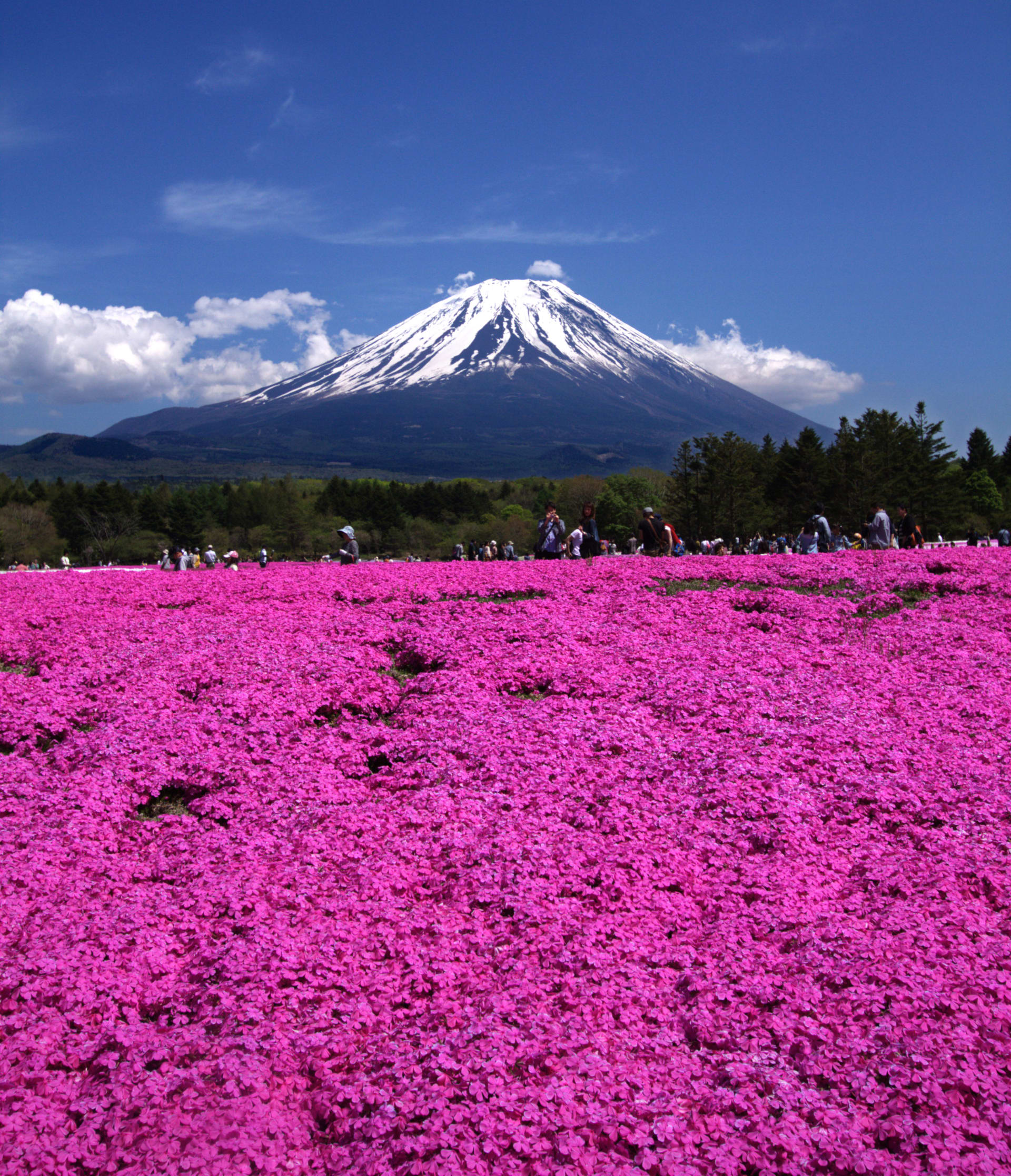
The first rays of morning light hit the pink carpet before they reach the mountain. From the viewpoint at Fuji Motosuko Resort, 800,000 moss phlox flowers stretch across 2.4 hectares in waves of magenta, white, and purple, and behind them, Mount Fuji cuts a clean line against the blue. The festival runs from mid-April through late May at the base of Mount Fuji near Lake Motosuko , and the best viewing typically falls into the first three weeks of May . Get there by 7am on a weekday if you want the shot without a hundred other photographers in it.
The Science Behind Shibazakura
Phlox subulata is a hardy plant also called moss phlox or pink moss for its creeping characteristics and vivid colors . Native to the eastern United States , it was brought to Japan and given the name shibazakura, which translates to "lawn cherry blossom." The resemblance is surface level only. While cherry trees (genus Prunus) bloom on branches, moss phlox is a ground cover that spreads horizontally, forming dense mats.
Unlike other seasonal flowers, moss phlox thrives in rocky soils, making it a resilient and hardy plant that can withstand various weather conditions . Each flower measures about 1.5 cm across with five petals radiating from a central tube. The blooms fire in such density that the ground itself disappears. The Fuji festival displays approximately 800,000 stalks of shibazakura across five varieties, producing fields of pink, white and purple colors in different hues . At Fuji Motosuko Resort, seven varieties are planted, including McDaniel Cushion with its vivid pink and Mont-Blanc in pure white.
The timing matters. Shibazakura bloom just after cherry trees, during April to late May . In Yamanashi at Fuji's base, this means mid-April is green shoots, late April is half-bloom, and the first two weeks of May are full saturation. After that, petals fade and the festival winds down.
When and Where to See Fuji Shibazakura
The Fuji Shibazakura Festival takes place at Fuji Motosuko Resort, near the base of Mount Fuji . For 2026, the festival runs April 13 (Monday) to May 26 (Tuesday) . Entrance fees vary by season from 800 to 1,300 yen for adults, with children at half price.
The venue can get quite crowded due to its popularity. Avoid weekends or Golden Week holidays. Visiting early in the mornings is generally good to avoid congestion and for good visibility . Golden Week (late April into early May) turns the park into a gridlock of buses and selfie sticks. Go at 7am on a Tuesday if you want space to compose a shot.
Mount Fuji visibility is the gamble. Whether you'll be able to see Mt. Fuji depends on the weather; he was hiding behind thick clouds on overcast days. Spring weather around the Five Lakes shifts hour to hour. Clear mornings offer the best odds. Check the forecast obsessively in the three days before your trip. A cloudy day still gives you the flowers, but the composition loses its anchor.
A shuttle bus called the Shibazakura Liner connects Kawaguchiko Station and the festival venue roughly hourly in about 40 minutes during the festival period. A ticket costs 2,800 yen and combines a bus round trip with admission to the festival area . From Shinjuku Station to Kawaguchiko Station costs 3,530 yen one-way. The direct Fuji Excursion train was sold out, so some take the Kaiji Limited Express to Otsuki, then transfer to a local train on the Fujikyu Railway. Round-trip bus fare from Kawaguchiko Station to the festival venue runs 2,500 yen, with the ticket including entrance .
Direct highway buses from Shinjuku to the festival venue run about 2.5 hours. Book in advance, especially for weekends. Seats sell out.
Your Witnessing Guide
Bring layers. The festival is located in the highlands, so it can still be chilly in April and May. Check the weather forecast before you go and dress accordingly . April mornings at 800 meters elevation can hit 5C. By midday it climbs to 18C. A fleece and a windbreaker handle the range.
For photography, bring a wide-angle lens (16-35mm) to capture the full field with Mount Fuji in one frame. A telephoto lens (70-200mm) compresses the distance and isolates flower clusters against the mountain. This festival is an excellent spot for photographers. The park's maps are even marked with the best shooting spots to capture the flower scenery with Mount Fuji in the backdrop . Tripods are allowed but get in the way when crowds build.
Camera settings for bright spring light: ISO 100-200, aperture f/8 to f/11 for depth across the field, shutter speed 1/250 or faster to freeze any breeze moving the flowers. If Fuji is visible at sunrise, shoot into the light for silhouette drama or wait 30 minutes for side light that brings out texture in both flowers and snow.
The venue isn't huge, but the scenery is very pretty, so you won't want to rush around. Allow yourself around two hours to enjoy it properly, that should give you time to have a bite to eat and use the restrooms too . Pathways are paved and accessible. No blue tarps allowed on the flowers, you stay on the trails.
Food stalls cluster in one section of the park. Numerous street food stalls are gathered in a special area. Yamanashi prefecture's specialty dishes are made of noodles and meat. Japanese classic desserts are all flavored with sakura for the occasion . Try the hoto noodles, thick wheat noodles in miso broth with vegetables. The sakura-flavored soft serve is pink and tastes like spring marketing, but you'll see everyone holding one.
Pack sunscreen, a hat, water. The site has minimal shade. Comfortable walking shoes, the paths are smooth but you'll cover distance. Arrive with a charged phone or camera battery, there are no charging stations.
Why Shibazakura Matters
Moss phlox holds a special place in Japanese culture, symbolizing the arrival of spring and the rejuvenation of nature. The blooming season typically spans from mid-April to early May . In a country that built an entire cultural practice around cherry blossom viewing (hanami), shibazakura offers a second act. The season is longer, the crowds are thinner outside Golden Week, and the flowers hold color for weeks instead of days.
The Fuji Shibazakura Festival was established to extend the spring tourism season beyond sakura. In 2025, the festival celebrated its 18th year . What started as a small planting has grown into one of the largest moss phlox displays accessible from Tokyo. The festival brings revenue to the Fuji Five Lakes region during a shoulder season and showcases non-native plants that have been adopted into Japanese floral culture.
Ecologically, moss phlox is not invasive in Japan but it is not native either. It requires active cultivation and does not self-seed aggressively in this climate. The festival is a managed landscape, replanted and maintained annually. This is horticulture as spectacle, not wilderness.
The pairing with Mount Fuji is what elevates it. Japan's most iconic peak appears on the old 1,000 yen note, in Hokusai's woodblock prints, and in a thousand tourist brochures. Framing it with a foreground of pink flowers creates a composition that registers instantly as "Japan in spring." The image travels well on social media, which drives attendance, which funds the next year's planting.
For photographers, the challenge is making a fresh image of an overphotographed subject. Arrive early, find a foreground element that breaks the pattern (a single white flower, a curve in the path), and wait for the light to do something unexpected. The mass of the scene is given, the details are where you find your frame.
This is the short version
This page shows a taste. The app has the full list of where to see this, the exact timing, and live conditions for 1,000+ natural phenomena worldwide, so you know the moment one is genuinely worth the trip.