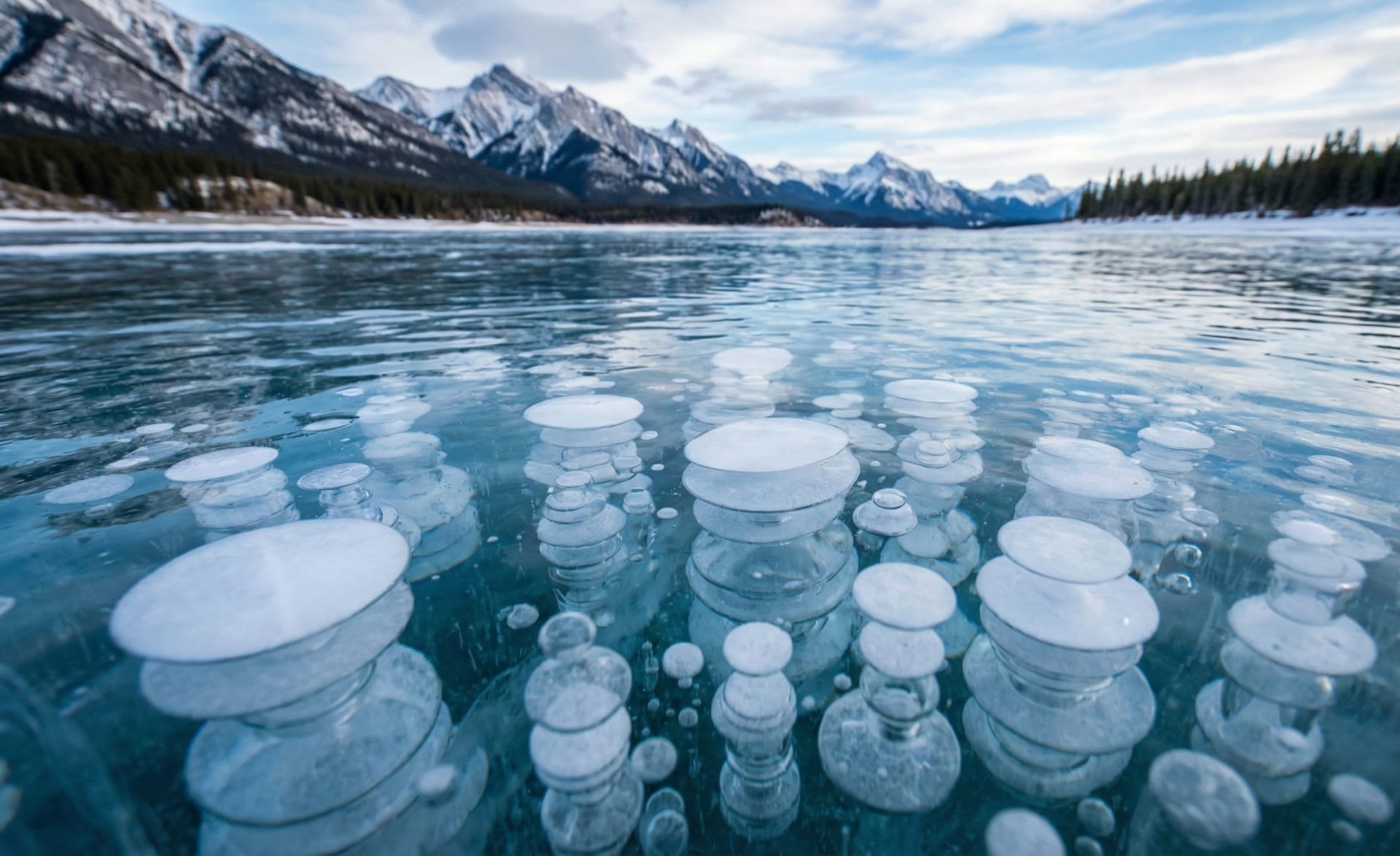
You hear the ice before you see it. A low, percussive groan rolls under your boots as you step onto the surface of Abraham Lake, somewhere between a whale song and a struck piano wire. The wind has stripped the ice bare, and when you finally look down, you stop walking. Beneath your feet, thousands of white discs float in suspension, stacked in columns like frozen jellyfish, each one a pocket of methane gas caught mid-escape and locked in place by advancing ice. Some are the size of a coin. Others spread wider than a dinner plate. They hang at different depths, layered in three dimensions, and the effect is of looking into a frozen aquarium where every creature is made of trapped gas.
This is Abraham Lake in the dead of a Canadian Rockies winter, and the bubbles beneath your feet are flammable.
The Science of Combustible Ice Sculptures
Abraham Lake is not a natural lake. It is an artificial reservoir on the North Saskatchewan River, created when the Bighorn Dam was completed in 1972. That origin story matters. When the valley flooded, it submerged forests, root systems, and organic river-bottom material. Decades later, that drowned landscape is still decomposing.
The process starts at the bottom. Bacteria called methanogens feed on dead organic matter in the lakebed sediment, producing methane (CH4) as a metabolic byproduct. The gas forms bubbles that rise through the water column. In summer, these bubbles reach the surface, pop, and dissipate into the atmosphere without anyone noticing. It is an invisible, continuous exhale.
Winter changes everything. As the lake surface freezes, descending ice traps the rising bubbles before they can escape. Each bubble flattens into a white, disc-shaped pocket. As the ice thickens downward over the season, new bubbles get caught at successively deeper layers, creating vertical stacks. The result is a three-dimensional sculpture frozen at various depths, visible through the ice like specimens in resin.
Two conditions make Abraham Lake world-famous for this phenomenon where other frozen lakes barely register. First, the flooded river valley provides an unusually rich supply of organic material, meaning more methane production than a typical mountain lake. Second, and more critically, Chinook winds blow through this corridor regularly, scouring snow off the ice surface and keeping it transparent. Most frozen lakes bury their bubbles under a blanket of snow within days of freezing. Abraham Lake gets polished clean by warm, dry Pacific air masses that funnel through the Rockies, leaving windows of black ice through which the bubble columns are perfectly visible.
One detail that sharpens the experience: the methane is genuinely combustible. Drill a hole through the ice above a large bubble cluster, hold a lighter to the escaping gas, and you will get a brief, real flame shooting from the surface. It is a visceral reminder that this is not decoration. It is a byproduct of deep biological activity, a gas that contributes to the greenhouse effect, temporarily held in cold storage.
When and Where to Find Them
The season runs from December through March, with the core window falling in December through February. Early season offers the advantage of thinner, more transparent ice before heavy snowfall events. Late season brings thicker, more stable ice but a higher chance of snow cover between Chinook cycles.
Two primary access points serve the lake. Preacher's Point (52.224, -116.427) sits along the southern section and is the most visited area. The bubble concentrations here tend to be dense, and the surrounding mountain views provide a dramatic backdrop. Abraham Lake North End Access (52.368, -116.488) offers a quieter experience with fewer visitors and its own bubble formations, though the drive is longer on rougher road.
Both areas are along the David Thompson Highway (Highway 11) west of Rocky Mountain House, Alberta. The highway is maintained year-round, but conditions can deteriorate rapidly.
Here is the friction: ice thickness varies dramatically across the lake and across the season. Abraham Lake is a reservoir, which means water levels fluctuate. Pressure ridges form. Thin spots develop without warning, particularly near inflows and where current runs underneath. There is no official ice monitoring or safety service. You are responsible for assessing conditions yourself, and people have fallen through. Check local reports, travel with a partner, carry ice picks on a lanyard around your neck, and never assume that because one section held your weight, the next will too.
Wind chill compounds the danger. Chinook winds may keep the ice clear, but between those warm spells, temperatures plunge to -30C or worse with wind chill. Exposed skin freezes in minutes. The lake sits in an open valley that channels wind directly across the surface with nothing to break it.
A Witnessing and Photography Guide
Start with survival. Ice cleats or crampons are non-negotiable. The wind-polished ice is slick enough to send you sprawling without them, and a hard fall on lake ice can crack ribs or worse. Layer serious winter clothing: a moisture-wicking base, insulating mid-layer, and a windproof outer shell. Wear a balaclava or full face protection. Bring hand warmers and a thermos of something hot. This is not a casual afternoon walk.
For photography, the approach is straightforward but demands patience. A wide-angle lens is essential. You want to capture both the bubble detail underfoot and the mountain ridgeline behind. Get low. Very low. Kneeling or lying on the ice with the camera angled into the surface reveals the three-dimensional depth of the bubble stacks in a way that standing shots never will.
Shoot into the ice, not across it. The bubbles are inside the medium, not on top of it. Compose so the viewer can see the layered discs at different depths, each one slightly different in size and opacity. Look for columns where five or six bubbles stack vertically, each caught at a different freeze stage.
Light transforms the lake twice a day. Golden hour paints the surrounding peaks warm while the ice stays cold and blue. Blue hour reverses the effect, saturating the ice surface with deep indigo and making the white bubbles glow by contrast. If you can catch reflected clouds in the ice surface alongside the bubbles below, you get a disorienting image where sky appears both above and beneath you. Include a human figure for scale whenever possible. Without one, viewers have no reference for how massive the bubble fields actually are.
Bring at least twice as many batteries as you think you need. Cold drains lithium-ion cells fast, and Abraham Lake cold drains them faster. Keep spares in an inside pocket against your body. A tripod opens up long exposures for star trails on clear, new-moon nights, with the Milky Way arcing over the Rockies and bubble-studded ice in the foreground.
One technical experiment worth trying: a polarizing filter. Rotating it changes how the ice surface reflects overhead light, and at certain angles, it can dramatically increase the visibility of bubbles trapped deeper in the ice. The results are inconsistent but occasionally stunning.
The Bigger Picture
Abraham Lake's methane bubbles are, in a literal sense, greenhouse gas made visible. Methane is roughly 80 times more effective than carbon dioxide at trapping heat over a twenty-year period. What you see frozen in the ice is a small fraction of what escapes into the atmosphere every summer when the lake thaws.
Across the Arctic and subarctic, permafrost lakes and reservoirs release methane at accelerating rates as temperatures climb. Thermokarst lakes in Siberia and Alaska bubble so aggressively in some areas that the gas can be lit continuously at the surface during warm months. Abraham Lake, as a human-made reservoir in a mountain corridor, is a contained and accessible example of a process happening at planetary scale in less photogenic settings.
The bubbles are roughly 3 to over 30 centimeters in diameter, and no two columns look alike. Some are tight stacks of uniform discs. Others spread and wander as the bubble found different paths through the thickening ice. The variety means you can spend hours on the same stretch of lake and keep finding new compositions, new structures, new arrangements of trapped gas.
Standing on the ice in January, with the wind cutting across the valley and the peaks sharp against a steel sky, the beauty of it is complicated. You are looking at decay. You are looking at biological processes working on drowned landscapes. You are looking at a potent greenhouse gas held temporarily in suspension by cold. And it is extraordinary.
Track live conditions for this and 590+ phenomena on the Earth Exhibit app: https://earthexhibit.com
Track This Phenomenon Live
The Earth Exhibit app monitors real-time conditions for this and 590+ natural phenomena worldwide. Get alerts when conditions peak near you.
