As of Jun 17, 2026, 4:21 PM, past peak, season runs to ~June 30. Earth Exhibit tracks the live conditions and flags it the moment it is on.
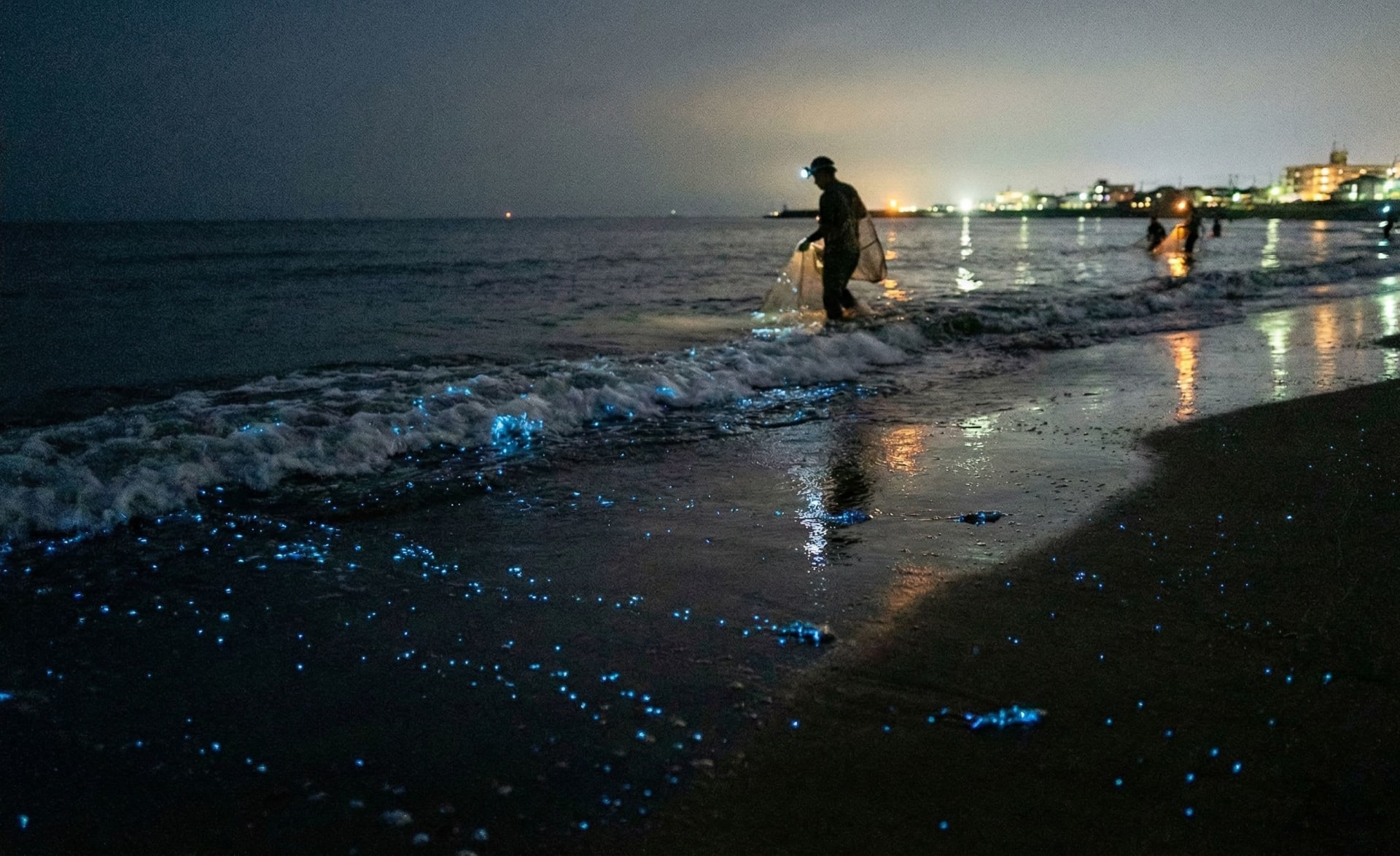
The fishing boat rocks hard enough to make you grab the railing with both hands. It is 3:17 in the morning, the air is four degrees Celsius, and your fingers stopped cooperating ten minutes ago. Then the fixed net comes up. Thousands of small squid, each no longer than your index finger, erupt into bioluminescence the moment they hit the open air. The entire surface of the water turns a shifting, electric blue. Not the soft glow of a firefly. This is aggressive, pulsing, almost digital. Your camera is fogging from the cold and you are fumbling with the ISO dial, and none of that matters because your eyes are doing what no sensor can replicate: taking in the full, hallucinatory scale of Watasenia scintillans doing what it has done in this bay for longer than any fishing village has existed here.
This is Toyama Bay between March and June. This is the firefly squid season.
The Biology Behind the Blue
Watasenia scintillans is a deep-sea cephalopod, roughly seven to eight centimeters long, that spends most of its life between 200 and 600 meters below the surface of the Sea of Japan. It lives about a year. In that single year, it develops one of the most complex bioluminescent systems of any known animal.
Each squid carries approximately 840 photophores across its body. The largest clusters sit on the tips of the two ventral arms, and these are the ones researchers have studied most closely. Unlike many bioluminescent organisms that rely on symbiotic bacteria (the way certain deep-sea anglerfishes do), Watasenia produces its own light through an intrinsic chemical reaction. The molecule responsible is coelenterazine disulfate, a luciferin variant that the squid synthesizes internally. When combined with a luciferase enzyme in the presence of molecular oxygen, it produces photons in the 470-nanometer range: pure, cold blue.
What makes Watasenia genuinely unusual among squid is the degree of neural control it exerts over this light. The squid can flash individual photophores or fire them in cascading waves across its mantle. Researchers at the University of Toyama documented distinct flash patterns associated with predator avoidance, prey attraction, and intraspecific communication during mating. The arm-tip photophores produce the brightest sustained glow, while the ventral body photophores create the counter-illumination camouflage that helps the squid disappear against downwelling light when viewed from below. It is, functionally, an animal that uses light the way other animals use sound: layered, directional, purposeful.
The spring spawning migration is what brings them into Toyama Bay's shallows. The bay's geography matters enormously here. A steep submarine canyon, the Toyama Trough, drops to over 1,000 meters just a few kilometers offshore. This means deep-water species like Watasenia can access the coastal shelf without traveling long horizontal distances. As water temperatures shift in March and April, the squid rise en masse to spawn in waters between 20 and 100 meters deep. Fixed nets set by local fishermen intercept them on these vertical migrations, and the concentrated catch is what produces the spectacle visitors come to see.
When and Where to Go
The season officially runs from March 1 through June 30, but the real window is tighter than that. Peak intensity falls between early April and mid-May, when water temperatures and spawning pressure align. The fishermen's cooperative in Namerikawa, a small coastal city about 25 minutes northeast of Toyama Station by train, operates the only official tourist viewing boats during this period.
Namerikawa is the place. Not Toyama city proper, not Kanazawa, not some resort town down the coast. Namerikawa. The city runs the Hotaruika Museum (hotaruika being the Japanese name for firefly squid), which serves as the booking hub for the predawn boat tours. These tours depart around 3:00 AM from Namerikawa fishing port, last roughly 90 minutes, and take you out to watch the fixed-net haul. Advance booking is essentially mandatory. The boats hold limited passengers and sell out weeks ahead during peak season, particularly on weekends. Book through the museum's website as soon as dates open, typically in February.
A few realities about the experience that promotional photos will not tell you. The boats go out in rough conditions. Toyama Bay is sheltered compared to open ocean, but a small fishing vessel at 3 AM in April is not a calm ride. If you have any susceptibility to motion sickness, take dramamine at least an hour before boarding. Bring it with you from home rather than hoping to find it at a convenience store in rural Toyama Prefecture at 2 AM. The cold is legitimate. Even in late April, predawn temperatures on the water hover around three to six degrees. Warm layers, a waterproof jacket, a hat, gloves. Dress like you are going winter hiking, not spring sightseeing.
There are also shoreline viewing opportunities. After storms or on certain tide cycles, spent squid wash ashore along Namerikawa's beaches, and the surf line glows blue in patches. This is less predictable than the boat tours but free, accessible, and genuinely eerie. Local social media accounts and the museum staff can sometimes give you a day or two of advance notice when beach strandings look likely.
Getting to Namerikawa is straightforward from Tokyo. Take the Hokuriku Shinkansen to Toyama Station (about two hours and ten minutes), then transfer to the Ainokaze Toyama Railway for the 25-minute local ride to Namerikawa. If you are coming from Osaka or Kyoto, route through Kanazawa on the Thunderbird limited express, then Shinkansen to Toyama. A rental car is useful if you want flexibility for shoreline scouting at odd hours, but not strictly necessary.
Accommodations in Namerikawa itself are limited. Most visitors stay in Toyama city and taxi or drive to the port for the early departure. Budget for cash yen. The boat tours, museum entry, and most of the small restaurants in the area do not reliably accept cards.
Photographing the Glow
Shooting firefly squid is a low-light discipline closer to astrophotography than wildlife photography. The light output from the squid is beautiful to the naked eye but challenging for cameras. You are working in near-total darkness on a moving platform with a subject that pulses unpredictably.
Start with ISO 3200 as a baseline and be prepared to push to 6400 or even 12800 depending on your body's noise performance. A fast lens is non-negotiable: f/2.8 at minimum, f/1.4 or f/1.8 if you have it. Shutter speeds between 1/60 and 1/125 will freeze the squid reasonably well, but the boat motion is your real enemy. Brace against the railing, exhale, shoot in bursts.
Honestly, video in 4K often produces more satisfying results than stills. The pulsing, wave-like quality of the bioluminescence is inherently temporal. A single frame captures a moment, but the phenomenon is about rhythm and movement. If you have a camera that handles 4K at high ISO without excessive noise (Sony A7S series, for instance), lean into video and pull stills from the footage later.
One failed-attempt confession: on my first visit, I spent the entire boat tour trying to nail a long-exposure shot of the glowing nets being hauled up. Every frame was a smeared mess of blue and black because I underestimated how much the boat pitched. The best image I got that morning was a handheld 1/80 at ISO 10000, slightly noisy, slightly soft, and absolutely alive with that surreal color. Technical perfection is not the goal here. Capturing the light is.
Why This Matters Beyond the Spectacle
Watasenia scintillans is a bioindicator species for Toyama Bay's deep-water ecosystem. The squid's annual migration depends on a precise chain of oceanographic conditions: water temperature stratification, nutrient upwelling through the Toyama Trough, and the health of the mesopelagic food web that sustains the squid during their deep-water phase. When the firefly squid show up in normal numbers, it signals that the deep bay ecosystem is functioning. When they do not, something has shifted.
Commercial catches have fluctuated significantly over the past two decades. Namerikawa's fishing cooperative tracks annual haul tonnage carefully, and the data shows increasing variability that correlates with sea surface temperature anomalies in the Sea of Japan. The squid are not endangered, but they are responsive. They register changes in ocean conditions faster than most monitoring systems can detect them.
The fishery itself is culturally embedded in Namerikawa's identity. Firefly squid have been harvested here since the Edo period. The local cuisine builds entire spring menus around them: sashimi (eaten whole, raw, glowing faintly on the plate), tempura, marinated in soy, boiled and served with vinegar miso. The Namerikawa fishing port is one of the few places in the world where bioluminescent seafood goes from net to kitchen in under an hour.
For Japan, this phenomenon sits at the intersection of marine science, traditional fishing culture, and the deep seasonal awareness that structures rural Japanese life. The squid arrive, the cherry blossoms open, the snow retreats from the Tateyama peaks visible across the bay. It is all one system, observed and calibrated over centuries.
This is the short version
This page shows a taste. The app has the full list of where to see this, the exact timing, and live conditions for 1,000+ natural phenomena worldwide, so you know the moment one is genuinely worth the trip.