As of today, out of season, returns ~September. Earth Exhibit tracks the live conditions and flags it the moment it is on.
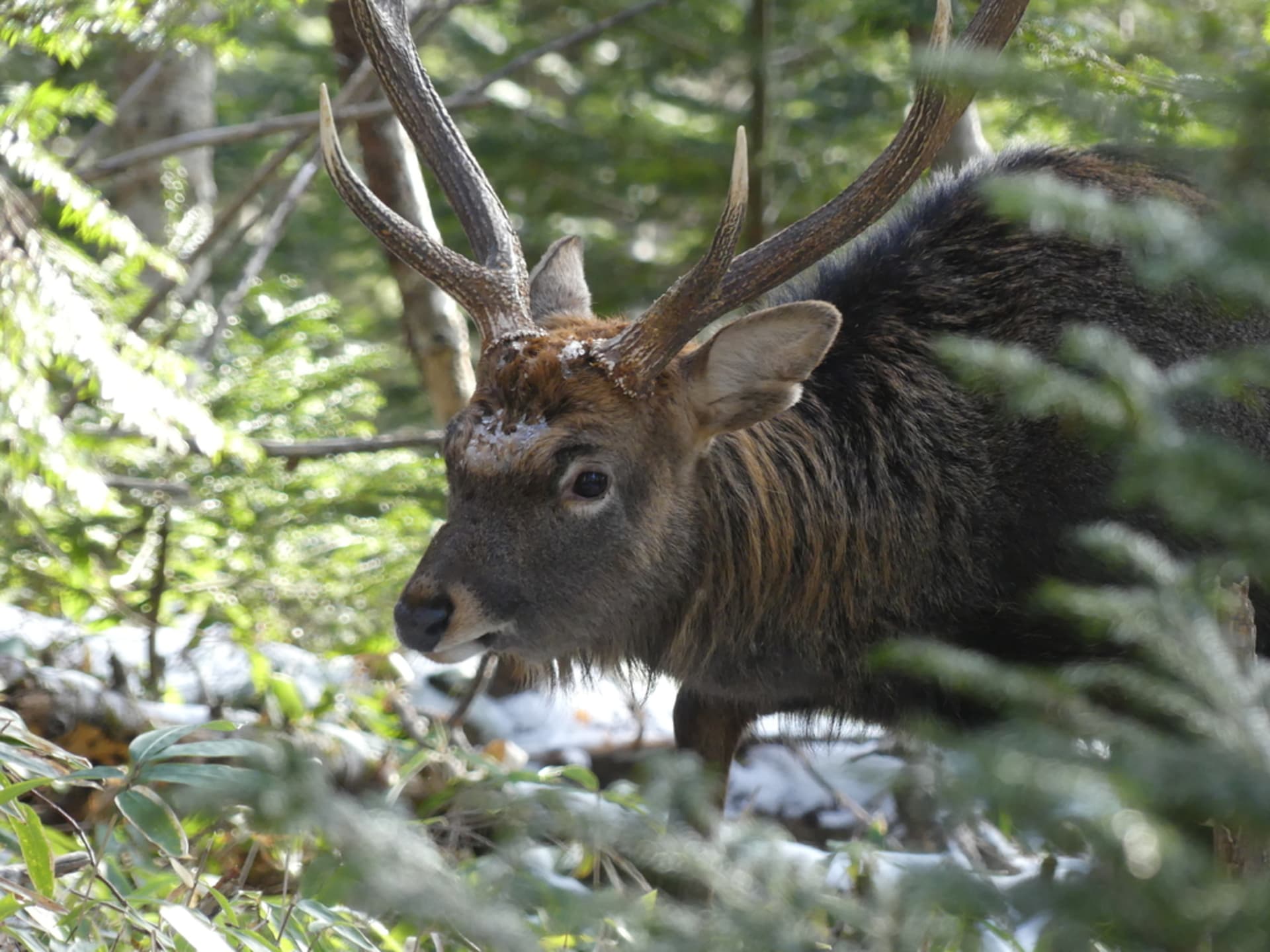
Dawn breaks over Nopporo Forest, and the stillness shatters. A high-pitched whistle cuts through the October air, somewhere between a bugle and a scream. Then antlers crack against antlers. Male Ezo sika deer call with high-pitched whistles and engage in antler battles during their September through October rut , transforming quiet mixed forests into arenas of competition. Hokkaido sika males sometimes exceed 200 kg in the fall , making them the largest of the sika subspecies. October is when to go.
The Science Behind Ezo Sika Deer Rut
The Ezo sika deer (Cervus nippon yesoensis) carries genetic adaptations specific to Hokkaido's harsh climate. The Yezo sika deer is a subspecies of sika deer that inhabits the northern Japanese island of Hokkaido . Unlike their smaller southern cousins, these northern deer have evolved larger body mass and more substantial antlers to survive deep snow and frigid winters.
Sika males are territorial and keep harems of females during their rut, which peaks from early September through November . The mechanism driving this behavior is testosterone. As days shorten in late summer, hormonal shifts trigger antler hardening, neck thickening, and behavioral transformation. Docile bachelor groups splinter. Males become aggressive, vocal, and territorial.
Rutting vocalizations play an important role in breeding behavior in sika deer . The calls serve multiple functions: advertising territory, challenging rivals, and attracting females. Sound levels reach approximately 92 to 96 dB at 7 meters for the howl vocalization , loud enough to carry hundreds of meters through dense forest.
Males mark territories by digging shallow pits or scrapes with forefeet or antlers, into which they urinate, emanating a strong, musky odor . The scent marks are visual and olfactory warnings. Fights between rival males for territorial disputes using hooves and antlers are sometimes fierce and long and may even be fatal .
When and Where to See Ezo Sika Deer Rut
October is the core month. During the rut from September to October, males call with high-pitched whistles and engage in antler battles , with activity peaking in mid-October as females enter estrus. Early morning and late afternoon bring the most intense displays.
Nopporo Forest Park (43.045867, 141.524724) sits on Sapporo's eastern edge, offering 2,053 hectares of mixed conifer and broadleaf forest. Approximately 80% of the park is national forest and wildlife sanctuary . Deer peek between trees along the flat forest routes . Access via JR Sekisho Line to Shinrin Koen Station, then a 10-minute walk to trailheads. The Mizuho entrance and trails around Mizuho Pond offer reliable sightings.
Akan-Mashu National Park (43.45, 144.1) in eastern Hokkaido provides wilder terrain. Deer concentrate near forest edges and open grasslands. The park's remote sections see fewer visitors, meaning less pressure on displaying males.
Shiretoko Five Lakes (Shiretoko Goko) (44.12556, 145.08111) combines rut viewing with UNESCO World Heritage wilderness. Hokkaido has wild herds in Shiretoko and other natural areas . Elevated boardwalks allow observation without disturbing animals. Book the ground pathway tour in advance for closer access.
Nara Park (34.685047, 135.843012) hosts a semi-tame population on Honshu. While not Ezo sika, the September through October rut offers accessible viewing for those unable to reach Hokkaido. Keep distance regulations strict even with habituated deer.
Weather in October means daytime highs around 12 to 15 degrees Celsius, mornings near freezing. First snow sometimes arrives late in the month. Trails remain passable, but mud is common after rain.
Your Witnessing Guide
Gear essentials:
- Binoculars (8x42 or 10x42 magnification). Males maintain 30-meter spacing during territorial displays. Optics are non-negotiable.
- Telephoto lens (300mm minimum, 400 to 600mm ideal). ISO 1600 to 3200, aperture f/5.6 to f/8, shutter speed 1/500 or faster to freeze sparring motion.
- Warm layers. October mornings in Hokkaido drop below freezing. Merino base layer, insulating mid-layer, windproof shell.
- Quiet clothing. Avoid synthetic fabrics that rustle. Wool and soft fleece work best.
- Sturdy boots. Forest trails in October alternate between muddy and frost-hardened.
- Headlamp with red filter for pre-dawn positioning.
Field strategy: Position yourself downwind at forest edges where trails meet open areas. Males patrol these transition zones. Arrive 45 minutes before sunrise. Sit. Wait. Patience eliminates 90% of failed sightings.
Listen for vocalizations. The high-pitched whistle travels farther than you expect. Once you hear a call, stay put. Males often vocalize from the same location repeatedly, especially if females are nearby.
If you witness sparring, resist the urge to move closer. Fights using hooves and antlers are sometimes fierce and long . Interrupting a territorial dispute can redirect aggression toward you. Rutting stags are unpredictable and fast. The 30-meter minimum distance is not optional.
Photography settings: shoot in burst mode. Sparring lasts seconds. Set continuous autofocus (AI Servo on Canon, AF-C on Nikon). Meter for the deer, not the background. Forest light is uneven. Check your histogram frequently.
Safety: Rutting males become aggressive. Never position yourself between a stag and his harem. Never approach a male displaying threat postures: ears back, head lowered, antlers forward. Back away slowly if a male approaches. Do not run. Sudden movement triggers chase instinct.
In 2016, there were 1,916 deer-car accidents across Hokkaido but in 2023 there were 5,287 . Deer activity peaks at dawn and dusk, exactly when you will be driving to viewing sites. Drive slowly. Scan roadsides constantly. One deer crossing often means more follow.
Why It Matters
Japan has the largest native sika population in the world, estimated at 3,080,000 in 2015 including Hokkaido . Yet this abundance creates ecological strain. Without its main predator, the population of sika exploded and is now overpopulated in many areas, posing a threat to both forests and farmlands .
The extinction of their main natural predator, the Ezo wolf, is one popular theory for the rise in deer population . The Ezo wolf vanished in the late 19th century after bounty hunting. Without predation pressure, deer numbers rebounded dramatically. In 2022, 144,989 deer were hunted or captured and killed under population control programs.
The rut is the fulcrum of this population dynamic. Successful males may hold harems of a dozen females. Hinds give birth to a single fawn weighing 4.5 to 7.0 kg after a seven-month gestation. High reproductive rates mean the population can absorb significant hunting pressure and still grow.
Cultural connections run deep. The Ainu indigenous people of Hokkaido hunted yezo sika deer for centuries and relied on them as a major food source . The Ainu word for deer is "yuk." Unlike bears, which held sacred status requiring elaborate ceremonies, deer were considered gifts from the gods spread across the land for human sustenance.
Modern Hokkaido embraces culled deer as a resource. Venison appears on restaurant menus across the island. Ezo deer meat is lean, high-protein, and low-fat, yielding about 20 kg per deer . Tanneries process hides into supple leather for bags and jackets. Antlers become craft materials. The economic loop attempts to offset agricultural damage.
Conservation status remains complex. The species thrives numerically but degrades its own habitat through overbrowsing. Forest understory vanishes. Tree regeneration stalls. Alpine plants disappear. Management now focuses on balance rather than preservation. Watching the October rut means witnessing an ecosystem out of equilibrium, magnificent and problematic at once.
This is the short version
This page shows a taste. The app has the full list of where to see this, the exact timing, and live conditions for 1,000+ natural phenomena worldwide, so you know the moment one is genuinely worth the trip.