As of Jun 17, 2026, 4:21 PM, in season now, through ~October 31. Earth Exhibit tracks the live conditions and flags it the moment it is on.
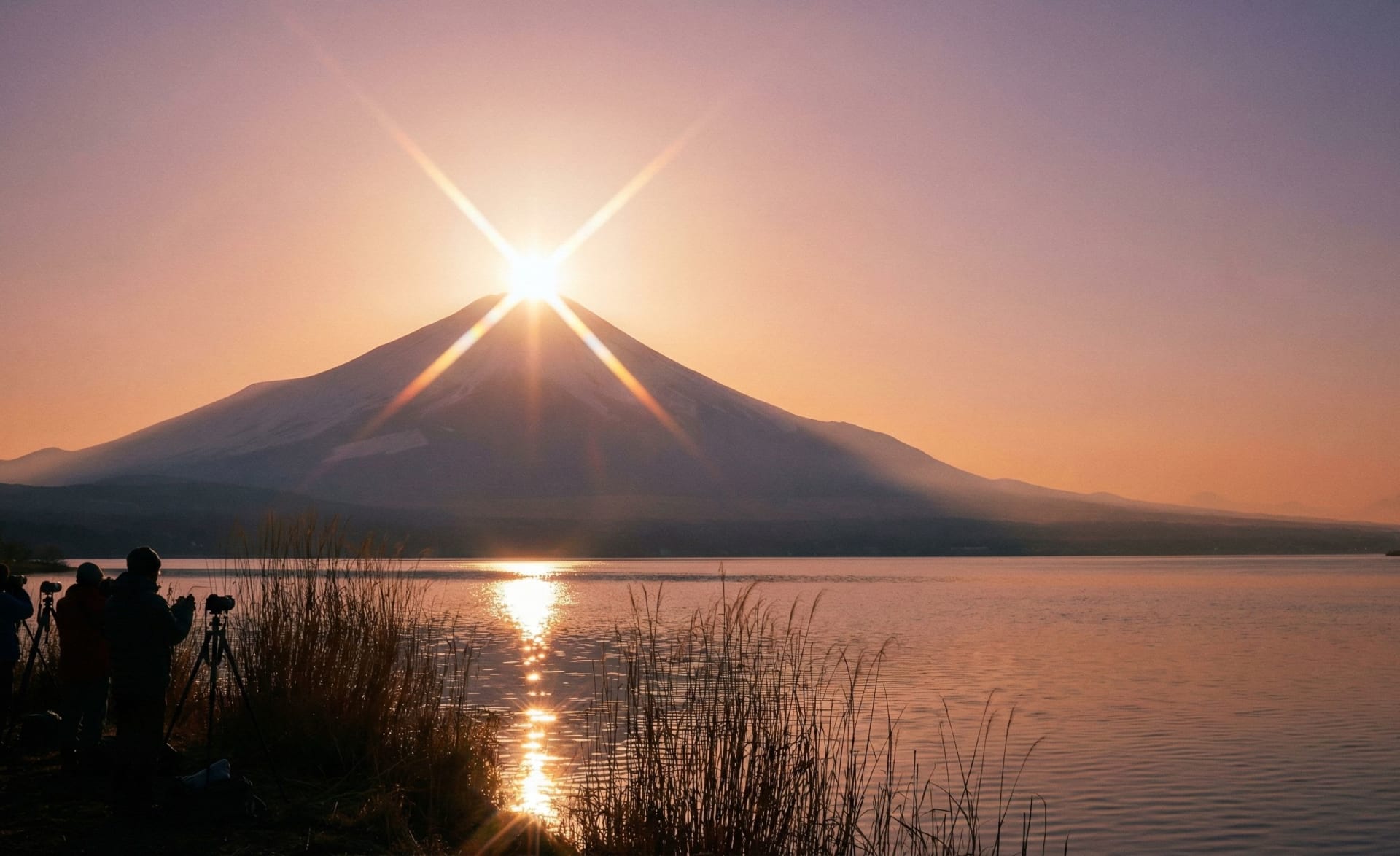
The sun touches the summit. For 90 seconds, Mt. Fuji wears a crown of fire. The orb compresses, flares, and disappears behind the peak, leaving a brief afterglow on the snow-covered slopes. Photographers position their tripods along Lake Yamanaka's northern shore between February 1 and 22 , when weather is stable and the alignment is perfect. This is Diamond Fuji, an optical phenomenon that occurs only when the setting sun meets the summit at exact coordinates. Miss the window by a few kilometers or a few days, and the sun sinks beside the mountain instead of behind it.
The Science Behind Diamond Fuji
Diamond Fuji occurs when the sun aligns perfectly with the summit of Mt. Fuji, shining brilliantly like a diamond . The name borrows from the diamond ring effect seen during total solar eclipses, when sunlight streams through lunar valleys at totality's edge. Here, the mechanism is simpler: pure geometry. The sun's apparent path across the sky shifts throughout the year. From any given viewpoint, the sun crosses Mt. Fuji's summit only on specific dates. The alignment shifts slightly each day , moving the ideal viewing position along the lake shore or to different locations entirely.
On the western side in Shizuoka Prefecture, you can see Diamond Fuji at sunrise, while on the eastern side in Yamanashi Prefecture, you can view it at sunset . Lake Yamanaka sits northeast of the mountain, making it a prime sunset location. The phenomenon lasts approximately two minutes from first contact to full disappearance. During sunset, the sun slowly descends diagonally from the upper right to the lower left, meeting the summit of Mt. Fuji before vanishing in a burst of brilliant light. This rare moment lasts only about two minutes .
When the lake surface is calm, a second sun appears in the water, mirroring the alignment. The calm, reflective waters of Lake Yamanaka often mirror Mount Fuji, creating the breathtaking "Double Diamond Fuji", where both the sun and its reflection align with the summit . On exceptional days with perfect stillness and specific lighting conditions, a third reflection can create Triple Diamond Fuji, though this is vanishingly rare.
Visibility is very high in February, with an overall viewing rate of 67.9% . The cold air holds less moisture, reducing atmospheric haze that obscures distant mountains during warmer months.
When and Where to See Diamond Fuji
The period from February 1st to 22nd is designated as Diamond Fuji Weeks at Lake Yamanaka, with peak viewing times occurring around sunset between 4:30 PM and 5:30 PM, depending on the day . The exact sunset time shifts earlier to later as February progresses. In early February, the sun sets around 4:30 PM. By late February, sunset has moved to approximately 5:20 PM.
Lake Yamanaka's northern shore provides the classic vantage point. Hirano Beach (coordinates: 35.4167, 138.8833) is the most accessible location, with free parking and open lakeside access. The success of witnessing Diamond Fuji depends on clear weather and selecting the right viewing spot along the northern shore of Lake Yamanaka. The alignment shifts slightly each day, so planning in advance is recommended . On February 10, you might stand at Hirano's eastern end. By February 15, the ideal spot has moved a few hundred meters west.
Panorama Dai offers views of Lake Yamanaka below and even the Southern Alps visible on clear days. Diamond Fuji season at Lake Yamanaka begins at Panorama Dai in mid-October and ends here in late February, with observation around October 16 to February 25, time around 4:22 PM to 4:50 PM . This elevated viewpoint sits partway up Mt. Myojin at over 1,000 meters elevation. The perspective changes the sun's apparent position relative to the summit, extending the viewing season.
Other locations around Mt. Fuji offer Diamond Fuji at different times. At Yamanakako Koryu Plaza Kirara, Diamond Fuji occurs in the period from Nov 30 to Dec 7 at around 3:20 p.m. and the period from Jan 3 to Jan 11 at around 3:40 p.m., with Feb 16 at 4:34 p.m. . Lake Tanuki in Shizuoka Prefecture offers sunrise Diamond Fuji, when the sun crests the summit from the west. Tokyo's skyscrapers catch the phenomenon in late January and mid-November, though from 90 kilometers away, Mt. Fuji appears smaller.
Highway buses go between Shinjuku or Tokyo Station and Yamanakako and take about two hours, for around 2,000 yen one-way. You can also travel by train to Kawaguchiko and take a bus to Yamanakako from there .
Your Witnessing Guide
Arrive at least 30 minutes before predicted sunset. The best positions fill quickly, especially during the designated Diamond Fuji Weeks. The alignment shifts slightly each day, so planning in advance is recommended . Check specific sunset times for your chosen date and scout the shoreline to identify where the sun will meet the peak.
Camera settings: Use a telephoto lens, 200-400mm minimum. Mt. Fuji is 25 kilometers south of Lake Yamanaka. At 200mm, the mountain fills about half the frame. At 400mm, you capture the summit in detail. Shoot in manual mode. Start at ISO 100, f/11, and shutter speed based on your meter reading. As the sun descends, it dims rapidly. Be prepared to adjust shutter speed continuously. At the moment of contact, the sun is bright enough to shoot at 1/500s or faster. Once half-disappeared, drop to 1/125s or slower.
Use a sturdy tripod. The phenomenon lasts two minutes, but you'll want multiple exposures at different shutter speeds. Bracket your shots: one exposed for the sun (which will render the landscape dark), one exposed for the mountain (which will blow out the sun), and one or two in between. Consider using a neutral density filter to extend exposure time without overexposing the sun, creating a slightly softer effect.
For Double Diamond Fuji, eliminate all vibration. Use a cable release or the camera's timer. Even wind rippling the surface destroys the reflection. The lake is calmest in early morning and late afternoon when thermal winds die down, but afternoon wind patterns can persist through sunset. Some photographers use warming filters or enhance the golden tones in post-processing, but the natural color at this hour needs little help.
What to bring: The database recommends camera, tripod, telephoto lens, warm layers, gloves, hand warmers, spare batteries, and an ND filter. Lake Yamanaka sits at 980 meters elevation. Mount Fuji weather in February is frigid. In areas around the foothills, the monthly average temperature ranges from -5 to 6 degrees Celsius (23-42.8 degrees Fahrenheit) . Be sure to dress warmly. It gets really cold after sunset . Temperatures can drop below -8?C at night. Your fingers will go numb. Bring glove liners that allow shutter button operation, and chemical hand warmers for pockets. Lithium-ion batteries drain faster in cold conditions. Carry two or three spares, kept warm against your body.
Wear insulated boots with good traction. The lakeshore can be icy. Some photographers stand in shallow water at the lake's edge to eliminate foreground distractions, but this requires waterproof waders and careful footing.
After the shot: The event period often coincides with the Ice Candle Festival and Sky Lantern Festival at Yamanakako Communication Plaza Kirara. In 2026, this special bonus event will take place on Sunday, February 22, 2026, with 3,000 ice candles lighting up the plaza, followed by a spectacular fireworks display . The festival site is a short drive from the main Diamond Fuji viewing areas.
Why It Matters
Diamond Fuji has become a pilgrimage for Japanese landscape photographers. Capturing the perfect "Diamond Fuji" has become a rite of passage for photographers and travelers seeking the ultimate winter landscape shot . The phenomenon appears in ukiyo-e prints and modern photo competitions alike. It represents the intersection of Mt. Fuji's sacred status and the precision of natural cycles.
Mt. Fuji is a sacred mountain, home to the deity Konohanasakuya-hime. The term was inspired by the "diamond ring effect" seen at the end of a total solar eclipse, when sunlight shines through the moon's craters, resembling a diamond ring . The name connects celestial mechanics to terrestrial landscape, turning a predictable alignment into something transcendent.
The phenomenon depends entirely on clear weather. Clouds obscure the summit roughly one-third of February days. The phenomenon is weather-dependent, and clear skies are essential for witnessing the sun perfectly aligning with Mount Fuji's peak . Climate patterns affect visibility. Warmer winters bring more moisture, more clouds. Photographers return year after year, chasing the alignment they missed last time.
Diamond Fuji also serves as a natural calendar. Before modern timekeeping, farmers and communities around Mt. Fuji used the sun's position relative to the mountain to mark seasonal transitions. The February alignment signaled the approach of spring planting. Today, it marks the peak of winter clarity, when Japan's iconic mountain stands sharpest against the sky.
The Fuji Five Lakes region, including Lake Yamanaka, is part of Mt. Fuji's World Heritage designation. The area balances heavy tourism with conservation. During Diamond Fuji Weeks, the northern shore sees hundreds of photographers and visitors daily. Local communities manage parking, maintain access, and ensure the lakeshore remains open. The phenomenon drives winter tourism to the region, supporting hotels, restaurants, and transport services during an otherwise quiet season.
If you find yourself standing at Lake Yamanaka in February, waiting for the alignment, you're participating in a tradition that stretches back centuries, reframed through modern optics and digital sensors. The sun will crown the mountain for two minutes. You will hold your breath. And then it will be gone until the geometry brings it back next year.
Thinking about spending more time in the Mt. Fuji region? Settle Japan helps with relocation logistics and visa navigation, while Maneki Homes lists properties near these natural sites. If you're looking for proof that these moments are worth planning your life around, follow @johnofjapan on Instagram for on-the-ground footage of Japan's most extraordinary natural events: https://instagram.com/johnofjapan
Find more about relocating: https://settlejapan.com
Browse regional properties: https://manekihomes.com
This is the short version
This page shows a taste. The app has the full list of where to see this, the exact timing, and live conditions for 1,000+ natural phenomena worldwide, so you know the moment one is genuinely worth the trip.