As of today, out of season, returns ~December. Earth Exhibit tracks the live conditions and flags it the moment it is on.
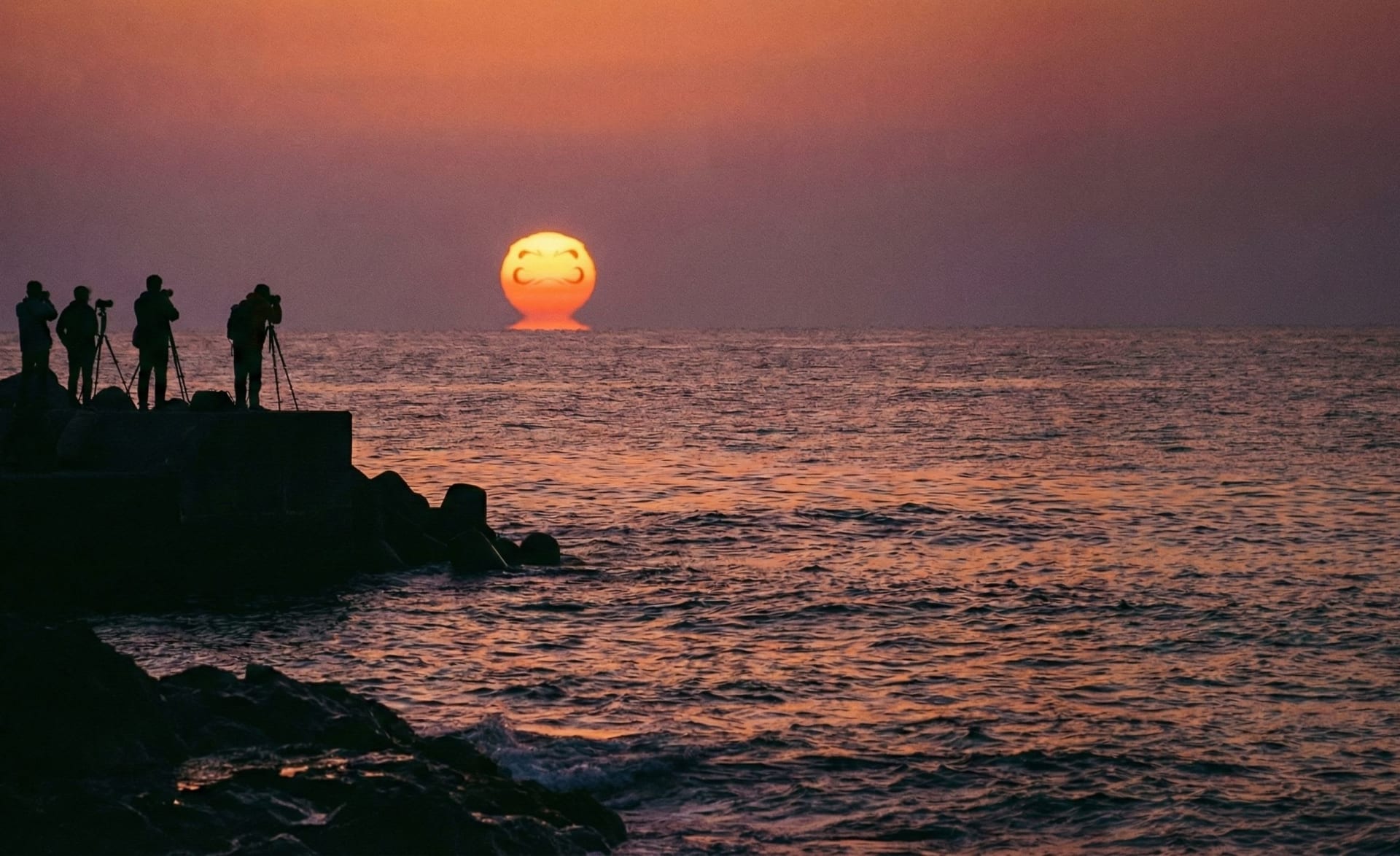
The sun hangs just above the Pacific horizon, and then it starts to warp. The lower edge flattens, stretches. An inverted sun rises from the sea to meet the real one, fusing into a shape like two red spheres stacked on top of each other. For three winter minutes along Kochi Prefecture's coast, atmospheric refraction transforms the solar disc into Daruma Yuuhi, the daruma sunset. It looks exactly like a daruma doll, that round-bodied, legless talisman of luck sold at temples across Japan. The phenomenon is most likely from late autumn to early spring , and December through January gives you the best shot at seeing it.
The Science Behind Daruma Yuuhi
Daruma Yuuhi is a type of inferior mirage, the same physics that makes hot roads look wet in summer. Inferior mirage of astronomical objects is the most common mirage. The setup requires a temperature inversion: warm air above the ocean surface overlaid by colder air higher up. This mirage occurs when sunlight is refracted by the warm air above the ocean surface interacting with the cold air higher above. The warm Kuroshio Current runs along Kochi's coast in winter, heating the lowest air layer while the upper atmosphere stays cold.
When the Sun is on the horizon, or very near it, refraction in the lower atmosphere appears to flatten the solar disk. This happens because sunlight directed towards us from the bottom portion of the Sun passes through a slightly denser atmosphere than do rays coming from the Sun's upper portion. But an inferior mirage does more than flatten. It creates a second, inverted image. Light from the sun's lower edge bends upward through the warm layer, then back down to your eye. You see two suns: the real one above, and a miraged, upside-down copy below. As the sunset proceeds the upper and lower images approach, touch and eventually overlap to form an 'omega' shaped sun. The Japanese call this the daruma shape.
The effect lasts about three minutes as the sun descends. The sun takes on the "Daruma" shape for only about 3 minutes before the sunset touches the sea. Then the sun sinks, the mirage collapses, and the horizon goes dark.
When and Where to See Daruma Yuuhi
The core season runs December through January along Kochi's southern and western coasts, though they are mainly visible from the middle of November until the latter half of February. You need clear skies, calm seas, and that temperature inversion. This phenomenon occurs about 20 times during a winter. Moreover, it becomes a perfect 'daruma' only about 10 times. The odds are decent, but not guaranteed.
Along Kochi Prefecture's 700km long coastline facing the Pacific Ocean, there are many places to see this natural wonder. The likelihood of catching a glimpse of one of these spectacular sunsets in Kochi is relatively high, thanks to the warm ocean currents that run along the prefecture's coastline. Four locations offer reliable viewing:
Katsurahama Beach (33.4974537, 133.5748696): A crescent bay 30 minutes south of Kochi city. The beach faces southwest across Tosa Bay, giving you an unobstructed Pacific horizon. Swimming is prohibited due to rough surf, but the shore is open for sunset watching. Arrive 30 minutes before sunset. The bronze statue of Sakamoto Ryoma stands on the left cape, facing the same horizon you will be watching.
Godaisan Observatory (33.5473007, 133.5743222): A hilltop park overlooking Kochi city and Urado Bay. The elevation gives you a wider view and slightly different refraction geometry compared to sea-level viewing.
Cape Muroto (33.2432991, 134.1764781): As the cape juts straight out into the Pacific Ocean, this is one of the few places in Japan where you can watch a gorgeous sunrise and sunset from the same spot. The exposed tip faces south and east, so sunset angles work here in winter. Expect 1.5 to 2.5 hours driving from Kochi city. Parking is available at the cape.
Cape Ashizuri Observatory (32.7238386, 133.0203158): The southwestern tip of Shikoku. Remote, but the westward-facing cliffs give you a direct shot at the winter sun's descent. Public transit is sparse. Rent a car.
In areas like Sukumo, the phenomenon can be seen up to 20 times within a 3.5 month period. Sukumo Bay opens to the west, making it one of the most reliable daruma-hunting grounds. Between mid-November and late February, daruma sunsets appear right in between two islands at Kanyo Island Park.
Arrive at your chosen viewing spot 30 minutes before sunset. To see the Daruma sunset, it's important to arrive at the coast 30 minutes before sunset. Check sunset time for Kochi in early 2026: around 5:30 PM in December, 5:45 PM in January. The daruma shape forms in the final minutes before the sun touches the horizon.
Your Witnessing Guide
This is a winter coastal phenomenon. Bring layers. The Pacific wind cuts through fleece. A rain jacket blocks wind even on clear days. The database recommends hiking boots if you plan to walk cliff trails at Cape Muroto or Ashizuri, but sneakers work fine for beach viewing at Katsurahama.
Gear list:
- Binoculars: Magnification shows the mirage structure more clearly. You will see the fold line where the erect and inverted images meet.
- Camera with zoom: A 200mm lens or longer captures the sun's distorted shape. Shoot in manual mode. Start with ISO 100, f/8, and 1/1000 second shutter speed. Adjust as the sun dims. Underexpose slightly to preserve disc detail. The sun will be orange to red at this angle, not white-hot.
- Tripod: Not in the database, but essential if you are shooting telephoto. The mirage changes second by second. Bracket your exposures.
- Water and sun protection: Even in winter, coastal glare is harsh before sunset. Sunglasses help until the final minutes.
Do not stare at the sun through binoculars or a camera viewfinder until it is very close to the horizon and deep orange. Even a setting sun can damage your retina if it is still bright white or yellow.
Safety notes from the database: stay behind railings on cliffs. Rocks are slippery at dusk. Waves are larger than they look. Do not approach cliff edges for a better view. Respect restricted access signs. The phenomenon happens every winter. It will come back next year. Do not risk a fall.
Photography settings for serious shooters: If you want to capture the mirage fold line (the boundary where the image inverts), shoot at 400mm or longer. Use a solar filter if the sun is still bright. As it reddens near the horizon, remove the filter. Shoot RAW. The color shifts are extreme, and you will want post-processing flexibility. If the air is hazy, you might catch faint green at the sun's upper rim (an inferior-mirage green flash), though haze usually kills it.
Why It Matters
Daruma Yuuhi sits at the intersection of meteorology, oceanography, and optics. The Kuroshio Current, one of the Pacific's major warm currents, flows northeast along Japan's southern coast. In winter, this warm water heats the air directly above it while the continental air mass over Shikoku stays cold. That vertical temperature gradient is the engine. The same current drives Japan's climate, moderates winter temperatures, and supports fisheries from Okinawa to Hokkaido. The mirage is a visible signature of that oceanic heat pump.
Due to their supposed rarity, seeing a daruma sunset is said to be lucky. The daruma doll itself represents Bodhidharma, the founder of Zen Buddhism, and symbolizes perseverance. You buy a daruma with blank eyes, paint in one eye when you set a goal, and paint the second eye when you achieve it. The dolls are round and weighted at the bottom so they always right themselves when knocked over: seven times down, eight times up. The sunset borrows that shape and that symbolism. Locals call it the "lucky sunset."
Culturally, Kochi has always looked to the Pacific. Sakamoto Ryoma, the samurai who helped engineer the Meiji Restoration, was born here. His statue at Katsurahama gazes out over the same water where daruma sunsets form. The phenomenon is embedded in regional identity, woven into tourism campaigns and folklore. It is both a scientific curiosity and a point of local pride.
Climate sensitivity: temperature inversions require specific conditions. Stronger wind mixes the air layers and destroys the mirage. Clouds block it. Humidity scatters light and blurs the disc. As sea temperatures shift with climate patterns, the frequency and timing of daruma sunsets may change. No studies track this yet, but the phenomenon is a potential indicator of boundary-layer dynamics.
This is the short version
This page shows a taste. The app has the full list of where to see this, the exact timing, and live conditions for 1,000+ natural phenomena worldwide, so you know the moment one is genuinely worth the trip.