As of today, in season now. Earth Exhibit tracks the live conditions and flags it the moment it is on.
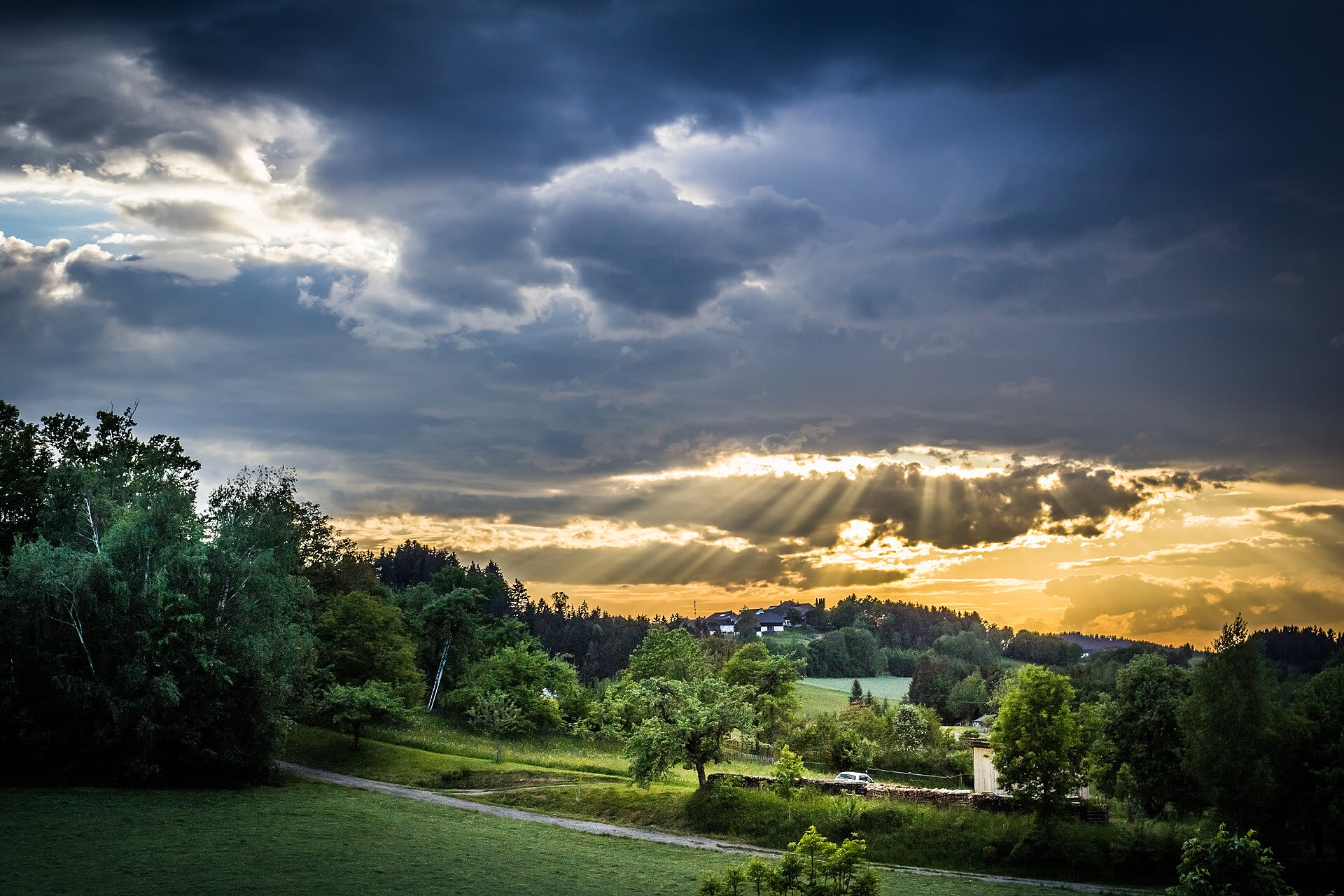
Crepuscular rays are the bright and dark shafts that seem to fan out from the sun near sunrise or sunset, streaming through gaps in clouds or past distant peaks and lit up by haze, dust, and moisture in the air.
They look like spokes radiating from a single point, but that is a trick of perspective — the beams are actually parallel, the same illusion as railway tracks converging toward the horizon.
Turn your back on the sunset and, if you search carefully, you can sometimes trace those same parallel beams all the way across the sky to where they appear to meet again at the antisolar point, directly opposite the sun.
Those are anticrepuscular rays: fainter, more elusive, and missed by almost everyone because they are looking the wrong way.
Both need the same recipe — an open horizon, the sun low or just hidden, and broken cloud or a ragged ridgeline to slice the light into beams.
Crepuscular rays are common if you watch the sky at dusk; the anticrepuscular version is the prize, and most people go a lifetime without noticing it.
Where to see it
A taste of where to see it. The full map, exact coordinates and the best timing for each spot live in the app.
| Viewing spots |
|---|
| Mather Point, Grand Canyon South Rim |
| Cape Reinga Lighthouse, Northland |
| + 2 more spots, with exact coordinates and timing, in the app → |
This is the short version
This page shows a taste. The app has the full list of where to see this, the exact timing, and live conditions for 1,000+ natural phenomena worldwide, so you know the moment one is genuinely worth the trip.