As of today, out of season, returns ~October. Earth Exhibit tracks the live conditions and flags it the moment it is on.
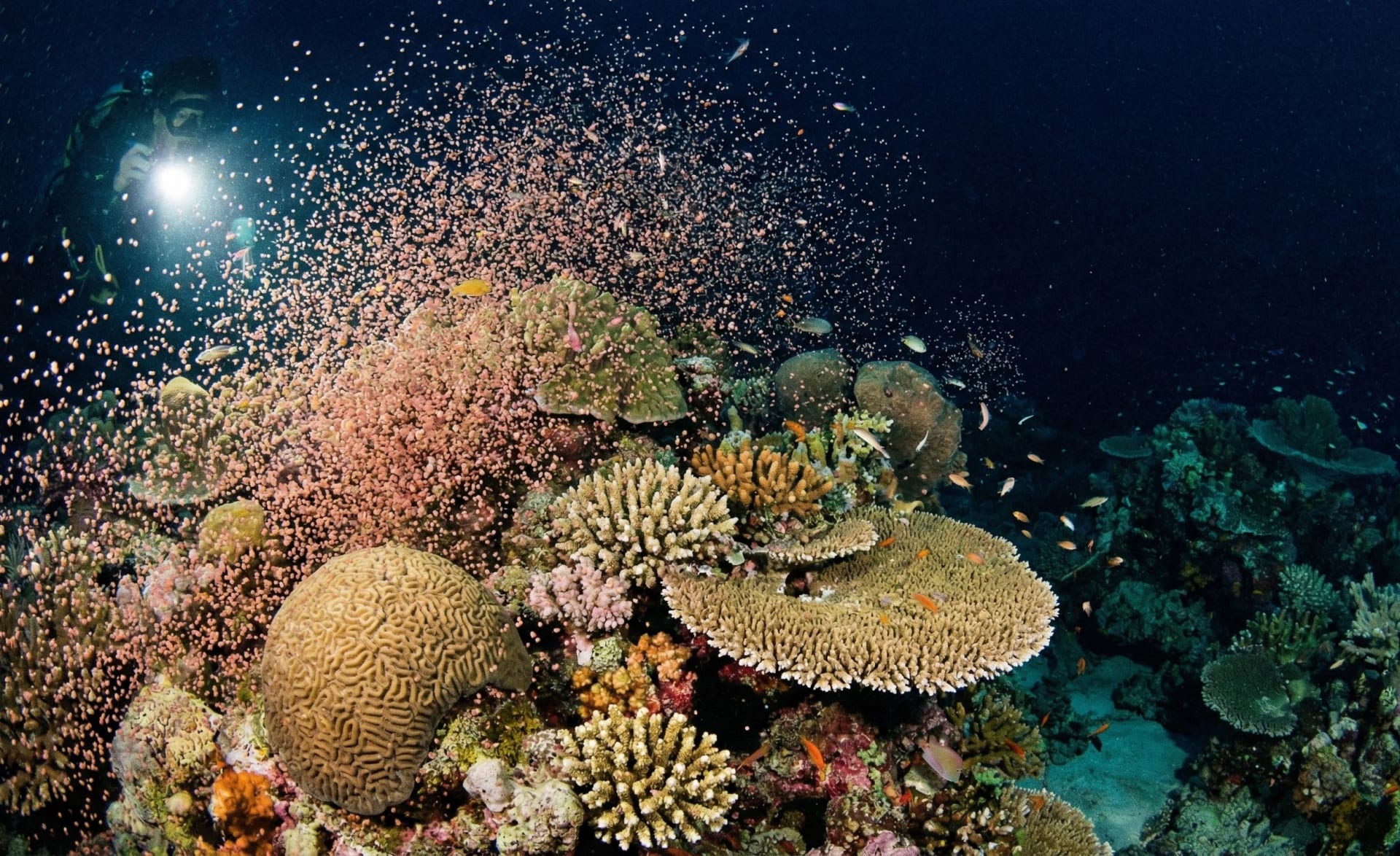
The first thing you notice is the smell. A faintly sweet, oceanic musk rising off the water's surface, thick enough to taste on the back of your tongue. Then your dive light catches it: tiny pink spheres, thousands of them, drifting upward past your mask like a slow-motion blizzard turned inside out. They are everywhere. Rising from the coral below, tumbling through your exhaled bubbles, catching the beam of your torch in soft orange halos. For the next ninety minutes, you float inside the largest synchronized reproductive event in the animal kingdom, surrounded by a galaxy of living particles so dense that by midnight you can barely see your own fins.
This is mass coral spawning on the Great Barrier Reef. And until 1982, no one on Earth knew it happened.
The Science Behind the Snowstorm
More than 400 species of hard coral on the Great Barrier Reef reproduce in a single coordinated pulse, releasing egg-sperm bundles into open water over just two to three nights each year. The scale is staggering. Each individual coral polyp, most of them smaller than your fingernail, packages its eggs and sperm together into a tiny buoyant bundle, usually pink or pale orange, and holds it at the mouth of its calcareous cup like a bead balanced on a thimble. Then, within the same narrow window of darkness, colonies spanning hundreds of kilometers let go at once.
The bundles are positively buoyant. They rise slowly toward the surface, spiraling through the water column in dense clouds that transform visibility the way a prairie blizzard erases a horizon. At the surface, the bundles break apart. Eggs from one colony meet sperm from a genetically distinct colony of the same species, and cross-fertilization begins. The resulting larvae, called planulae, drift on ocean currents for days to weeks before settling onto hard substrate and metamorphosing into new coral polyps. A single night's spawning can seed reef systems dozens of kilometers away.
What coordinates this event across such distances? The trigger is not one signal but a convergence of four. Water temperature must climb to roughly 27 degrees Celsius, priming the reproductive physiology that has been building for months. The lunar cycle provides the calendar: spawning typically occurs four to six days after the full moon in late November, during the waning phase when nighttime darkness deepens progressively. That darkness itself matters, because light inhibits the release. And finally, calm seas. Heavy swells disperse the bundles too quickly, reducing fertilization success at the surface.
Scientists at James Cook University stumbled onto the phenomenon during routine night dives in 1982. Before that discovery, the reproductive biology of reef-building corals was essentially a mystery. The idea that sessile animals could synchronize across an ecosystem the size of Italy seemed implausible. It turned out they had been doing it for millions of years.
When and Where to Be
The spawning window is brutally narrow. You are looking at late November, occasionally bleeding into early December, concentrated on two to three nights. Miss it by forty-eight hours and you see nothing. The exact date shifts year to year depending on when the November full moon falls and whether water temperatures cooperate. Reef operators and marine biologists begin issuing predictions weeks in advance, but even they sometimes get it wrong by a night.
The event unfolds after dark. Peak activity runs from roughly 9 PM to midnight, with different species staggering their release times by as little as thirty minutes to reduce hybridization. The first species to go often triggers a visible chain reaction as chemical cues spread through the water.
Four locations along the Great Barrier Reef offer the best chances:
Agincourt Reefs and the Outer Ribbon Reefs (-16.137, 145.942) sit on the continental shelf edge north of Port Douglas. Strong tidal flushing keeps these reefs in relatively good health, and their exposure to oceanic water means temperature thresholds are reached reliably. Multiple dive operators run dedicated spawning expeditions from Port Douglas, often as liveaboard trips to eliminate the long boat transit on spawning night.
Flynn Reef (-16.714, 146.292), accessible from Cairns, is a mid-shelf platform reef with consistent coral cover and good night diving conditions. It is one of the more commonly visited spawning sites for operators running day-boat trips with evening extensions.
Moore Reef (-16.869, 146.211), also within range of Cairns, provides shallower reef platforms where spawning can be observed at relatively modest depths, making it more accessible for less experienced divers.
Lizard Island (-14.667, 145.467) in the northern Great Barrier Reef hosts the Australian Museum's Lizard Island Research Station, where much of the foundational spawning research was conducted. Diving here puts you on reefs that scientists have monitored for decades. Access is limited and more expensive, but the coral diversity at these latitudes is among the highest on the reef system.
Here is the friction: booking is a gamble. Liveaboard operators require reservations months in advance, and they base departure dates on lunar predictions that cannot account for late-season temperature anomalies or cyclone disruptions. Some years, divers arrive to flat calm water and no spawning. There are no refunds for the moon being wrong.
Witnessing and Photographing the Spawn
You need a current open water dive certification at minimum, though advanced certification and night diving experience will serve you far better in the disorienting conditions of a full spawn event. The reef at night is already a different world. Add a blizzard of organic particles reducing visibility to a few meters and the experience demands composure.
Gear matters. Carry a primary dive light and a backup. When spawning peaks, the water becomes so clouded with bundles that your light scatters back at you like high beams in fog. A focused, narrow beam cuts through better than a wide flood. Wear a 3 to 5mm wetsuit even though water temperatures are warm; November in the tropics means box jellyfish season, and a full stinger suit underneath your wetsuit is non-negotiable on many operators' boats. Bring reef-safe sunscreen for the daytime surface intervals and seasickness medication if you have any susceptibility, because liveaboard boats anchored on outer reefs will roll.
For photography, video outperforms stills dramatically. The spawning is a moving event, and static images rarely capture the density and motion that make it extraordinary. Mount a wide-angle or fisheye lens on your underwater camera or GoPro. Get within one to two meters of a coral colony that has not yet released, point your lens slightly upward, and wait. When the bundles emerge, they rise through your frame like inverted rain.
A red filter helps preserve natural color tones. Have your dive buddy position their torch behind the rising bundles to create backlit silhouettes against dark water. Use manual focus locked on the coral surface; autofocus will hunt endlessly in the particle-filled water and miss everything.
The most important advice is counterintuitive: stop swimming. Pick one coral head. Settle onto the sand nearby at a respectful distance. Watch it for ten full minutes before you touch your camera. You will see the bundles forming at the polyp mouths, then the slow collective exhale of an entire colony releasing at once. That single observation, unhurried and deliberate, will stay with you longer than any footage.
The Bigger Picture
The Great Barrier Reef has endured five mass bleaching events since 2016, with severe episodes in 2016, 2017, 2020, 2022, and 2024. Rising ocean temperatures, the same warmth that triggers spawning, are also the force behind coral bleaching when they climb too high or persist too long. Sections of the reef that bleached heavily show reduced spawning output. Dead coral does not reproduce.
But spawning continues where healthy coral remains. Every November, the surviving colonies broadcast their genetic material into the current, and the larvae that settle may carry heat-tolerant gene variants selected by the very bleaching events that killed their neighbors. The spawning is not just reproduction. It is the reef's primary mechanism for genetic adaptation under pressure. Larvae that drift to cooler southern waters may establish colonies in habitats that were previously too cold for their parent species, gradually extending the reef's range as isotherms shift poleward.
Researchers now use spawning intensity as a direct health metric for reef sections. A reef that spawns vigorously is a reef still fighting. The data matters, and so does the witnessing. Every diver who surfaces from a spawning night with footage, observations, and a story becomes a carrier of urgency. You saw it. You know what is at stake.
The reef is not waiting for permission to adapt. It is spawning, drifting, settling, growing. Whether the pace of that adaptation can outrun the pace of warming is the open question of our generation's marine science.
This is the short version
This page shows a taste. The app has the full list of where to see this, the exact timing, and live conditions for 1,000+ natural phenomena worldwide, so you know the moment one is genuinely worth the trip.