As of Jun 17, 2026, 4:21 PM, peak season now, through ~December 15. Earth Exhibit tracks the live conditions and flags it the moment it is on.
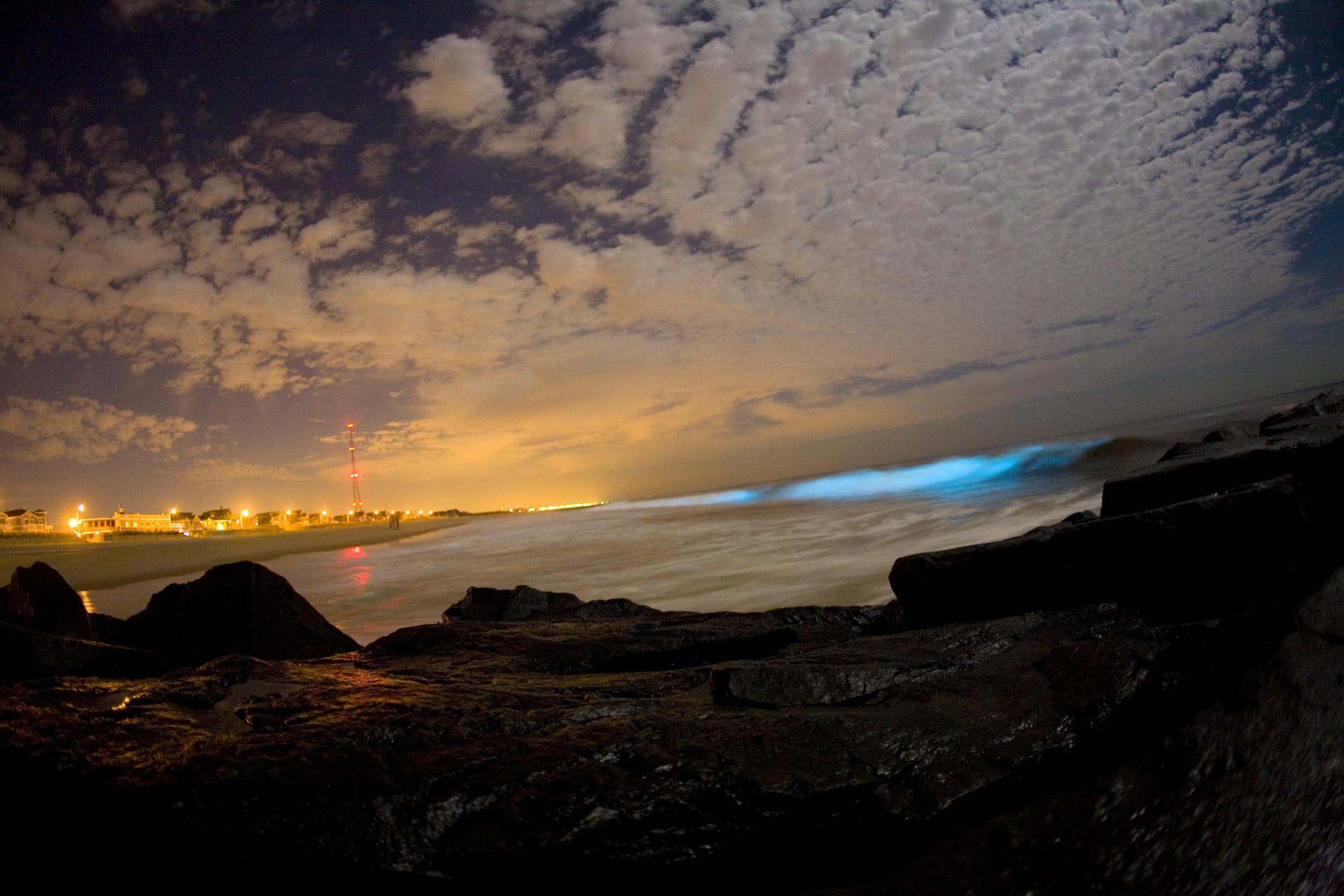
San Diego's bioluminescence has two faces. By day, a heavy bloom can tint the water a murky rust-brown, the "red tide," just a nickname for a dense plankton bloom (it isn't always literally red). By night, the very same plankton set the surf on fire: a wave curls, breaks, and for a half-second the whole face of it glows electric, chemical blue, then the foam flares as it slides up the sand and your footprints glow behind you. Rust-red by day, electric-blue by night: one organism, two completely different shows.
What's actually glowing
The light comes from a single-celled dinoflagellate, Lingulodinium polyedra, that blooms in dense numbers near shore. Each cell carries the same luciferin–luciferase chemistry that powers a firefly, but here it's triggered mechanically: when turbulence deforms the cell (a breaking wave, a kicked-up splash, a hand dragged through the shallows), it fires a brief flash of blue-green light around 470 nanometers. One cell is invisible. Millions firing at once turn a breaking wave into a wall of light.
Worth knowing: not every red tide glows, and a glowing bloom can fade in a matter of days, which is exactly why it's so hard to plan around.
Why it's so unpredictable
A San Diego bloom needs several things to line up: warm, stratified water, a pulse of nutrients (from upwelling or runoff), and calm conditions that let the cells concentrate near the surf. When those align, a bloom can run for days to weeks. The famous 2020 event, studied by the Scripps Institution of Oceanography, was one of the longest on record. Other years bring little or nothing. There is no reliable annual date; the honest answer is always "watch the conditions."
That's the gap Earth Exhibit is built to close. Rather than promise a date, it reads the live conditions (season, water, wind, darkness, moon) and watches for the actual evidence of a bloom, so "it's happening" means it's actually happening.
Where to see it
When a bloom is on, these San Diego shorelines give the most reliable look at the surf line:
| Spot | Why |
|---|---|
| La Jolla Shores / La Jolla Cove | Broad, accessible beach; the most consistent viewing. |
| Scripps Pier shoreline | Dark stretch near the research pier; a classic vantage. |
| Mission Beach / Belmont Park | Long open oceanfront; easy access. |
| Torrey Pines State Beach | Darker skies to the north, away from city light. |
| Silver Strand, Coronado | South-bay option with wide, quiet sand. |
How to actually catch it
- Go on a dark night. A new moon (like tonight's) is ideal; bright moonlight washes the glow out the way city lights kill stars.
- Wait a couple hours after sunset, and give your eyes 15–20 minutes to adapt, with no phone screens.
- Watch the breaking waves and the wet sand, not the open water. The light triggers on turbulence, so the surf line is where it fires.
- Lower your camera expectations. Phones on auto see far less than your eyes; a long-exposure / night mode braced against something steady does best. Video of a breaking wave beats a still.
- A note on the water: heavy red-tide blooms can irritate skin and eyes for some people. Fine to watch from shore; use your judgment about going in.
This is the short version
This page shows a taste. The app has the full list of where to see this, the exact timing, and live conditions for 1,000+ natural phenomena worldwide, so you know the moment one is genuinely worth the trip.