As of today, out of season, returns ~January. Earth Exhibit tracks the live conditions and flags it the moment it is on.
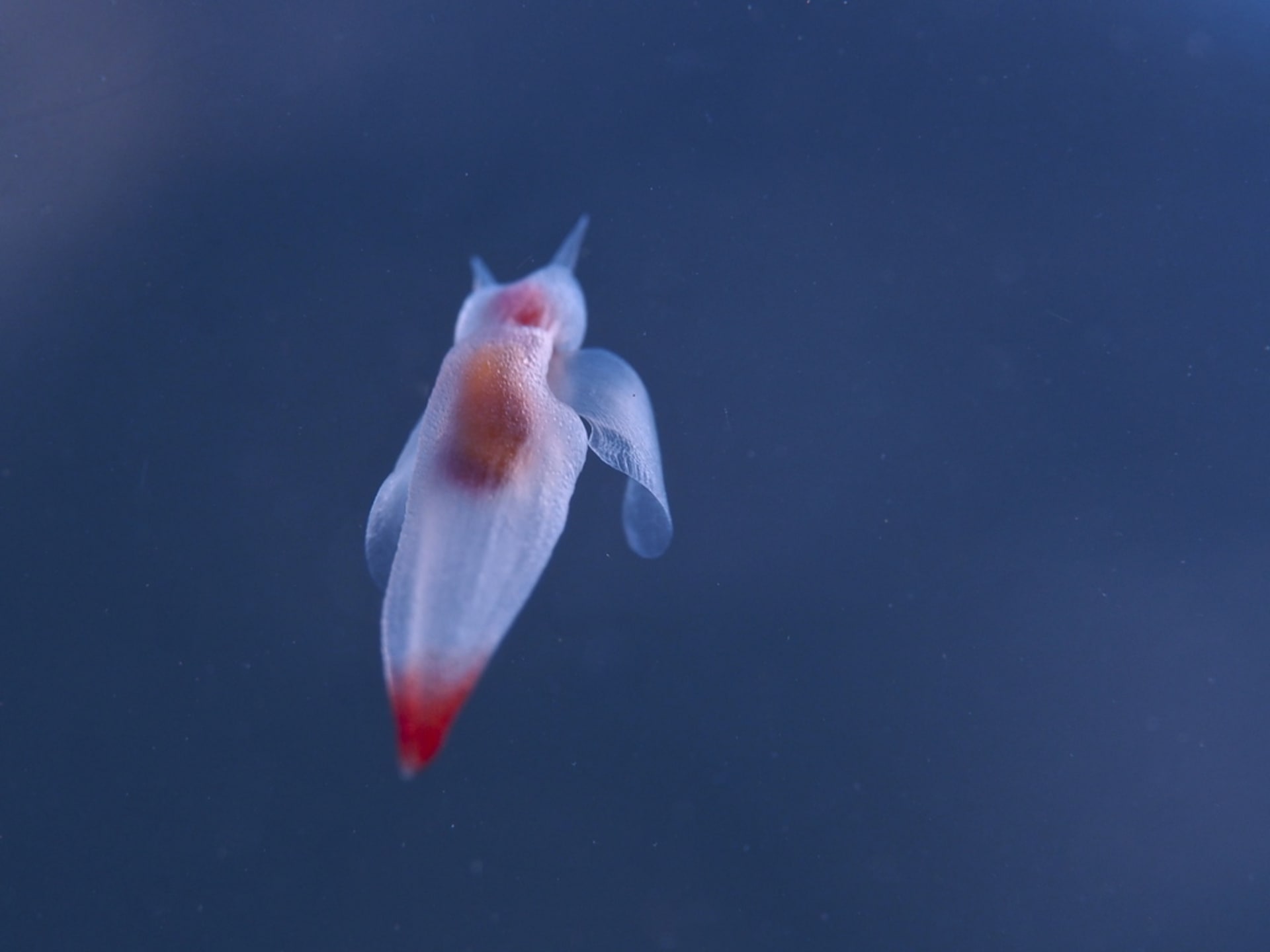
The first thing you notice from the deck of the icebreaker is the silence. Then the ice itself begins to glow pale blue where the hull cracks it open, and beneath the shattered floes you catch movement. Translucent, thumb-sized bodies pulse upward, beating delicate wing-like lobes, a red glow at head and belly. Clione, also known as the drift ice angels, arrive along with the drift ice. Every winter from February through March, these pteropod mollusks concentrate along the drift-ice edges in the Sea of Okhotsk, and Hokkaido's northern coast offers the only place in Japan where you can see them.
The Science Behind Clione limacina
The scientific name of Clione is "Clione limacina," derived from "Clio," a goddess of the sea in Greek mythology, and "limacina" means "resembling a slug" in Latin.
At the time of birth, Clione has a shell, but it disappears as it grows. The adult form, typically 10 to 30 millimeters long, swims by rhythmic beating of two parapodia, the wing-like extensions that give it its angelic appearance. The red pigmentation at the head and visceral mass stands in stark contrast to the otherwise transparent body, making them visible even in low light beneath ice floes.
Unlike the cute appearance, Clione is one of the species of carnivorous snails. When Clione finds the shellfish, Limacina helicina, Clione extends six tentacles called buccal cones from its head and preys on Limacina helicina. Clione only eats Limacina helicina. This extreme dietary specialization means Clione populations track Limacina blooms. It is said that Clione is able to survive for about a year without eating anything, but its survival mechanism is still unclear.
Clione inhabit cold waters throughout the Arctic and subarctic oceans, but the Sea of Okhotsk offers a rare combination: seasonal drift ice that brings the animals close to shore, accessible ports with ice-breaking cruise vessels, and coastal currents that concentrate the animals near predictable locations. Until the time of discovery, it was thought that Clione inhabits the deep sea, but in the winter of 1990, a housewife walking on the coast of Abashiri City contacted the Okhotsk Aquarium and claimed that she found the Clione attached to the kelp she had picked up. After receiving the information, the aquarium staff went to the beach to collect Cliones.
When and Where to See Clione on Drift Ice
At this time of year, drift ice arrives in the Sea of Okhotsk in eastern Hokkaido, bringing with it the message of winter.
The ice originates from the Amur River in Russia and then drifts through the Sea of Okhotsk to reach Hokkaido typically in mid-January to early February before disappearing again around mid-March to mid-April. Clione sightings align with this drift-ice season, but the animals concentrate most reliably from mid-February through late March, when ice floes remain close to shore and the plankton they feed on bloom beneath the ice.
The three primary access points are Abashiri, Monbetsu, and Rausu. All three run icebreaker cruises during drift-ice season, and Clione sightings are possible on any of these routes. While drift ice can be observed along the entire Sea of Okhotsk coast from Wakkanai to the Shiretoko Peninsula, it gets thickest around Abashiri.
Abashiri Drift Ice Cruise Terminal (Icebreaker Aurora): The largest and most accessible operation. Please note that clione (sea angels) cannot be seen from the ship. This official warning reflects reality: the Aurora's one-hour cruise covers 20 kilometers round-trip through the ice field, but spotting Clione from the moving vessel is extremely difficult. However, shore-based viewing and smaller zodiac operations occasionally offer better angles.
Monbetsu Drift Ice Cruise Terminal: The Garinko III uses a front-mounted screw to pulverize ice directly ahead, creating visible cracks and openings where Clione may rise. Monbetsu also hosts year-round Clione exhibits at the Okhotsk Sea Ice Museum.
Rausu Port / Shiretoko Drift Ice Viewing: If you are lucky, you will get to meet seals and Clione, or sea angels, around March. Rausu offers smaller-boat operations with closer water access, increasing your chances of spotting Clione. The trade-off is rougher seas and less predictable ice conditions.
Fly into Memanbetsu Airport (MMB) for Abashiri, or connect via Sapporo (New Chitose, CTS) by train or rental car. The drive from Sapporo to Abashiri takes 5 to 6 hours. The Abashiri Okhotsk Drift Ice Festival in 2026 will be held from February 7 to February 8. Plan your visit around this window if you want to combine Clione viewing with cultural events.
They might be hard to spot from a boat or the shore, but they can be scooped up readily when participating in an ice floe walk, and in Abashiri in the tourist center and Okhotsk Ryu-hyo Museum you can see them too. If on-water sightings prove elusive, both Abashiri and Monbetsu maintain aquarium exhibits with live Clione year-round.
Your Witnessing Guide
Clothing: The average temperature during the drift ice season from mid-February to early March, is about -6?C. Wind chill on open water drops this further. Layer merino wool base, insulated mid-layer, and a windproof shell. Insulated waterproof boots rated to -20?C, thick gloves, neck gaiter, and a wool hat that covers ears are non-negotiable. Most passengers view drift ice from the exterior decks, and exposure lasts the full hour.
Photography: Clione are small, translucent, and moving. A camera with a zoom lens (200mm minimum, 400mm ideal) gives you a fighting chance if you spot one near the surface. For aboard-cruise shooting: ISO 800-1600, aperture f/5.6 to f/8, shutter speed 1/500 or faster to freeze motion. The blue cast of ice and water benefits from +0.3 to +0.7 exposure compensation. Bring extra batteries; cold drains them fast. Keep your camera inside your jacket when not shooting to prevent condensation.
Gear Checklist:
- Binoculars (8x42 or 10x50 with good close focus)
- Camera with telephoto zoom lens
- Extra camera batteries (kept warm inside jacket)
- Water bottle (insulated to prevent freezing)
- Sunglasses and sun protection (snow glare is intense)
- Field guide to Arctic marine life
- Waterproof notebook for logging sighting conditions
On-Ice Walking Tours: If you book an ice-floe walking experience, you'll wear a dry suit over your clothing. Wearing a special dry suit, take a walk while admiring the scenery of the Sea of Okhotsk covered in drift ice. The suit is well-insulated and also provides adequate buoyancy, so you do not have to worry as it will float even if you enter the sea. Guides sometimes net Clione from cracks in the ice during these tours, offering close-up views impossible from larger vessels.
Safety: The ship may roll depending on the sea condition on the day. We don't have some medicine for seasickness. Please prepare them by yourself. Small-boat operations to Rausu may cancel in rough seas. Always follow crew instructions, wear provided life jackets during zodiac transfers, and avoid leaning on railings when photographing.
Why It Matters
Clione limacina occupy a narrow ecological niche. Their dependence on a single prey species (Limacina helicina) and on cold-water conditions make them sensitive indicators of Arctic and subarctic ocean health. The Sea of Okhotsk represents the southernmost seasonal extent of drift ice in the Northern Hemisphere, and warming trends threaten both the ice and the planktonic ecosystems beneath it. The drift ice tends to be seen from mid-February to early March. In recent years, global warming has had a negative impact on things like the size of the drift ice and when it can be seen. Therefore, past trends about drift ice are not helpful.
Focusing on the drift ice, which is losing strength year by year due to the effects of global warming, the festival will be held under the theme of "SAVE THE ICE SAVE THE EARTH." Local awareness campaigns highlight the link between drift-ice health and the fisheries, tourism, and unique biodiversity of the Okhotsk coast.
The director of the now-closed Okhotsk Aquarium coined the name "the angel of drift ice" in the early 1990s, and the nickname stuck. Clione became a minor celebrity in Japan, sold in pet shops (though they are notoriously difficult to raise in captivity), and featured in educational programs about cold-water ecosystems. This cultural foothold has helped sustain public interest in drift-ice conservation.
For researchers, Clione aggregations beneath Okhotsk ice offer a rare accessible population for studying pteropod physiology, starvation tolerance, and reproductive timing in polar environments. The animals' transparent bodies and simple organ systems make them useful models, but field access remains challenging.
If you find yourself wondering what it would be like to live near these extraordinary winter coasts, Settle Japan (https://settlejapan.com) helps with relocation logistics, and Maneki Homes (https://manekihomes.com) lists properties across Hokkaido. For on-the-ground footage of drift ice, Clione sightings, and other seasonal events in Japan, follow @johnofjapan on Instagram (https://instagram.com/johnofjapan).
This is the short version
This page shows a taste. The app has the full list of where to see this, the exact timing, and live conditions for 1,000+ natural phenomena worldwide, so you know the moment one is genuinely worth the trip.