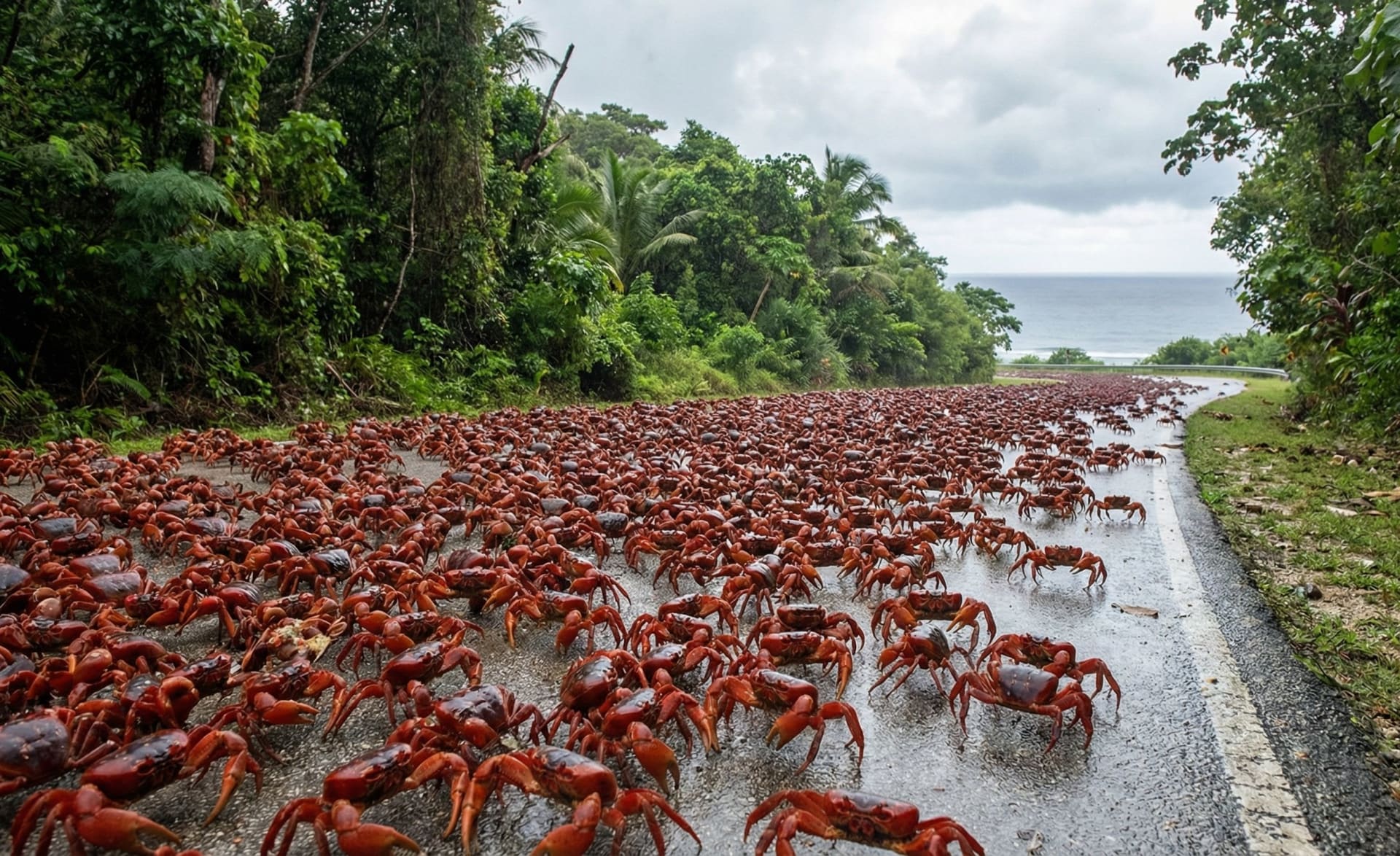
The road is gone. Not closed, not under construction. Gone. Where tarmac should be, there is a moving carpet of brilliant crimson, clicking and scraping and flowing downhill like a slow, living lava. You are standing on a narrow strip of cleared pavement on Christmas Island, and in every direction, an estimated 40 to 50 million red crabs are walking past your feet, over your shoes, and around the tires of the car you will not be driving today. The air smells like wet soil and crushed leaves. A crab the size of your palm climbs your boot, pauses, considers you with black stalked eyes, then continues on its way to the sea. It has been walking for days. It will not stop for you.

This is the annual breeding migration of *Gecarcoidea natalis*, a species found nowhere else on Earth. And it is, by sheer biomass in motion, one of the largest animal migrations on the planet.

The Science of 50 Million Synchronized Walkers

Christmas Island sits in the Indian Ocean, 2,600 kilometers northwest of Perth and 360 kilometers south of Java. It is an Australian external territory, 135 square kilometers of steep limestone covered in tropical rainforest. For most of the year, the island's red crabs live solitary lives on the forest floor, sheltering in burrows and rock crevices, feeding on fallen leaves, fruit, flowers, and seedlings. They are land crabs. They breathe through modified gills that must stay moist, which means they cannot tolerate direct sun or dry conditions for long. During the dry season, from roughly June to September, they barely move at all.

Then the monsoon arrives.

The first sustained rainfall of the wet season, typically in late October or November, triggers the migration. The exact start date shifts from year to year because the crabs are waiting for two signals to align: enough rain to keep their gills wet during the exposed walk, and the right phase of the moon. Spawning must coincide with the last quarter moon, when the difference between high and low tide is smallest. This narrow tidal window means the females can release their eggs at the turn of the high tide at dawn without waves smashing them against the rocks.

Males leave the forest first. They march downhill toward the coast over a period of five to seven days, crossing roads, railway lines, private gardens, and the occasional living room. Females follow a few days later. The males dig burrows near the shore and mate with arriving females, then begin the long walk back inland. The females stay behind for roughly two weeks, brooding eggs in the coastal burrows, each carrying up to 100,000 eggs in a brood pouch beneath her abdomen. On the precise predawn morning when the moon and tide align, the females descend to the waterline, raise their bodies, and shake their eggs into the receding ocean.

The larvae spend three to four weeks developing at sea through several zoeal stages. When they finally return to shore, they are roughly 5 millimeters across, translucent pink, and they arrive in such numbers that the rocks look like they are breathing. These babies will take four to five years to reach breeding maturity and make their own first walk to the coast.

When and Where to See It

The migration window runs from late October through December, but timing varies. Christmas Island's Parks Australia office publishes forecasts as the season approaches, and those forecasts are your most reliable planning tool. In some years the first major wave hits in late October. In others, the rains come late and the main spectacle does not begin until mid-November. Plan for a minimum stay of seven to ten days to have a strong chance of witnessing the peak movement or the spawning event.

Flying Fish Cove Settlement (-10.429, 105.679) is where most visitors stay, and it is a prime viewing area. Crabs pour through the settlement on their way to the coast, crossing roads that are barricaded and redirected by park rangers. The infrastructure here makes access easy.

Ethel Beach (-10.464, 105.707) is one of the major spawning sites. This is where you want to be at dawn during the final egg release. The beach is rocky and uneven, not a soft sand stroll, so wear closed shoes with good grip.

Greta Beach (-10.502, 105.675) and Dolly Beach (-10.521, 105.675) along the island's south coast offer dramatic density. Dolly Beach in particular is backed by steep jungle, and the crabs descend in concentrated streams down the cliff paths. The access trail is slippery in the rain. There are no handrails.

Getting to Christmas Island requires a flight from Perth (roughly 3.5 hours) or, less commonly, from Jakarta. There are only a few flights per week, and accommodation on the island is limited to a handful of lodges and rental houses. During migration season, everything books out months in advance. This is not a place you visit on impulse.

One honest friction point: the island's isolation means supplies, food options, and medical facilities are limited. If you need prescription medication, bring extra. If you need a specific camera battery, bring two. The nearest proper city is a four-hour flight away.

How to Photograph a River of Red

Your primary lens is a wide-angle, 16 to 35mm range. This is a phenomenon defined by overwhelming numbers, and you need to show that scale. Get low. Kneel at the edge of the crab flow and shoot along the surface of the road or forest floor so the crabs fill the frame from foreground to infinity. The compressed perspective at a low angle transforms a dense crowd into an ocean.

Include a person, a car, or a road sign for scale. Without a reference object, a photograph of a thousand crabs looks identical to a photograph of ten.

For individual portraits, switch to a macro lens in the 100mm range. The crabs' carapaces are a deep, saturated red that photographs beautifully, and their black eyes on stalks are surprisingly expressive. Get parallel to the crab's eyeline. Avoid direct flash, which can disorient them and produces harsh glare on the wet shell. A small LED panel with a diffuser works better.

The dawn spawning is the defining shot. Set up on the rocks above the waterline at Ethel Beach or Greta Beach at least 45 minutes before sunrise. You will need a headlamp (red light mode to preserve your night vision and avoid disturbing the crabs). The females cluster at the tide line, and the moment they begin shaking their eggs into the wash, the water turns a milky orange. Shoot at a fast shutter speed (1/500 or higher) to freeze the egg release, or slow it down (1/15) to capture the motion blur of thousands of tiny legs. Both approaches work. The light at dawn is soft and warm, and the wet rocks add reflection.

Rain is almost guaranteed. A waterproof camera bag is not optional. Bring a rain jacket for yourself, waterproof cases for your phone, and silica gel packets for your equipment bag. Humidity is relentless and will fog internal lens elements overnight if you are not careful. Keep your gear in a sealed dry bag when not shooting.

Insect repellent is essential, not for the crabs, but for the mosquitoes and sandflies that thrive in the same wet conditions.

The Bigger Picture: Crazy Ants and a Fragile Balance

The red crab migration is not a stable, guaranteed spectacle. It is under threat.

Yellow crazy ants (*Anoplolepis gracilipes*), an invasive species accidentally introduced to Christmas Island, have killed an estimated 10 to 15 million red crabs since their spread was first documented in the 1990s. The ants form supercolonies in the forest, spraying formic acid that blinds and kills the crabs. In areas of heavy ant infestation, the crab population has been locally wiped out. Parks Australia runs ongoing baiting programs using a fipronil-based bait that targets the ants without affecting the crabs, and these programs have reclaimed significant areas of forest. But the battle is not won.

The crabs' ecological role is enormous. As the dominant consumer of leaf litter on the forest floor, they shape the entire structure of the island's rainforest. In areas where crazy ants have eliminated the crabs, the forest floor becomes choked with unprocessed leaves, seedling composition changes, and other invertebrate populations explode. The crabs are a keystone species. Remove them and the forest reorganizes.

Climate change introduces another uncertainty. The migration's trigger depends on the timing and intensity of monsoon rains. Shifts in monsoon patterns could decouple the rain signal from the lunar signal, leaving crabs stranded mid-migration on exposed roads in dry conditions, where they desiccate and die. Researchers at the University of Western Australia are monitoring these patterns, but projections remain uncertain.

What you witness when you stand on a road turned solid red is not just spectacle. It is an ecosystem balanced on the edge of two converging threats, defended by a small team of rangers on a remote island, visible to the world for a few weeks each year. The crabs do not know any of this. They just walk.

Track live conditions for this and 590+ phenomena on the Earth Exhibit app: https://earthexhibit.com

Track This Phenomenon Live

The Earth Exhibit app monitors real-time conditions for this and 590+ natural phenomena worldwide. Get alerts when conditions peak near you.