As of today, out of season, returns ~March. Earth Exhibit tracks the live conditions and flags it the moment it is on.
The petals land on your coffee before you notice the wind. You are sitting on a blue tarp beneath a canopy of pale pink at Maruyama Park in Kyoto, and the tree above you is shedding. Not dying. Performing. A single gust sends thousands of petals spiraling into the morning air, and for three full seconds the space between the branches and the ground becomes a slow, churning blizzard of pink and white. The couple next to you stops talking. A toddler reaches up with both hands. Somewhere behind you, a shamisen player starts a new phrase, and the petals keep falling, indifferent to all of it.
This is hanami, the act of watching flowers. Japan has been doing it for over a thousand years, and the trees have been doing their part for far longer. Every spring, roughly 10 million cherry trees across the Japanese archipelago flower within a span of about six weeks, with any single tree holding its full bloom for just 7 to 14 days. The spectacle moves northward like a slow tide, and the entire country reorganizes itself around it.
The Science of a Synchronized Bloom
The star of cherry blossom season is Prunus x yedoensis, commonly called Somei-Yoshino. This hybrid cultivar accounts for roughly 80% of all cherry trees in Japan, and nearly every one of them is a clone. Somei-Yoshino does not reproduce reliably from seed. Instead, it has been propagated by grafting since the Edo period (1603-1868), meaning the trees lining the Meguro River in Tokyo and the trees surrounding Hirosaki Castle in Aomori are genetically identical. When environmental conditions align, they bloom in near-perfect synchrony within their local area.
The trigger is temperature. Cherry blossom buds form in summer, then enter a dormancy period that requires sustained cold (below about 5 degrees Celsius) to break. Once a tree accumulates enough chilling hours, typically by late January in central Honshu, it becomes responsive to warming. From that point, the rate of bud development tracks closely with cumulative daily temperatures above a base threshold. A stretch of 15-18 degrees Celsius days in mid-March can push Tokyo's trees from tight bud to full bloom in under a week. A cold snap can stall the process for days.
The Japan Meteorological Corporation (JMC) and several competing forecasters issue sakura predictions starting in January each year, updating them weekly. They track 58 official "sample trees" (hyohonboku) across the country, each one a designated Somei-Yoshino whose first open blossoms mark the official start of the season for that city. The resulting sakura zensen (cherry blossom front) map shows the bloom wave moving from subtropical Okinawa in late January to subarctic Hokkaido in mid-May, covering roughly 3,000 kilometers in about 120 days.
This slow northward march exists because Japan stretches across nearly 25 degrees of latitude. Kagoshima (31.5 degrees N) typically sees first bloom around March 23. Tokyo (35.7 degrees N) follows around March 24-27. Kyoto (35.0 degrees N) usually blooms within a day or two of Tokyo. Sendai (38.3 degrees N) arrives in early to mid-April. Sapporo (43.1 degrees N) waits until late April or early May.
Climate change is compressing the timeline. Records from Kyoto's Arashiyama district, where cherry blossom viewing dates have been logged since the 9th century, show that peak bloom has shifted roughly 10 days earlier over the past century. In 2021, Kyoto recorded its earliest bloom in 1,200 years of recordkeeping: March 26. The trend is not linear (cold years still occur), but the direction is consistent.
When and Where to See It
The core window for the most popular viewing areas, Tokyo and Kyoto, runs roughly March 25 through April 10 in a typical year. Within that window, full bloom (mankai, when 80% or more of buds are open) lasts about one week. Peak petal fall (hanafubuki, "flower blizzard") occurs 3 to 5 days after full bloom. Rain and strong wind accelerate the process. A single heavy storm can strip a tree in hours.
Tokyo offers the densest concentration of accessible viewing sites. Ueno Park in Taito-ku has over 800 trees and draws roughly 2 million visitors during the season. It is loud, crowded, and genuinely festive. Meguro River in Nakameguro lines both banks with approximately 800 trees whose branches arch over the water, creating a tunnel effect. At night, the trees are lit from below. Shinjuku Gyoen charges a 500 yen admission fee, which thins the crowds noticeably. It also contains late-blooming varieties (Ichiyo, Kanzan) that extend the season into late April.
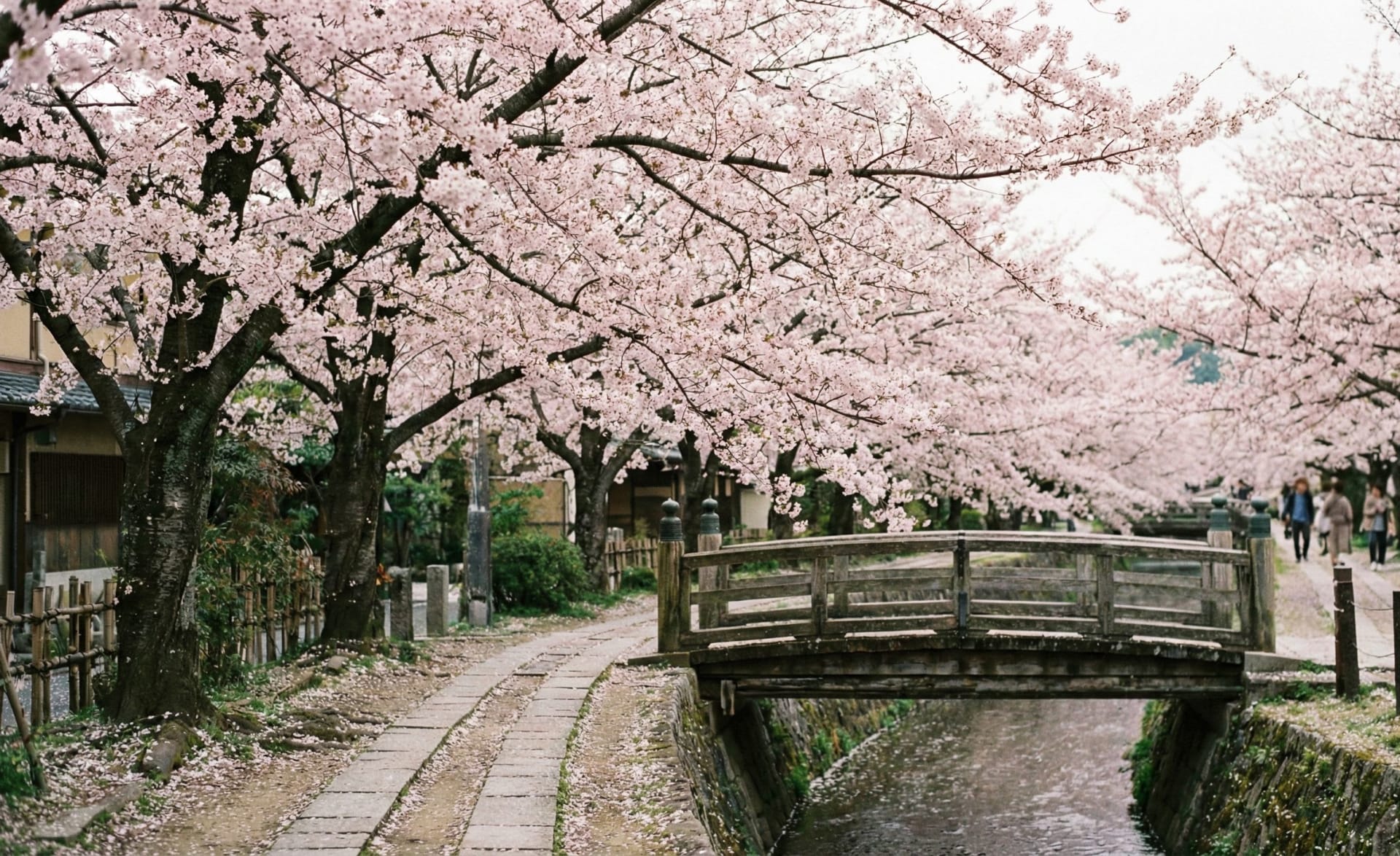
Kyoto trades volume for composition. The Philosopher's Path runs 2 kilometers along a canal in the Higashiyama district, with roughly 500 Somei-Yoshino trees forming a canopy over the stone walkway. Maruyama Park centers around a single massive weeping cherry (shidarezakura) that is lit at night and has become one of the most photographed trees in the country. Arashiyama's bamboo grove and cherry trees along the Katsura River create layered foreground and background compositions that are difficult to find anywhere else.
Osaka puts cherry blossoms against architecture. Osaka Castle Park has approximately 3,000 trees, and the castle's white walls and green-copper roofline against pink canopies create a color palette that looks engineered. Kema Sakuranomiya Park runs 4.2 kilometers along the O River with over 4,500 trees.
For those willing to travel beyond the golden triangle, the rewards multiply. Mount Yoshino in Nara Prefecture has 30,000 cherry trees planted across four altitude zones, which means the mountain blooms from bottom to top over approximately two weeks (early to mid-April). It has been a pilgrimage site for cherry blossom viewing since the 7th century. Hirosaki Castle in Aomori Prefecture, far to the north, peaks in late April and is famous for its moat, where fallen petals form a solid pink carpet on the water surface, a phenomenon called hanaikada ("flower raft"). Hokkaido brings up the rear: Matsumae (the only traditional castle town in Hokkaido), Goryokaku Fort in Hakodate (a star-shaped citadel ringed with 1,600 trees), and Sapporo's Maruyama Park all bloom between late April and mid-May.
How to Photograph and Witness It
Arrive early or stay late. The soft, directional light before 7:00 AM and during golden hour (roughly 5:30-6:30 PM in early April) transforms cherry blossoms from washed-out white blobs into translucent, warmly lit individual petals. Midday sun flattens everything.
Overcast days are your ally. A flat, white sky acts as a giant softbox, eliminating harsh shadows and letting the subtle pink gradient of Somei-Yoshino petals actually register on camera. If you are only visiting for a few days, do not waste a cloudy morning sleeping in.
Yozakura (night viewing) is a distinct experience. Many parks and temple grounds install temporary lighting, often warm white or pale pink, that illuminates the canopy from below against a dark sky. Long exposures (2-4 seconds on a tripod) at Meguro River or the Philosopher's Path can capture both the sharp detail of lit branches and the soft blur of moving water. A circular polarizing filter cuts reflections on water surfaces and deepens the contrast between blossoms and sky.
Frame against context. A cherry tree photographed in isolation could be anywhere. A cherry tree framed against a vermillion torii gate, a grey castle wall, a still canal, or a line of paper lanterns is unmistakably Japan. Look for layers: foreground petals on water, midground trunk, background architecture.
Gear recommendations: A camera body with weather sealing (rain is common in early April), a portable battery pack for phones that die quickly in cold mornings, comfortable walking shoes (you will cover 15,000-20,000 steps easily), a compact rain jacket, and layers (mornings hover around 8-10 degrees Celsius even when afternoons reach 18 degrees Celsius). If you plan to do hanami picnicking, bring a waterproof ground sheet. Allergy sufferers should pack antihistamines, as cedar pollen season overlaps. A JR Rail Pass makes chasing the bloom front between cities economical, and a translation app helps at smaller, less tourist-oriented sites.
The Bigger Picture
Cherry blossom season is not a festival. It is a biological event that a culture decided to pay very close attention to. The Somei-Yoshino clone army, for all its engineered uniformity, is still subject to temperature, rainfall, wind, and the slow press of a warming climate. Every year the bloom arrives a little differently. Every year, the window is finite.
That finitude is the point. The Japanese concept of mono no aware, roughly translated as "the pathos of things," holds that beauty is most acute when it is fleeting. A cherry blossom season that lasted two months would not generate hanami. It is precisely because the petals fall so quickly, because a single rainstorm can end it, because you cannot store or preserve the experience, that millions of people sit beneath the trees each spring and simply watch.
The ecological role of these mass blooming events extends beyond aesthetics. Cherry blossoms provide early-season nectar for pollinators emerging from winter dormancy, including the Japanese honeybee (Apis cerana japonica). Fallen petals contribute organic matter to waterways. And the phenological data, those 1,200 years of Kyoto bloom records, now serve as one of the longest continuous datasets for studying climate change impacts on plant biology.
The 2026 season forecasts suggest Tokyo's first bloom around March 22-25, with full bloom by March 29-April 2. Kyoto is expected within a day or two of Tokyo. Northern Honshu follows in mid-April. Hokkaido closes the season in early May. These dates will shift as winter ends and the forecasters refine their models.
The petals will fall on schedule. The question is whether you will be sitting beneath them when they do.
This is the short version
This page shows a taste. The app has the full list of where to see this, the exact timing, and live conditions for 1,000+ natural phenomena worldwide, so you know the moment one is genuinely worth the trip.