As of Jun 17, 2026, 4:21 PM, in season, building toward peak (~September 1). Earth Exhibit tracks the live conditions and flags it the moment it is on.
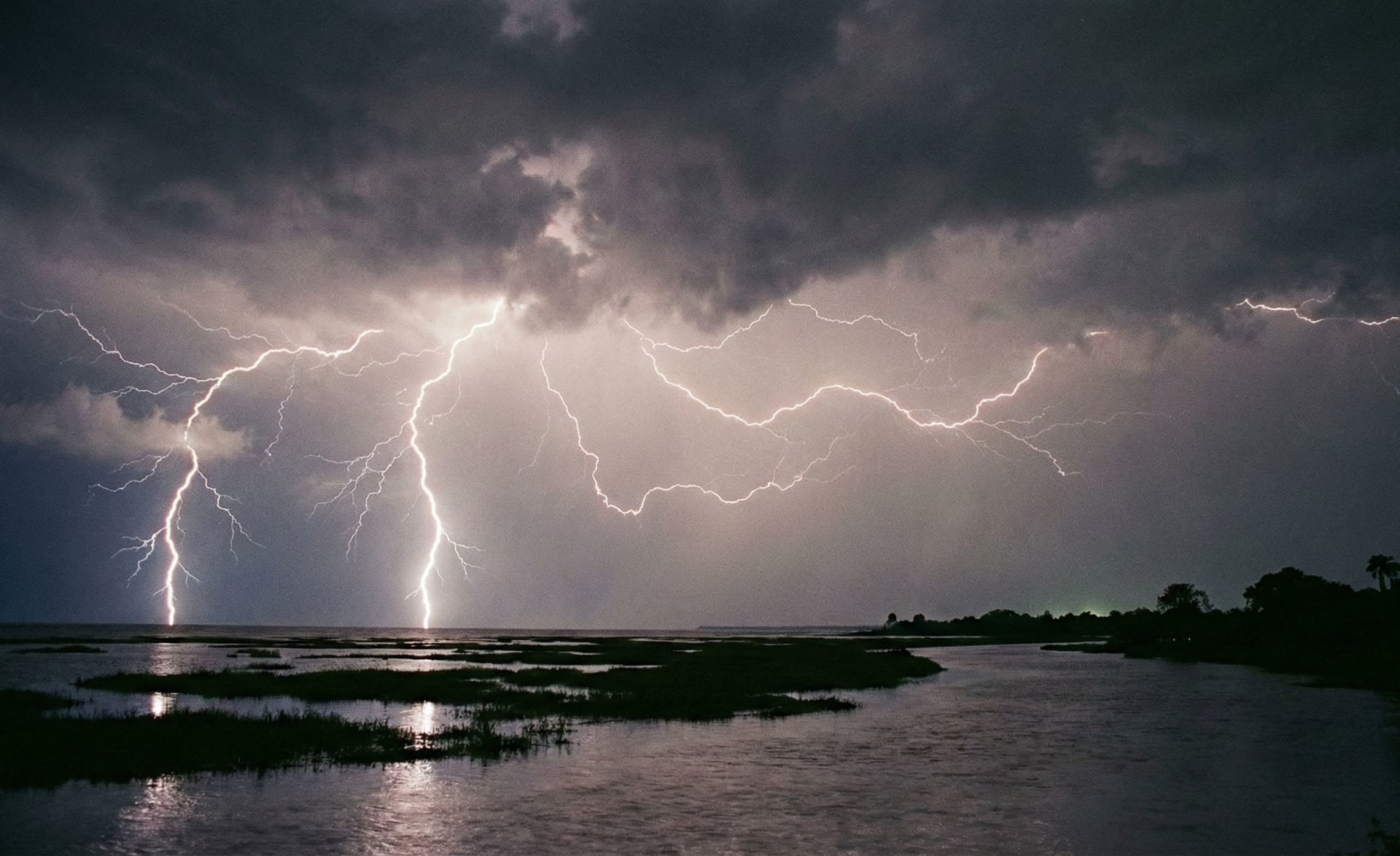
The wooden boat pitches sideways and your knuckles go white on the gunwale. It is just past midnight, the air so thick with humidity that your shirt has been soaked through since sundown. Then the sky cracks open. Not once. Not twice. A continuous, silent barrage of white and violet light pulses across the horizon where the Catatumbo River meets Lake Maracaibo, strobing so fast your eyes cannot adjust between flashes. There is no thunder at this distance, just light, relentless and ancient, painting the underbellies of cumulonimbus towers that rise ten kilometers into the atmosphere. Your guide cuts the outboard motor. "Relampago," he says, though he does not need to. Up to 280 lightning bolts per hour are detonating above the water, and they have been doing this nearly every night for thousands of years.
This is the Catatumbo Lightning, the most concentrated electrical storm on Earth. It holds the Guinness World Record for the highest density of lightning, and it will keep firing until dawn.
Why the Same Patch of Sky Explodes Every Night
The physics are violent and elegant. Lake Maracaibo, the largest lake in South America at roughly 13,210 square kilometers, acts as a heat engine. All day, the tropical sun bakes its shallow southern basin. Evaporation is enormous. By late afternoon, a low-level jet of warm, moisture-laden air begins streaming northward across the lake surface.
At the same time, cool air descends from two mountain ranges that bracket the lake's southern shore: the Andes to the south and the Sierra de Perija to the west. These cold downslope winds collide with the warm, rising lake air right where the Catatumbo River delta fans out into open water. The collision forces the moist air upward with extraordinary speed, building thunderheads that routinely punch into the upper troposphere.
The result is a convective cell that re-forms in almost exactly the same location, night after night. The storms typically ignite around 7 p.m., peak between midnight and 3 a.m., and fade by dawn. They can last ten hours straight. Across a calendar year, the lightning fires on roughly 260 nights, pausing only during the dry months of January through March when reduced evaporation weakens the cycle.
One contested variable makes the Catatumbo particularly intriguing. The surrounding basin is rich in petroleum deposits and wetland swamps that vent methane into the lower atmosphere. Some atmospheric scientists have proposed that elevated methane concentrations increase air conductivity, lowering the threshold for electrical discharge. Others argue the methane contribution is negligible compared to the sheer mechanical forcing of the wind convergence. The debate remains open, but the storms themselves do not wait for a consensus. They fire regardless.
When and Where to See It
Peak season runs from September through November, when the Intertropical Convergence Zone shifts southward and Lake Maracaibo's surface temperatures are still elevated from months of tropical sun. April and May offer a secondary peak as the rainy season returns. December through March sees diminished activity, and January is often nearly silent.
The primary viewing location is Congo Mirador, a small stilted village of a few hundred residents built directly over the lake's shallow southern waters. Congo Mirador sits almost precisely beneath the epicenter of the storm cell, at coordinates 9.386N, 71.800W. There is no road to Congo Mirador. You reach it by boat, typically departing from the town of Ologa (9.426N, 71.829W), a 30- to 45-minute ride depending on conditions.
Some operators run overnight boat tours directly from the city of Maracaibo or from smaller lakeside towns to the north. These tours position you farther from the epicenter (around 10.579N, 71.612W), which means the lightning appears as a horizon-level light show rather than an overhead assault. The trade-off is less logistical difficulty and a more comfortable boat, but you lose the visceral intensity of being directly underneath the cell.
Here is the friction you need to understand: Venezuela's ongoing political and economic instability makes travel logistics genuinely difficult. Currency exchange is complicated, ATMs are unreliable, and infrastructure outside major cities is sparse. Organized tours to Congo Mirador exist but are limited in number and sometimes cancel without warning. You will need USD cash in small denominations for most transactions. Potable water is not guaranteed. Antimalarial medication is strongly recommended for the lake basin, and you should bring your own insect repellent, water purification tablets, and a first aid kit. This is not a polished tourism experience. The reward is proportional to the effort.
Sailors navigating the Caribbean and the Gulf of Venezuela have used this phenomenon as a navigational beacon for centuries, earning it the name "Lighthouse of Maracaibo" (Faro de Maracaibo). The glow is visible from distances exceeding 400 kilometers on clear nights. Sir Francis Drake's 1595 raid on Maracaibo was reportedly foiled when the lightning illuminated his ships to Spanish defenders. Whether or not the story is apocryphal, the lightning's role as a natural lighthouse is documented in maritime charts going back to the colonial era.
In 2010, the lightning went silent for several months, the longest cessation in recorded memory. Scientists linked the blackout to a severe El Nino drought that lowered Lake Maracaibo's water levels and reduced evaporation below the threshold needed to fuel the nightly convection. The storms returned when the rains did, but the episode proved that the Catatumbo Lightning is not invincible. It depends on the lake, and the lake depends on rain.
Photographing 280 Flashes Per Hour
The sheer frequency of the lightning is both a gift and a technical challenge. During peak activity, you are not waiting for a single bolt. You are trying to manage an onslaught.
Set your camera to bulb mode or use exposures of 20 to 30 seconds. An aperture of f/5.6 to f/8 balances sharpness with enough light gathering to register the bolts against the dark sky. Start at ISO 800 and push to 1600 if the strikes are distant or obscured by rain curtain. A wide-angle lens (14-24mm equivalent) lets you capture the full breadth of the storm front, which can span 30 degrees or more of the horizon.
A tripod is essential, though using one on a rocking fishing boat is an exercise in frustration. Brace the legs against the hull ribs or wedge them between gear bags. Some photographers bring a beanbag to stabilize the camera on the gunwale directly. If you are shooting from the stilted walkways of Congo Mirador, conditions are more stable, but the wooden platforms still sway in wind.
At 280 flashes per hour, a single 30-second exposure can capture multiple strikes threading across the frame. This creates dramatic composite-looking images from a single unedited frame. Bring far more memory cards than you think you need. A five-hour shooting session at one frame every 30 seconds generates 600 RAW files. Double that if you are bracketing or shooting shorter exposures during peak bursts.
The humidity is punishing. Rain covers for your camera body and lens are not optional. Condensation will coat exposed glass within minutes, and spray from the lake surface reaches everything in an open boat. Carry a microfiber cloth in a sealed bag. Bring extra batteries, as the moisture accelerates drain, and cold does not apply here (nighttime temperatures hover around 27C). A headlamp with a red-light mode preserves your night vision between bursts.
A Lighthouse for the Anthropocene
The Catatumbo Lightning generates so much electrical activity that it produces a measurable percentage of the Earth's tropospheric ozone. Estimates vary, but the region contributes meaningfully to atmospheric chemistry on a planetary scale, all from a patch of lake surface smaller than some national parks.
Its 2010 silence was a warning. As climate patterns shift and El Nino events grow more erratic, the hydrological cycle that powers the Catatumbo could falter again. Meanwhile, oil extraction around the lake, deforestation in the watershed, and sedimentation of the river delta are altering the very geography that makes the convergence zone so precise. The lightning is not a decorative spectacle. It is an indicator of a functioning atmospheric system, and when it stops, it means something has broken upstream.
Standing in a boat at 2 a.m., watching the sky ignite with a frequency that makes camera shutters seem slow, you understand why sailors trusted this light for centuries. It is not gentle. It is not scenic in the postcard sense. It is a raw, repeating detonation of energy that has outlasted empires and will outlast your visit, provided the lake and the winds and the mountains continue their nightly conspiracy.
This is the short version
This page shows a taste. The app has the full list of where to see this, the exact timing, and live conditions for 1,000+ natural phenomena worldwide, so you know the moment one is genuinely worth the trip.