As of today, out of season, returns ~September. Earth Exhibit tracks the live conditions and flags it the moment it is on.
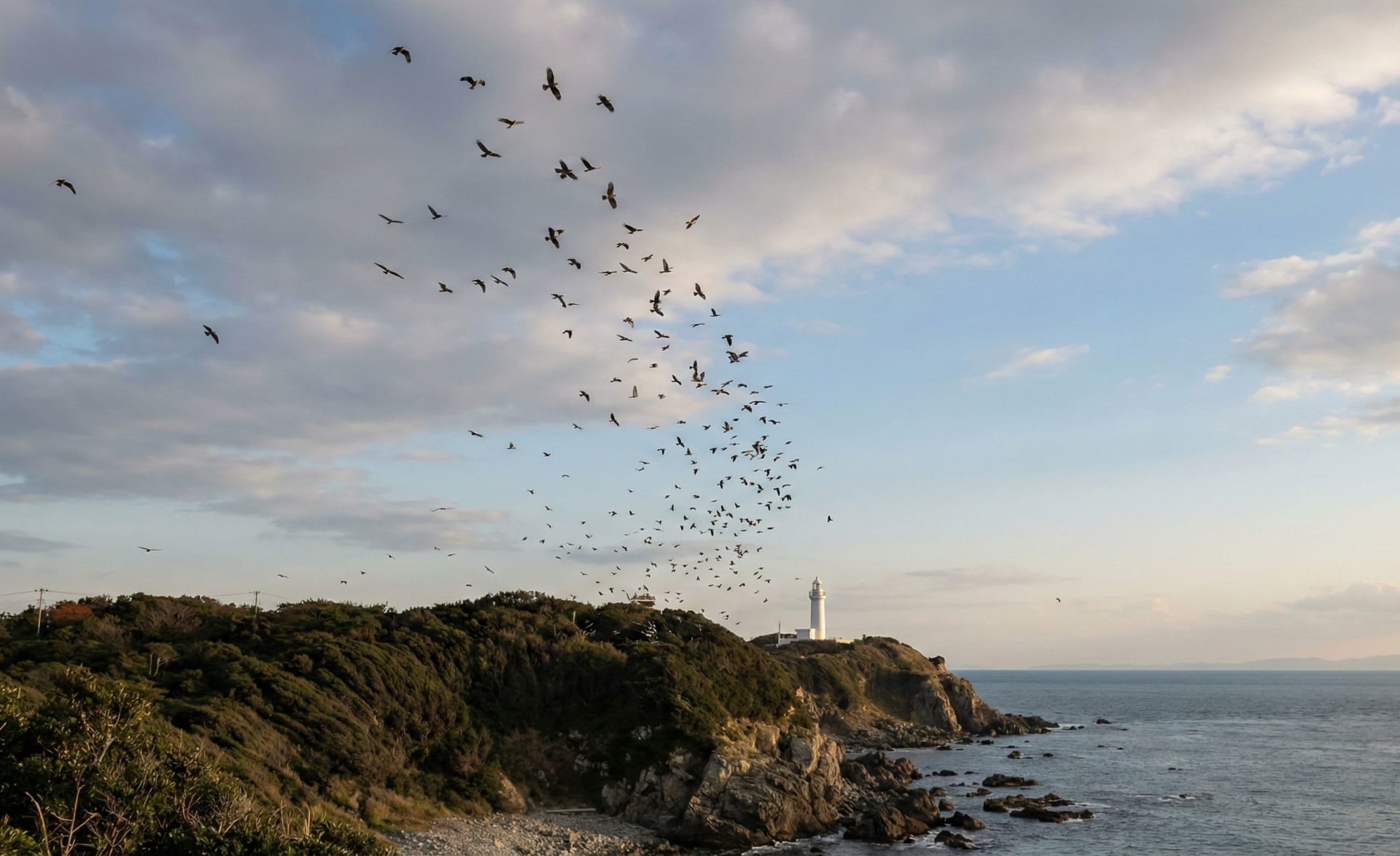
The scope becomes visible first as movement. A flicker at the edge of your peripheral vision, then a second, then six more. Within an hour, the sky above Cape Irago transforms into a living river. On a good day, hundreds of grey-faced buzzards pass overhead in concentrated streams before they risk the crossing over Ise Bay. The cape's position at the tip of the Atsumi Peninsula makes it the final gathering point before the water, and what you witness is thousands of raptors making split-second calculations about survival.
The Science Behind Cape Irago Hawk Migration
Grey-faced buzzards (Butastur indicus) use the East Asian oceanic flyway, the world's only oceanic migration route for raptors, navigating by island-hopping and flying up to 300 kilometers over open water between islands . Most raptor species avoid water crossings because soaring flight depends on thermal updrafts rising from heated land. Flapping flight is relatively costly for soaring birds such as raptors, so migrating raptors generally avoid flying over water .
Cape Irago works as a natural bottleneck. The occurrence of numerous islands and suitable wind support along the oceanic flyway are responsible for route selection in grey-faced buzzards, with wind support showing high importance . In autumn, honey buzzards cross the 650 kilometer-wide East China Sea from western Japan to reach eastern China in strong tail winds . The cape concentrates birds that would otherwise scatter across a broad front, creating the spectacle that draws birders from across Asia.
Oriental honey buzzards (Pernis ptilorhyncus) migrate alongside grey-faced buzzards, along with smaller numbers of Japanese Lesser, Chinese and Eurasian sparrowhawks, Northern Goshawk, Hobby, Peregrine Falcon, and occasional Osprey or Eastern Buzzard .
When and Where to See Cape Irago Hawk Migration
Peak migration runs from late September through early October, with the best viewing during the last week of September or the first two weeks of October . Movements are dependent on wind direction and weather patterns . The database notes that best viewing days follow weather fronts with clear skies and northwest winds.
The primary viewing site is the car park at Kojiga Beach (Kojigahama), at coordinates 34.580859, 137.021644 . Another excellent observation point is the roof of the Irako View Hotel, perched prominently on the hill overlooking Cape Irago and Kojigahama beach . During peak migration, local birdwatchers carry out detailed counts of the birds as they fly overhead .
Activity often does not get going until mid-morning, depending on weather and wind direction and speed . The database recommends watching from 9am to 2pm. On clear days, birds passing overhead at the car park are often very high up, sometimes mere dots in the blue sky .
To reach the cape from Tokyo: take the Tokaido Shinkansen to Toyohashi Station (under three hours). From Toyohashi, the cape is roughly 90 minutes by bus or car. Rooms in hotels and minshuku close to Cape Irago are likely to be in short supply during peak migration season, so book ahead .
Your Witnessing Guide
Bring quality binoculars (8x42 or 10x42) and a spotting scope if you have one. The database gear list includes these as essentials. On clear days, birds can pass at extreme altitudes where binoculars alone will strain your eyes.
For photography, you need reach. A telephoto lens (400mm minimum, 600mm ideal) is necessary. Set your camera to shutter priority mode at 1/1600s or faster to freeze wing motion. Use continuous autofocus (AF-C or AI Servo) and back-button focus so you can track birds across the frame. ISO will likely run 800-1600 to maintain fast shutter speeds. Shoot RAW for maximum post-processing flexibility when recovering detail from distant silhouettes.
The cape offers minimal shade. Beside Kojigahama car park there are several restaurants serving large grilled clams and local fish, and toilets are available at the car park . Pack water, snacks, sun hat, and sunscreen. A camp chair makes long watches comfortable. The database safety notes mention sun exposure during extended watches and cliff edges at the cape.
Wind matters more than anything else. Northwest winds following a cold front create ideal conditions. Check the Japan Meteorological Agency forecast for Tahara City the night before. If winds are predicted at 10-20 km/h from the northwest and skies are clear, go.
Why It Matters
Grey-faced buzzards migrate 4,000-5,000 kilometers between breeding and winter areas , traveling from breeding grounds in Japan, eastern Russia, and eastern China to winter in Indochina, Malaysia, and the Philippines. This migration is one of the most physically demanding journeys undertaken by any raptor species, requiring precise timing and favorable wind conditions.
The species relies on traditional stopover habitats, and loss of these stopover forests and wetlands along the route could disrupt migration . This concern has spurred international interest in protecting key migration bottlenecks like Cape Irago.
In Japan, the sight of grey-faced buzzards streaming south marks the turn of seasons. The bird's piercing whistle is known in Japanese as chinmii, and watching flocks wheeling overhead is a rite of fall in parts of Japan and Taiwan .
Climate change poses emerging threats to this phenomenon. Wind patterns over the East China Sea are shifting, and researchers using mathematical models predict potential disruption to migration routes by mid-century. The cape serves as a monitoring site where volunteers count every bird, contributing to decades of data that track population trends and migration timing shifts.
This is the short version
This page shows a taste. The app has the full list of where to see this, the exact timing, and live conditions for 1,000+ natural phenomena worldwide, so you know the moment one is genuinely worth the trip.